Yulong He, Zicheng Luo, Hongfei Xu, Zehong Yuan, Songmei Li, Shubin Yang and Bin Li
{"title":"Boosting the lithium transport in phase-change polymer electrolytes towards stable cycling lithium metal batteries with thermal robustness†","authors":"Yulong He, Zicheng Luo, Hongfei Xu, Zehong Yuan, Songmei Li, Shubin Yang and Bin Li","doi":"10.1039/D5TA00896D","DOIUrl":null,"url":null,"abstract":"<p >Phase-change electrolytes hold great promise for sustainable energy storage technologies but are constrained by limited ionic conductivity and inefficient ion transport across phase transitions. In this work, to boost the lithium transport in polycaprolactone (PCL)-based phase-change polymer electrolytes, a novel semi-vehicle lithium transport pathway, which integrates solvent-mediated and polymer-assisted migration, has been created <em>via</em> a co-solvent strategy. It is demonstrated that the preferential coordination of dimethyl dodecanedioate (DDCA) and propylene carbonate (PC) attenuates the interaction between the lithium ions and PCL chain, achieving continuous and rapid ion transport across phase transition. Furthermore, the synergistic effect of linear and cyclic solvents promotes the formation of a LiF-rich inorganic SEI layer, effectively stabilizing the lithium anode. The resulting electrolyte (PCL-DDCA-PC) achieves a high ionic conductivity of 3.38 × 10<small><sup>−4</sup></small> S cm<small><sup>−1</sup></small> and Li<small><sup>+</sup></small> transference number of 0.84. In cell tests, the Li‖Li symmetric cell exhibits stable cycling over 1000 hours at 0.05 mA cm<small><sup>−2</sup></small>. The Li‖LiFePO<small><sub>4</sub></small> cells retain 91% capacity after 500 cycles at 0.5C, while Li‖NCM811 cells retain 80% after 200 cycles. Due to the unique endothermic phase-change effect of PCL and DDCA, the obtained electrolyte enables Li//LFP pouch cells to demonstrate enhanced thermal hysteresis, reaching 100 °C at a rate four times slower than those with liquid electrolytes.</p>","PeriodicalId":82,"journal":{"name":"Journal of Materials Chemistry A","volume":" 21","pages":" 15680-15690"},"PeriodicalIF":9.5000,"publicationDate":"2025-04-15","publicationTypes":"Journal Article","fieldsOfStudy":null,"isOpenAccess":false,"openAccessPdf":"","citationCount":"0","resultStr":null,"platform":"Semanticscholar","paperid":null,"PeriodicalName":"Journal of Materials Chemistry A","FirstCategoryId":"88","ListUrlMain":"https://pubs.rsc.org/en/content/articlelanding/2025/ta/d5ta00896d","RegionNum":2,"RegionCategory":"材料科学","ArticlePicture":[],"TitleCN":null,"AbstractTextCN":null,"PMCID":null,"EPubDate":"","PubModel":"","JCR":"Q1","JCRName":"CHEMISTRY, PHYSICAL","Score":null,"Total":0}
引用次数: 0
Abstract
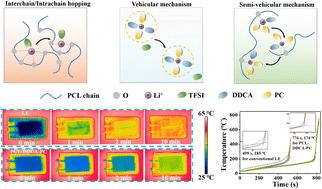
Phase-change electrolytes hold great promise for sustainable energy storage technologies but are constrained by limited ionic conductivity and inefficient ion transport across phase transitions. In this work, to boost the lithium transport in polycaprolactone (PCL)-based phase-change polymer electrolytes, a novel semi-vehicle lithium transport pathway, which integrates solvent-mediated and polymer-assisted migration, has been created via a co-solvent strategy. It is demonstrated that the preferential coordination of dimethyl dodecanedioate (DDCA) and propylene carbonate (PC) attenuates the interaction between the lithium ions and PCL chain, achieving continuous and rapid ion transport across phase transition. Furthermore, the synergistic effect of linear and cyclic solvents promotes the formation of a LiF-rich inorganic SEI layer, effectively stabilizing the lithium anode. The resulting electrolyte (PCL-DDCA-PC) achieves a high ionic conductivity of 3.38 × 10⁻⁴ S cm−1 and Li+ transference number of 0.84. In cell tests, the Li‖Li symmetric cell exhibits stable cycling over 1000 hours at 0.05 mA cm−2. The Li‖LiFePO4 cells retain 91% capacity after 500 cycles at 0.5C, while Li‖NCM811 cells retain 80% after 200 cycles. Due to the unique endothermic phase-change effect of PCL and DDCA, the obtained electrolyte enables Li//LFP pouch cells to demonstrate enhanced thermal hysteresis, reaching 100 °C at a rate four times slower than those with liquid electrolytes.
相变电解质在可持续能源存储技术中具有很大的前景,但受到有限的离子电导率和低效率的离子跨相变传输的限制。在这项工作中,为了促进锂在聚己内酯(PCL)基相变聚合物电解质中的运输,通过共溶剂策略创建了一种新型的半车辆锂运输途径,该途径集溶剂介导和聚合物辅助迁移于一体。结果表明,二甲基十二烷基二酸酯(DDCA)和碳酸丙烯(PC)的优先配位减弱了锂离子与PCL链之间的相互作用,实现了离子跨相变的连续快速输运。此外,线性溶剂和循环溶剂的协同作用促进了富liff无机SEI层的形成,有效地稳定了锂阳极。所得电解质(PCL-DDCA-PC)离子电导率为3.38 × 10⁻⁴ S cm-1, Li+转移数为0.84。在电池测试中,Li||Li对称电池在0.05 mA cm-2下稳定循环1000小时以上。Li||LiFePO₄电池在0.5℃下循环500次后容量保持91%,而Li||NCM811电池在200次循环后容量保持80%。由于PCL和DDCA独特的吸热相变效应,所获得的电解质使Li//LFP袋状电池表现出增强的热滞后,达到100°C的速度比液体电解质慢4倍
期刊介绍:
The Journal of Materials Chemistry A, B & C covers a wide range of high-quality studies in the field of materials chemistry, with each section focusing on specific applications of the materials studied. Journal of Materials Chemistry A emphasizes applications in energy and sustainability, including topics such as artificial photosynthesis, batteries, and fuel cells. Journal of Materials Chemistry B focuses on applications in biology and medicine, while Journal of Materials Chemistry C covers applications in optical, magnetic, and electronic devices. Example topic areas within the scope of Journal of Materials Chemistry A include catalysis, green/sustainable materials, sensors, and water treatment, among others.



 京公网安备 11010802042870号
京ICP备2023020795号-1
京公网安备 11010802042870号
京ICP备2023020795号-1

 分享
分享
 求助内容:
求助内容: 应助结果提醒方式:
 扫码关注我们
