Thermal evolution of sol–gel-synthesized 8YSZ thin films: insights from coupled in situ synchrotron diffraction and electrical conductivity measurements†
Yanet B. Mansilla, Catalina E. Jimenéz, Juan F. Basbus, Horacio E. Troiani, Daniel M. Többens, Adriana C. Serquis and Mauricio D. Arce
{"title":"Thermal evolution of sol–gel-synthesized 8YSZ thin films: insights from coupled in situ synchrotron diffraction and electrical conductivity measurements†","authors":"Yanet B. Mansilla, Catalina E. Jimenéz, Juan F. Basbus, Horacio E. Troiani, Daniel M. Többens, Adriana C. Serquis and Mauricio D. Arce","doi":"10.1039/D5TA01967B","DOIUrl":null,"url":null,"abstract":"<p >The thin film approach for Solid Oxide Cell (SOC) electrolytes offers a pathway to reduce the high fabrication and operating temperatures of these devices. In this work, we present a detailed <em>ex situ</em> and <em>in situ</em> study of 8 mol% yttria-stabilized zirconia (8YSZ) nanostructured dense thin films with a thickness of 100 nm. These films were synthesised through the sol–gel method and deposited by dip-coating on fused glass. The microstructural and crystalline evolution in the 300–800 °C range was studied by synchrotron Grazing Incidence X-ray Diffraction (GIXRD). Crystallisation of the 8YSZ films was observed to start at 343 °C with 4–5 nm crystallites consisting only of the cubic phase. With increasing temperature, this phase is maintained and the crystallite size reaches 38 nm at 800 °C. Additionally, the evolution of the lattice parameter was studied, which allowed us to determine the variation of the thermal expansion coefficient (TEC) of the films during both heating and cooling. The TEC as a function of temperature has three linear regions during heating and two during cooling, with values between 9.6 × 10<small><sup>−7</sup></small> K<small><sup>−1</sup></small> and 3.7 × 10<small><sup>−5</sup></small> K<small><sup>−1</sup></small>. These findings provide valuable insights into the structural response of the material under thermal cycling, relevant to the performance and stability of SOC devices. Coupled with the crystallographic characterisation, the electrical properties of the thin films were studied through conductivity measurements, obtaining conductivities about 1.5 to 5 times higher than the conductivity of 8YSZ bulk samples, with values of 0.06 S cm<small><sup>−1</sup></small> at 700 °C. Thus, the conjunction of a reduced electrolyte thickness with the enhanced conductivity of nanostructured 8YSZ makes these films attractive for intermediate-temperature SOC applications.</p>","PeriodicalId":82,"journal":{"name":"Journal of Materials Chemistry A","volume":" 21","pages":" 15979-15988"},"PeriodicalIF":9.5000,"publicationDate":"2025-04-14","publicationTypes":"Journal Article","fieldsOfStudy":null,"isOpenAccess":false,"openAccessPdf":"","citationCount":"0","resultStr":null,"platform":"Semanticscholar","paperid":null,"PeriodicalName":"Journal of Materials Chemistry A","FirstCategoryId":"88","ListUrlMain":"https://pubs.rsc.org/en/content/articlelanding/2025/ta/d5ta01967b","RegionNum":2,"RegionCategory":"材料科学","ArticlePicture":[],"TitleCN":null,"AbstractTextCN":null,"PMCID":null,"EPubDate":"","PubModel":"","JCR":"Q1","JCRName":"CHEMISTRY, PHYSICAL","Score":null,"Total":0}
引用次数: 0
Abstract
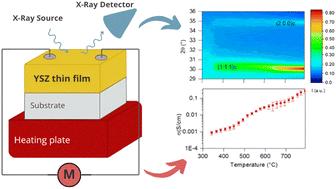
The thin film approach for Solid Oxide Cell (SOC) electrolytes offers a pathway to reduce the high fabrication and operating temperatures of these devices. In this work, we present a detailed ex situ and in situ study of 8 mol% yttria-stabilized zirconia (8YSZ) nanostructured dense thin films with a thickness of 100 nm. These films were synthesised through the sol–gel method and deposited by dip-coating on fused glass. The microstructural and crystalline evolution in the 300–800 °C range was studied by synchrotron Grazing Incidence X-ray Diffraction (GIXRD). Crystallisation of the 8YSZ films was observed to start at 343 °C with 4–5 nm crystallites consisting only of the cubic phase. With increasing temperature, this phase is maintained and the crystallite size reaches 38 nm at 800 °C. Additionally, the evolution of the lattice parameter was studied, which allowed us to determine the variation of the thermal expansion coefficient (TEC) of the films during both heating and cooling. The TEC as a function of temperature has three linear regions during heating and two during cooling, with values between 9.6 × 10⁻⁷ K−1 and 3.7 × 10⁻⁵ K−1. These findings provide valuable insights into the structural response of the material under thermal cycling, relevant to the performance and stability of SOC devices. Coupled with the crystallographic characterisation, the electrical properties of the thin films were studied through conductivity measurements, obtaining conductivities about 1.5 to 5 times higher than the conductivity of 8YSZ bulk samples, with values of 0.06 S cm−1 at 700 °C. Thus, the conjunction of a reduced electrolyte thickness with the enhanced conductivity of nanostructured 8YSZ makes these films attractive for intermediate-temperature SOC applications.
期刊介绍:
The Journal of Materials Chemistry A, B & C covers a wide range of high-quality studies in the field of materials chemistry, with each section focusing on specific applications of the materials studied. Journal of Materials Chemistry A emphasizes applications in energy and sustainability, including topics such as artificial photosynthesis, batteries, and fuel cells. Journal of Materials Chemistry B focuses on applications in biology and medicine, while Journal of Materials Chemistry C covers applications in optical, magnetic, and electronic devices. Example topic areas within the scope of Journal of Materials Chemistry A include catalysis, green/sustainable materials, sensors, and water treatment, among others.



 京公网安备 11010802042870号
京ICP备2023020795号-1
京公网安备 11010802042870号
京ICP备2023020795号-1

 分享
分享
 求助内容:
求助内容: 应助结果提醒方式:
 扫码关注我们
