{"title":"Evaluation of the Effect of Anions on Oxygen Reduction Reactions at Polycrystalline Platinum Electrodes Using Scanning Electrochemical Cell Microscopy","authors":"Yusuke Kawabe, Fumiya Ito, Kaito Hirata, Naoto Todoroki, Yasufumi Takahashi","doi":"10.1021/acs.jpcc.4c07227","DOIUrl":null,"url":null,"abstract":"Understanding how anion adsorption and crystallographic orientation affect the oxygen reduction reaction (ORR) activity is important for designing efficient Pt-based catalysts for fuel cell cathodes. In this study, we used scanning electrochemical cell microscopy (SECCM) to investigate the relationship between anion adsorption and the crystallographic orientation for the ORR activity on polycrystalline Pt electrodes. The ORR is sensitive to surface contamination, so it is important to clean the electrode surface prior to measurement. Therefore, we proposed a method to measure the ORR current using SECCM by linear sweep voltammetry after cyclic-voltammetry-based electrochemical cleaning. A comparative analysis of grains with different crystallographic orientations showed that the ORR activity was higher in the HClO<sub>4</sub> solution than in the H<sub>2</sub>SO<sub>4</sub> solution for grains oriented close to (111). This difference is probably due to the specific adsorption of (bi)sulfate anions on Pt(111) terrace, which inhibits the oxygen adsorption and thereby reduces the ORR activity. These results demonstrated the applicability of SECCM in studying the anion adsorption effect on the ORR activity at the polycrystalline Pt electrode. The insights gained are valuable for understanding how the solution composition influences the electrochemical behavior at different crystallographic orientations, providing important guidance for optimizing catalyst design.","PeriodicalId":61,"journal":{"name":"The Journal of Physical Chemistry C","volume":"40 1","pages":""},"PeriodicalIF":3.2000,"publicationDate":"2025-04-14","publicationTypes":"Journal Article","fieldsOfStudy":null,"isOpenAccess":false,"openAccessPdf":"","citationCount":"0","resultStr":null,"platform":"Semanticscholar","paperid":null,"PeriodicalName":"The Journal of Physical Chemistry C","FirstCategoryId":"1","ListUrlMain":"https://doi.org/10.1021/acs.jpcc.4c07227","RegionNum":3,"RegionCategory":"化学","ArticlePicture":[],"TitleCN":null,"AbstractTextCN":null,"PMCID":null,"EPubDate":"","PubModel":"","JCR":"Q2","JCRName":"CHEMISTRY, PHYSICAL","Score":null,"Total":0}
引用次数: 0
Abstract
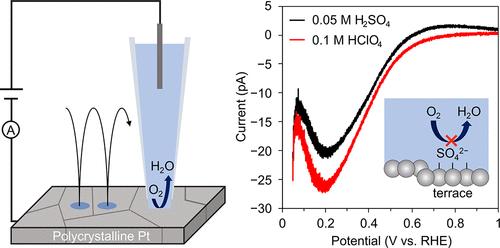
Understanding how anion adsorption and crystallographic orientation affect the oxygen reduction reaction (ORR) activity is important for designing efficient Pt-based catalysts for fuel cell cathodes. In this study, we used scanning electrochemical cell microscopy (SECCM) to investigate the relationship between anion adsorption and the crystallographic orientation for the ORR activity on polycrystalline Pt electrodes. The ORR is sensitive to surface contamination, so it is important to clean the electrode surface prior to measurement. Therefore, we proposed a method to measure the ORR current using SECCM by linear sweep voltammetry after cyclic-voltammetry-based electrochemical cleaning. A comparative analysis of grains with different crystallographic orientations showed that the ORR activity was higher in the HClO4 solution than in the H2SO4 solution for grains oriented close to (111). This difference is probably due to the specific adsorption of (bi)sulfate anions on Pt(111) terrace, which inhibits the oxygen adsorption and thereby reduces the ORR activity. These results demonstrated the applicability of SECCM in studying the anion adsorption effect on the ORR activity at the polycrystalline Pt electrode. The insights gained are valuable for understanding how the solution composition influences the electrochemical behavior at different crystallographic orientations, providing important guidance for optimizing catalyst design.
期刊介绍:
The Journal of Physical Chemistry A/B/C is devoted to reporting new and original experimental and theoretical basic research of interest to physical chemists, biophysical chemists, and chemical physicists.



 京公网安备 11010802042870号
京ICP备2023020795号-1
京公网安备 11010802042870号
京ICP备2023020795号-1

 分享
分享
 求助内容:
求助内容: 应助结果提醒方式:
 扫码关注我们
