Sunlight-driven photocatalytic degradation of organic dyes using Cu(i) coordination polymers: an efficient and recyclable solution for wastewater remediation†
Anrudh Mishra, Dilip Pandey, Sarvesh Kumar Maurya and Abhinav Raghuvanshi
{"title":"Sunlight-driven photocatalytic degradation of organic dyes using Cu(i) coordination polymers: an efficient and recyclable solution for wastewater remediation†","authors":"Anrudh Mishra, Dilip Pandey, Sarvesh Kumar Maurya and Abhinav Raghuvanshi","doi":"10.1039/D5CE00124B","DOIUrl":null,"url":null,"abstract":"<p >Industrial wastewater containing organic dye pollutants poses significant environmental challenges, necessitating cost-effective and eco-friendly solutions. Coordination polymers (CPs), with their structural regularity and stability, present a promising approach for efficient solar-driven photodegradation of such contaminants. Herein we report two new 1D-Cu(<small>I</small>) coordination polymers, namely [Cu<small><sub>2</sub></small>(μ<small><sub>2</sub></small>-I)<small><sub>2</sub></small>(μ<small><sub>2</sub></small>-DTP)<small><sub>2</sub></small>]<small><sub><em>n</em></sub></small><strong>CP1</strong> and [Cu<small><sub>2</sub></small>(μ<small><sub>2</sub></small>-Br)<small><sub>2</sub></small>(μ<small><sub>2</sub></small>-DTP)<small><sub>2</sub></small>]<small><sub><em>n</em></sub></small><strong>CP2</strong> achieved from the self-assembly of 3-(1,3-dithian-2-yl)pyridine (DTP) ligand with CuI and CuBr, respectively. The polymeric chain in both CPs consists of a Cu<small><sub>2</sub></small>X<small><sub>2</sub></small> secondary building unit. Both CPs display excellent photocatalytic efficiency in degrading organic dyes under sunlight using a minimal amount of catalyst and H<small><sub>2</sub></small>O<small><sub>2</sub></small>. <strong>CP1</strong> surpassed <strong>CP2</strong> in performance due to its narrower energy band gap, achieving an impressive 96% degradation of methylene blue (MB) within 15 minutes. The mechanism of the dye degradation was established by several experiments, including XPS analysis, which suggests the involvement of a Fenton-like Cu(<small>I</small>)/Cu(<small>II</small>) redox cycle during the photocatalytic process. The exceptional photocatalytic properties, recyclability and facile synthesis of these CPs underscore their potential for practical environmental remediation applications.</p>","PeriodicalId":70,"journal":{"name":"CrystEngComm","volume":" 16","pages":" 2462-2469"},"PeriodicalIF":2.6000,"publicationDate":"2025-03-13","publicationTypes":"Journal Article","fieldsOfStudy":null,"isOpenAccess":false,"openAccessPdf":"","citationCount":"0","resultStr":null,"platform":"Semanticscholar","paperid":null,"PeriodicalName":"CrystEngComm","FirstCategoryId":"92","ListUrlMain":"https://pubs.rsc.org/en/content/articlelanding/2025/ce/d5ce00124b","RegionNum":3,"RegionCategory":"化学","ArticlePicture":[],"TitleCN":null,"AbstractTextCN":null,"PMCID":null,"EPubDate":"","PubModel":"","JCR":"Q2","JCRName":"CHEMISTRY, MULTIDISCIPLINARY","Score":null,"Total":0}
引用次数: 0
Abstract
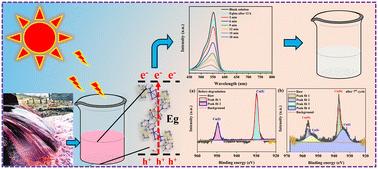
Industrial wastewater containing organic dye pollutants poses significant environmental challenges, necessitating cost-effective and eco-friendly solutions. Coordination polymers (CPs), with their structural regularity and stability, present a promising approach for efficient solar-driven photodegradation of such contaminants. Herein we report two new 1D-Cu(I) coordination polymers, namely [Cu2(μ2-I)2(μ2-DTP)2]nCP1 and [Cu2(μ2-Br)2(μ2-DTP)2]nCP2 achieved from the self-assembly of 3-(1,3-dithian-2-yl)pyridine (DTP) ligand with CuI and CuBr, respectively. The polymeric chain in both CPs consists of a Cu2X2 secondary building unit. Both CPs display excellent photocatalytic efficiency in degrading organic dyes under sunlight using a minimal amount of catalyst and H2O2. CP1 surpassed CP2 in performance due to its narrower energy band gap, achieving an impressive 96% degradation of methylene blue (MB) within 15 minutes. The mechanism of the dye degradation was established by several experiments, including XPS analysis, which suggests the involvement of a Fenton-like Cu(I)/Cu(II) redox cycle during the photocatalytic process. The exceptional photocatalytic properties, recyclability and facile synthesis of these CPs underscore their potential for practical environmental remediation applications.



 京公网安备 11010802042870号
京ICP备2023020795号-1
京公网安备 11010802042870号
京ICP备2023020795号-1

 分享
分享
 求助内容:
求助内容: 应助结果提醒方式:
 扫码关注我们
