{"title":"Electrochemical Modulation of MoS2 Structures to Boost Hydrogen Evolution Reaction Efficiency","authors":"Venumbaka Maneesh Reddy, Bhanu Chandra Marepally, Ranjithkumar Selvam, Saravanan Gengan, Maiyalagan Thandavarayan, Selvakumar Duraisamy","doi":"10.1002/elan.12046","DOIUrl":null,"url":null,"abstract":"<p>The use of molybdenum disulfide (MoS<sub>2</sub>) as a non-noble metal electrocatalyst for the hydrogen evolution reaction (HER) has gained significant attention due to its affordability and the ease of modifying factors such as voltage, current, duration, and the composition and concentration of the electrolyte solution using electrodeposition techniques. To increase the number of active sites on the surface of MoS<sub>2</sub>, fine nanoscale tailoring of the crystalline phase is necessary. This can be accomplished using electrochemical phase formation. In this study, four types of MoS<sub>2</sub> nanoparticles are successfully electrodeposited on copper foil substrates using a mixture of Na<sub>2</sub>MoO<sub>4</sub> and Na<sub>2</sub>S electrolytes, namely fine nodular MoS<sub>2</sub> (FNMoS<sub>2</sub>), small sheet MoS<sub>2</sub> (SSMoS<sub>2</sub>), highly porous MoS<sub>2</sub> (HPMoS<sub>2</sub>), and low porous MoS<sub>2</sub> (LPMoS<sub>2</sub>), with nanoparticles of FNMoS<sub>2</sub>, SSMoS<sub>2</sub>, HPMoS<sub>2</sub>, and LPMoS<sub>2</sub> being produced at potentials of −0.9, −1.0, −1.1, and −1.2, respectively. The electrochemical performance of these nanoparticles on HER is carefully investigated using techniques such as high-resolution transmission electron microscopy (HRTEM), X-ray diffraction (XRD), and energy dispersive spectroscopy. Linear sweep voltammetry, Tafel plot analysis, and electrochemical impedance spectroscopy are used to study the electrocatalytic performance of HER in a 0.5 M KOH electrolyte. HPMoS<sub>2</sub> electrodeposited at −1.1 V for 200 s had a HER current density of 10 mA cm<sup>−2</sup> at <i>η</i> = −270 mV and a Tafel slope (vs RHE) of 35.8 mV/dec, lower than that of FNMoS<sub>2</sub>, SSMoS<sub>2</sub>, and LPMoS<sub>2</sub>. These results have significant implications for the development of low cost, affordable, and environmentally friendly electrochemical methods of producing hydrogen, and pave the way for further research in this field.</p>","PeriodicalId":162,"journal":{"name":"Electroanalysis","volume":"37 4","pages":""},"PeriodicalIF":2.3000,"publicationDate":"2025-04-15","publicationTypes":"Journal Article","fieldsOfStudy":null,"isOpenAccess":false,"openAccessPdf":"","citationCount":"0","resultStr":null,"platform":"Semanticscholar","paperid":null,"PeriodicalName":"Electroanalysis","FirstCategoryId":"92","ListUrlMain":"https://analyticalsciencejournals.onlinelibrary.wiley.com/doi/10.1002/elan.12046","RegionNum":3,"RegionCategory":"化学","ArticlePicture":[],"TitleCN":null,"AbstractTextCN":null,"PMCID":null,"EPubDate":"","PubModel":"","JCR":"Q2","JCRName":"CHEMISTRY, ANALYTICAL","Score":null,"Total":0}
引用次数: 0
Abstract
The use of molybdenum disulfide (MoS2) as a non-noble metal electrocatalyst for the hydrogen evolution reaction (HER) has gained significant attention due to its affordability and the ease of modifying factors such as voltage, current, duration, and the composition and concentration of the electrolyte solution using electrodeposition techniques. To increase the number of active sites on the surface of MoS2, fine nanoscale tailoring of the crystalline phase is necessary. This can be accomplished using electrochemical phase formation. In this study, four types of MoS2 nanoparticles are successfully electrodeposited on copper foil substrates using a mixture of Na2MoO4 and Na2S electrolytes, namely fine nodular MoS2 (FNMoS2), small sheet MoS2 (SSMoS2), highly porous MoS2 (HPMoS2), and low porous MoS2 (LPMoS2), with nanoparticles of FNMoS2, SSMoS2, HPMoS2, and LPMoS2 being produced at potentials of −0.9, −1.0, −1.1, and −1.2, respectively. The electrochemical performance of these nanoparticles on HER is carefully investigated using techniques such as high-resolution transmission electron microscopy (HRTEM), X-ray diffraction (XRD), and energy dispersive spectroscopy. Linear sweep voltammetry, Tafel plot analysis, and electrochemical impedance spectroscopy are used to study the electrocatalytic performance of HER in a 0.5 M KOH electrolyte. HPMoS2 electrodeposited at −1.1 V for 200 s had a HER current density of 10 mA cm−2 at η = −270 mV and a Tafel slope (vs RHE) of 35.8 mV/dec, lower than that of FNMoS2, SSMoS2, and LPMoS2. These results have significant implications for the development of low cost, affordable, and environmentally friendly electrochemical methods of producing hydrogen, and pave the way for further research in this field.
期刊介绍:
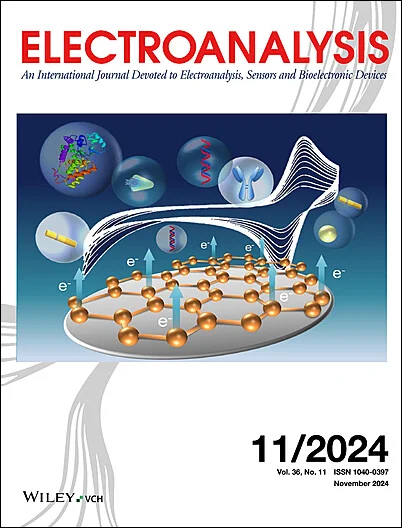
Electroanalysis is an international, peer-reviewed journal covering all branches of electroanalytical chemistry, including both fundamental and application papers as well as reviews dealing with new electrochemical sensors and biosensors, nanobioelectronics devices, analytical voltammetry, potentiometry, new electrochemical detection schemes based on novel nanomaterials, fuel cells and biofuel cells, and important practical applications.
Serving as a vital communication link between the research labs and the field, Electroanalysis helps you to quickly adapt the latest innovations into practical clinical, environmental, food analysis, industrial and energy-related applications. Electroanalysis provides the most comprehensive coverage of the field and is the number one source for information on electroanalytical chemistry, electrochemical sensors and biosensors and fuel/biofuel cells.



 京公网安备 11010802042870号
京ICP备2023020795号-1
京公网安备 11010802042870号
京ICP备2023020795号-1

 分享
分享
 求助内容:
求助内容: 应助结果提醒方式:
 扫码关注我们
