Qiaosheng Pan, Ning Sang, Tianpei Zhou, Changzheng Wu, Ting Si, Fangsheng Huang and Zhiqiang Zhu
{"title":"Array-structured microcapsule fibers for efficient fire extinguishing in confined spaces†","authors":"Qiaosheng Pan, Ning Sang, Tianpei Zhou, Changzheng Wu, Ting Si, Fangsheng Huang and Zhiqiang Zhu","doi":"10.1039/D4LC00802B","DOIUrl":null,"url":null,"abstract":"<p >Fire incidents in confined spaces pose significant risks to human lives and property. In such scenarios, achieving structural encapsulation and design of fire extinguishing agents is crucial. However, there is still a significant knowledge gap in the rational structural design and understanding of fire extinguishing mechanisms. Herein, we have developed a fire extinguishing material with a hemispherical knotted microfiber structure by microfluidic spinning and achieved directed multiple-fire extinguishing in a confined space. Fire-extinguishing microfibers (FEMFs) are uniformly distributed with perfluorohexanone (PFH)-embedded knots, each of which acts as an independent fire-extinguishing unit. The rational design of fiber microstructure can achieve a variety of dosage ratios of extinguishing agents that activate at a fire extinguishing temperature of 120 °C. Through high-speed imaging and simulation calculations, we found that FEMFs containing only 0.2 g PFH can generate up to 207 directional jets to extinguish fires. Fire-extinguishing patches (FEPs) made from FEMFs have a uniform distribution of the extinguishing agent and exhibit excellent fire extinguishing performance in electrical junction boxes. This new fire extinguishing material is believed to have broad applications in enhancing fire safety within confined spaces.</p>","PeriodicalId":85,"journal":{"name":"Lab on a Chip","volume":" 9","pages":" 2193-2204"},"PeriodicalIF":5.4000,"publicationDate":"2025-04-04","publicationTypes":"Journal Article","fieldsOfStudy":null,"isOpenAccess":false,"openAccessPdf":"","citationCount":"0","resultStr":null,"platform":"Semanticscholar","paperid":null,"PeriodicalName":"Lab on a Chip","FirstCategoryId":"5","ListUrlMain":"https://pubs.rsc.org/en/content/articlelanding/2025/lc/d4lc00802b","RegionNum":2,"RegionCategory":"工程技术","ArticlePicture":[],"TitleCN":null,"AbstractTextCN":null,"PMCID":null,"EPubDate":"","PubModel":"","JCR":"Q1","JCRName":"BIOCHEMICAL RESEARCH METHODS","Score":null,"Total":0}
引用次数: 0
Abstract
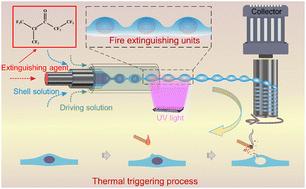
Fire incidents in confined spaces pose significant risks to human lives and property. In such scenarios, achieving structural encapsulation and design of fire extinguishing agents is crucial. However, there is still a significant knowledge gap in the rational structural design and understanding of fire extinguishing mechanisms. Herein, we have developed a fire extinguishing material with a hemispherical knotted microfiber structure by microfluidic spinning and achieved directed multiple-fire extinguishing in a confined space. Fire-extinguishing microfibers (FEMFs) are uniformly distributed with perfluorohexanone (PFH)-embedded knots, each of which acts as an independent fire-extinguishing unit. The rational design of fiber microstructure can achieve a variety of dosage ratios of extinguishing agents that activate at a fire extinguishing temperature of 120 °C. Through high-speed imaging and simulation calculations, we found that FEMFs containing only 0.2 g PFH can generate up to 207 directional jets to extinguish fires. Fire-extinguishing patches (FEPs) made from FEMFs have a uniform distribution of the extinguishing agent and exhibit excellent fire extinguishing performance in electrical junction boxes. This new fire extinguishing material is believed to have broad applications in enhancing fire safety within confined spaces.
期刊介绍:
Lab on a Chip is the premiere journal that publishes cutting-edge research in the field of miniaturization. By their very nature, microfluidic/nanofluidic/miniaturized systems are at the intersection of disciplines, spanning fundamental research to high-end application, which is reflected by the broad readership of the journal. Lab on a Chip publishes two types of papers on original research: full-length research papers and communications. Papers should demonstrate innovations, which can come from technical advancements or applications addressing pressing needs in globally important areas. The journal also publishes Comments, Reviews, and Perspectives.




 京公网安备 11010802042870号
京ICP备2023020795号-1
京公网安备 11010802042870号
京ICP备2023020795号-1

 分享
分享
 求助内容:
求助内容: 应助结果提醒方式:
 扫码关注我们
