{"title":"Photosynthesis of NH3 from NO3− Using CH4 in Homogenous Rhenium Catalysis","authors":"Genta Nakamura, Masaya Sakurai, Yohei Kametani, Yudai Kawasaki, Yoshihito Shiota, Kazunari Yoshizawa, Seiji Ogo, Takahiro Matsumoto","doi":"10.1002/anie.202423543","DOIUrl":null,"url":null,"abstract":"<p>We present Re catalysis of one-pot synthesis of NH<sub>3</sub> from NO<sub>3</sub><sup>−</sup> using CH<sub>4</sub> as a reductant under UV light irradiation at room temperature. NO<sub>3</sub><sup>−</sup> leads to environmental issues such as water contamination, eutrophication, and biodiversity loss. In a natural system and a sewage facility, NO<sub>3</sub><sup>−</sup> can be detoxified to N<sub>2</sub> using hydrogen donors by a microbial process. However, it is better to convert NO<sub>3</sub><sup>−</sup> to NH<sub>3</sub> rather than N<sub>2</sub>. To develop a desirable process of NO<sub>3</sub><sup>−</sup> to NH<sub>3</sub> for a sustainable society, it is required that the reducing agent is derived from a renewable resource/energy. Thus, we turned our attention to CH<sub>4</sub>, which has a high affinity with renewable resource/energy since it can be produced from livestock waste. Therefore, our system reported here is to directly convert NO<sub>3</sub><sup>−</sup> to NH<sub>3</sub> using CH<sub>4</sub> with light energy.</p>","PeriodicalId":125,"journal":{"name":"Angewandte Chemie International Edition","volume":"64 25","pages":""},"PeriodicalIF":16.9000,"publicationDate":"2025-04-15","publicationTypes":"Journal Article","fieldsOfStudy":null,"isOpenAccess":false,"openAccessPdf":"https://onlinelibrary.wiley.com/doi/epdf/10.1002/anie.202423543","citationCount":"0","resultStr":null,"platform":"Semanticscholar","paperid":null,"PeriodicalName":"Angewandte Chemie International Edition","FirstCategoryId":"92","ListUrlMain":"https://onlinelibrary.wiley.com/doi/10.1002/anie.202423543","RegionNum":1,"RegionCategory":"化学","ArticlePicture":[],"TitleCN":null,"AbstractTextCN":null,"PMCID":null,"EPubDate":"","PubModel":"","JCR":"Q1","JCRName":"CHEMISTRY, MULTIDISCIPLINARY","Score":null,"Total":0}
引用次数: 0
Abstract
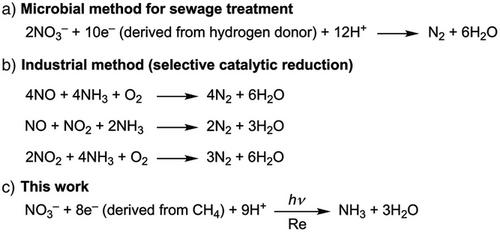
We present Re catalysis of one-pot synthesis of NH3 from NO3− using CH4 as a reductant under UV light irradiation at room temperature. NO3− leads to environmental issues such as water contamination, eutrophication, and biodiversity loss. In a natural system and a sewage facility, NO3− can be detoxified to N2 using hydrogen donors by a microbial process. However, it is better to convert NO3− to NH3 rather than N2. To develop a desirable process of NO3− to NH3 for a sustainable society, it is required that the reducing agent is derived from a renewable resource/energy. Thus, we turned our attention to CH4, which has a high affinity with renewable resource/energy since it can be produced from livestock waste. Therefore, our system reported here is to directly convert NO3− to NH3 using CH4 with light energy.
期刊介绍:
Angewandte Chemie, a journal of the German Chemical Society (GDCh), maintains a leading position among scholarly journals in general chemistry with an impressive Impact Factor of 16.6 (2022 Journal Citation Reports, Clarivate, 2023). Published weekly in a reader-friendly format, it features new articles almost every day. Established in 1887, Angewandte Chemie is a prominent chemistry journal, offering a dynamic blend of Review-type articles, Highlights, Communications, and Research Articles on a weekly basis, making it unique in the field.




 京公网安备 11010802042870号
京ICP备2023020795号-1
京公网安备 11010802042870号
京ICP备2023020795号-1

 分享
分享
 求助内容:
求助内容: 应助结果提醒方式:
 扫码关注我们
