Excited-State Mixing in the LOV Domain Proteins: Possible Physics behind the Difference in the Transient Absorption and Transient Stimulated Raman Spectroscopy
Yingliang Liu, Aditya S. Chaudhari, Alessandra Picchiotti, Mateusz Rebarz, Miroslav Kloz, Martin Přeček, Jakob Andreasson, Bohdan Schneider
{"title":"Excited-State Mixing in the LOV Domain Proteins: Possible Physics behind the Difference in the Transient Absorption and Transient Stimulated Raman Spectroscopy","authors":"Yingliang Liu, Aditya S. Chaudhari, Alessandra Picchiotti, Mateusz Rebarz, Miroslav Kloz, Martin Přeček, Jakob Andreasson, Bohdan Schneider","doi":"10.1021/acs.jpclett.4c02978","DOIUrl":null,"url":null,"abstract":"It remains uncertain whether excited electronic state mixing occurs in the flavin cofactor of the light-oxygen-voltage-sensing (LOV) domain. In this study, we present transient absorption and femtosecond stimulated Raman spectra of both free and EL222 binding flavin mononucleotide (FMN). We observed a change in the shape of the excited-state absorption around 800 nm in the S<sub>1</sub> state transient absorption after binding to EL222, alongside a relative intensity increase of the N<sub>1</sub>–C<sub>2</sub> and C<sub>2</sub>═O<sub>2</sub> stretching modes in the S<sub>1</sub> state Raman spectra. Based on the previous calculated geometric differences between the ππ* and nπ* states, we propose a probable electronic state mixing in EL222 binding FMN. This mixing is favored by the nonsymmetric hydrogen bonding interaction between the flavin O<sub>4</sub> atom and the asparagine residue and fewer hydrogen bonds with the O<sub>2</sub> atom in EL222.","PeriodicalId":62,"journal":{"name":"The Journal of Physical Chemistry Letters","volume":"120 1","pages":""},"PeriodicalIF":4.6000,"publicationDate":"2025-04-16","publicationTypes":"Journal Article","fieldsOfStudy":null,"isOpenAccess":false,"openAccessPdf":"","citationCount":"0","resultStr":null,"platform":"Semanticscholar","paperid":null,"PeriodicalName":"The Journal of Physical Chemistry Letters","FirstCategoryId":"1","ListUrlMain":"https://doi.org/10.1021/acs.jpclett.4c02978","RegionNum":2,"RegionCategory":"化学","ArticlePicture":[],"TitleCN":null,"AbstractTextCN":null,"PMCID":null,"EPubDate":"","PubModel":"","JCR":"Q2","JCRName":"CHEMISTRY, PHYSICAL","Score":null,"Total":0}
引用次数: 0
Abstract
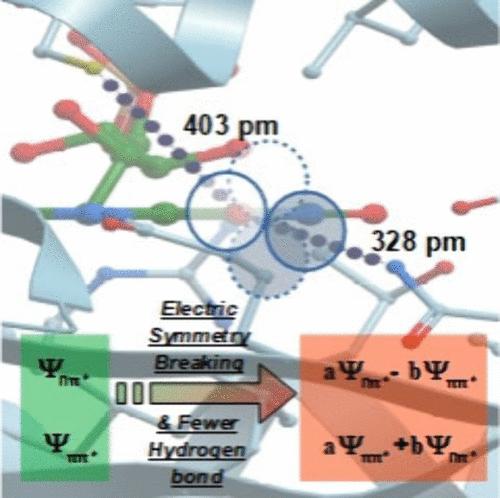
It remains uncertain whether excited electronic state mixing occurs in the flavin cofactor of the light-oxygen-voltage-sensing (LOV) domain. In this study, we present transient absorption and femtosecond stimulated Raman spectra of both free and EL222 binding flavin mononucleotide (FMN). We observed a change in the shape of the excited-state absorption around 800 nm in the S1 state transient absorption after binding to EL222, alongside a relative intensity increase of the N1–C2 and C2═O2 stretching modes in the S1 state Raman spectra. Based on the previous calculated geometric differences between the ππ* and nπ* states, we propose a probable electronic state mixing in EL222 binding FMN. This mixing is favored by the nonsymmetric hydrogen bonding interaction between the flavin O4 atom and the asparagine residue and fewer hydrogen bonds with the O2 atom in EL222.
期刊介绍:
The Journal of Physical Chemistry (JPC) Letters is devoted to reporting new and original experimental and theoretical basic research of interest to physical chemists, biophysical chemists, chemical physicists, physicists, material scientists, and engineers. An important criterion for acceptance is that the paper reports a significant scientific advance and/or physical insight such that rapid publication is essential. Two issues of JPC Letters are published each month.




 京公网安备 11010802042870号
京ICP备2023020795号-1
京公网安备 11010802042870号
京ICP备2023020795号-1

 分享
分享
 求助内容:
求助内容: 应助结果提醒方式:
 扫码关注我们
