{"title":"Atomistic Modeling of the Active Site Formation Mechanism and Olefin Metathesis Kinetics for WOx/SiO2","authors":"Oluwatosin Ohiro, Bryan R. Goldsmith","doi":"10.1021/acs.jpcc.5c00190","DOIUrl":null,"url":null,"abstract":"Atomically dispersed WO<sub><i>x</i></sub> on amorphous silica (WO<sub><i>x</i></sub>/SiO<sub>2</sub>) is known to be an active catalyst for olefin metathesis. There has been longstanding interest in determining the structure of the WO<sub><i>x</i></sub>/SiO<sub>2</sub> active sites, the mechanism of their activation from their precursor state, and characterizing their activity toward olefin metathesis. Atomistic knowledge is lacking about the formation mechanism and the identity of the kinetically active W-alkylidene site for ethene/trans-2-butene (C<sub>2</sub>/C<sub>4</sub>) metathesis to produce propene (C<sub>3</sub>). Herein, we analyze the active site formation mechanism and C<sub>2</sub>/C<sub>4</sub> metathesis kinetics for WO<sub><i>x</i></sub>/SiO<sub>2</sub> using density functional theory calculations and mean-field microkinetic modeling. We predict that the pseudo-Wittig reaction is the predominant mechanism for W-alkylidene active site formation from the most-abundant W<sup>6+</sup> digrafted dioxo precursor (S<sub>0</sub>) using either C<sub>2</sub> or C<sub>4</sub> as the activating reagent. Although the W-ethylidene site could be formed by C<sub>2</sub> or C<sub>4</sub> reacting with S<sub>0</sub>, the W-methylidene and W-butylidene sites are formed only through S<sub>0</sub> activation with C<sub>2</sub> and C<sub>4</sub>, respectively. Microkinetic analysis predicts that the W-methylidene site exhibits an order of magnitude higher rate constant for metathesis reaction to C<sub>3</sub> compared to the W-ethylidene site.","PeriodicalId":61,"journal":{"name":"The Journal of Physical Chemistry C","volume":"108 1","pages":""},"PeriodicalIF":3.2000,"publicationDate":"2025-04-16","publicationTypes":"Journal Article","fieldsOfStudy":null,"isOpenAccess":false,"openAccessPdf":"","citationCount":"0","resultStr":null,"platform":"Semanticscholar","paperid":null,"PeriodicalName":"The Journal of Physical Chemistry C","FirstCategoryId":"1","ListUrlMain":"https://doi.org/10.1021/acs.jpcc.5c00190","RegionNum":3,"RegionCategory":"化学","ArticlePicture":[],"TitleCN":null,"AbstractTextCN":null,"PMCID":null,"EPubDate":"","PubModel":"","JCR":"Q2","JCRName":"CHEMISTRY, PHYSICAL","Score":null,"Total":0}
引用次数: 0
Abstract
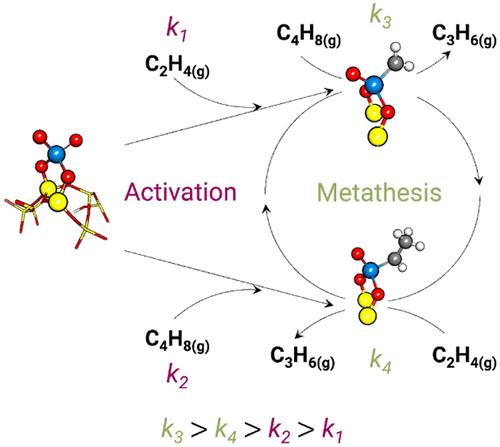
Atomically dispersed WOx on amorphous silica (WOx/SiO2) is known to be an active catalyst for olefin metathesis. There has been longstanding interest in determining the structure of the WOx/SiO2 active sites, the mechanism of their activation from their precursor state, and characterizing their activity toward olefin metathesis. Atomistic knowledge is lacking about the formation mechanism and the identity of the kinetically active W-alkylidene site for ethene/trans-2-butene (C2/C4) metathesis to produce propene (C3). Herein, we analyze the active site formation mechanism and C2/C4 metathesis kinetics for WOx/SiO2 using density functional theory calculations and mean-field microkinetic modeling. We predict that the pseudo-Wittig reaction is the predominant mechanism for W-alkylidene active site formation from the most-abundant W6+ digrafted dioxo precursor (S0) using either C2 or C4 as the activating reagent. Although the W-ethylidene site could be formed by C2 or C4 reacting with S0, the W-methylidene and W-butylidene sites are formed only through S0 activation with C2 and C4, respectively. Microkinetic analysis predicts that the W-methylidene site exhibits an order of magnitude higher rate constant for metathesis reaction to C3 compared to the W-ethylidene site.
期刊介绍:
The Journal of Physical Chemistry A/B/C is devoted to reporting new and original experimental and theoretical basic research of interest to physical chemists, biophysical chemists, and chemical physicists.



 京公网安备 11010802042870号
京ICP备2023020795号-1
京公网安备 11010802042870号
京ICP备2023020795号-1

 分享
分享
 求助内容:
求助内容: 应助结果提醒方式:
 扫码关注我们
