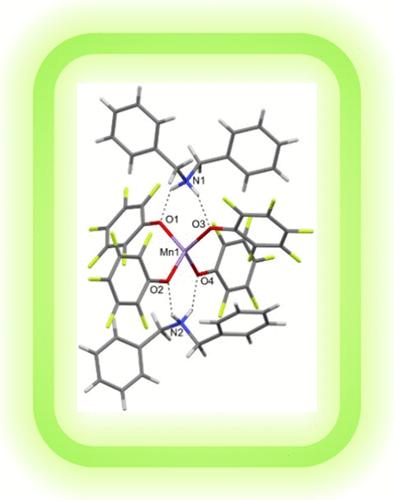
{"title":"Luminescent Tetrahedral Manganese(II) Pentaphluorophenolate Complex as a Highly Sensitive Molecular Thermometer","authors":"Luca Labella, Gregorio Bottaro, Fabio Marchetti, Simona Samaritani, Lidia Armelao","doi":"10.1021/acs.inorgchem.4c05477","DOIUrl":null,"url":null,"abstract":"A mononuclear tetrahedral manganese complex containing all O-donor ligands has been prepared under mild conditions starting from a dialkylcarbamato manganese(II) precursor. Manganese(II) <i>N,N</i>-dibutylcarbamate [Mn(O<sub>2</sub>CNBu<sub>2</sub>)<sub>2</sub>]<sub><i>n</i></sub>, <b>1</b>, can be conveniently prepared by extraction from a deoxygenated water solution of manganese(II) sulfate using a CO<sub>2</sub>-saturated toluene solution of dibutylamine. Access to the <i>N</i>,<i>N</i>-dibenzylcarbamato manganese complex [Mn(O<sub>2</sub>CNBz<sub>2</sub>)<sub>2</sub>]<sub><i>n</i></sub>, <b>2</b>, occurs through metathesis by reaction with dibenzylamine and carbon dioxide. By reaction of <b>2</b> with pentafluorophenol, an almost quantitative reaction affords [Bz<sub>2</sub>NH<sub>2</sub>]<sub>2</sub>[Mn(OC<sub>6</sub>F<sub>5</sub>)<sub>4</sub>], <b>3</b>, that has been crystallographically characterized through single-crystal X-ray diffraction. Compound <b>3</b> exhibits absorption and emission spectral features characteristic of Mn<sup>2+</sup> ions in a tetrahedral coordination environment. Upon cooling, the emission intensity was observed to increase by approximately two orders of magnitude. The excited-state lifetimes exhibited significant temperature dependence, ranging from 12.7 ms at 80 K to 10 μs at 290 K. The temperature-dependent trends of both emission intensity and lifetimes showed nearly identical profiles. As a result, compound <b>3</b> functions as a dual-mode highly sensitive luminescent molecular thermometer, with a maximum relative thermal sensitivity (<i>S</i><sub>r</sub>) of 7.4% K<sup>–1</sup> at 220 K and <i>S</i><sub>r</sub> >1 over the temperature range 170–270 K. A distinctive feature of compound <b>3</b> is its capacity to yield equivalent luminescent molecular thermometers (LMT) using either the emission intensity or lifetime, thus enhancing its versatility in thermal sensing applications.","PeriodicalId":40,"journal":{"name":"Inorganic Chemistry","volume":"15 1","pages":""},"PeriodicalIF":4.7000,"publicationDate":"2025-04-16","publicationTypes":"Journal Article","fieldsOfStudy":null,"isOpenAccess":false,"openAccessPdf":"","citationCount":"0","resultStr":null,"platform":"Semanticscholar","paperid":null,"PeriodicalName":"Inorganic Chemistry","FirstCategoryId":"92","ListUrlMain":"https://doi.org/10.1021/acs.inorgchem.4c05477","RegionNum":2,"RegionCategory":"化学","ArticlePicture":[],"TitleCN":null,"AbstractTextCN":null,"PMCID":null,"EPubDate":"","PubModel":"","JCR":"Q1","JCRName":"CHEMISTRY, INORGANIC & NUCLEAR","Score":null,"Total":0}
引用次数: 0
Abstract
A mononuclear tetrahedral manganese complex containing all O-donor ligands has been prepared under mild conditions starting from a dialkylcarbamato manganese(II) precursor. Manganese(II) N,N-dibutylcarbamate [Mn(O2CNBu2)2]n, 1, can be conveniently prepared by extraction from a deoxygenated water solution of manganese(II) sulfate using a CO2-saturated toluene solution of dibutylamine. Access to the N,N-dibenzylcarbamato manganese complex [Mn(O2CNBz2)2]n, 2, occurs through metathesis by reaction with dibenzylamine and carbon dioxide. By reaction of 2 with pentafluorophenol, an almost quantitative reaction affords [Bz2NH2]2[Mn(OC6F5)4], 3, that has been crystallographically characterized through single-crystal X-ray diffraction. Compound 3 exhibits absorption and emission spectral features characteristic of Mn2+ ions in a tetrahedral coordination environment. Upon cooling, the emission intensity was observed to increase by approximately two orders of magnitude. The excited-state lifetimes exhibited significant temperature dependence, ranging from 12.7 ms at 80 K to 10 μs at 290 K. The temperature-dependent trends of both emission intensity and lifetimes showed nearly identical profiles. As a result, compound 3 functions as a dual-mode highly sensitive luminescent molecular thermometer, with a maximum relative thermal sensitivity (Sr) of 7.4% K–1 at 220 K and Sr >1 over the temperature range 170–270 K. A distinctive feature of compound 3 is its capacity to yield equivalent luminescent molecular thermometers (LMT) using either the emission intensity or lifetime, thus enhancing its versatility in thermal sensing applications.
期刊介绍:
Inorganic Chemistry publishes fundamental studies in all phases of inorganic chemistry. Coverage includes experimental and theoretical reports on quantitative studies of structure and thermodynamics, kinetics, mechanisms of inorganic reactions, bioinorganic chemistry, and relevant aspects of organometallic chemistry, solid-state phenomena, and chemical bonding theory. Emphasis is placed on the synthesis, structure, thermodynamics, reactivity, spectroscopy, and bonding properties of significant new and known compounds.



 京公网安备 11010802042870号
京ICP备2023020795号-1
京公网安备 11010802042870号
京ICP备2023020795号-1

 分享
分享
 求助内容:
求助内容: 应助结果提醒方式:
 扫码关注我们
