Maryam Manafi Moghadam, Ali Ramazani, Ali Morsali, Sobhan Rezayati
{"title":"Functionalization of Magnetic UiO-66-NH2 with Schiff Base Copper(II) Complex for the One-Pot Synthesis of Pyran-Annulated Heterocyclic Scaffolds","authors":"Maryam Manafi Moghadam, Ali Ramazani, Ali Morsali, Sobhan Rezayati","doi":"10.1021/acs.inorgchem.4c05574","DOIUrl":null,"url":null,"abstract":"This study explores the design and synthesis of the magnetic UiO-66-NH<sub>2</sub>(Zr) functionalized with a Schiff base copper(II) complex via the postsynthesis method, forming a core–shell structure that acts as a magnetically recyclable nanocatalyst. The nanocatalyst was synthesized using an affordable and straightforward method and abbreviated as magnetic@UiO-66-NH-SB-Cu(II). For this purpose, magnetic@UiO-66-NH<sub>2</sub> was synthesized by modifying Fe<sub>3</sub>O<sub>4</sub> with tetraethyl orthosilicate, ZrCl<sub>4</sub>, and 2-aminoterephthalic acid, stabilizing the core, and promoting Zr-MOF growth. The surface was functionalized with pyrrole-2-carboxaldehyde and CuCl<sub>2</sub>, followed by characterization through various techniques. Using particle size distributions from transmission electron microscopy images, the average size was determined to be roughly 10–22 nm. The presence of cupric ions (Cu<sup>2+</sup>) within the catalyst was confirmed through X-ray photoelectron spectroscopy analysis, which distinctly revealed two peaks at 940.2 and 960.1 eV corresponding to Cu 2p<sub>3/2</sub> and Cu 2p<sub>1/2</sub>, respectively. The synthesized nanocatalyst exhibits improved performance in the formation of chromene-annulated heterocycles from various aromatic aldehydes and various phenols with malononitrile in ethanol under reflux conditions. The catalyst can be reused by a magnet field up to seven times with only a minimal drop in the yield of the product. Cu leaching is confirmed by inductively coupled plasma analysis to occur at a rate of 0.7 wt %.","PeriodicalId":40,"journal":{"name":"Inorganic Chemistry","volume":"270 1","pages":""},"PeriodicalIF":4.7000,"publicationDate":"2025-04-16","publicationTypes":"Journal Article","fieldsOfStudy":null,"isOpenAccess":false,"openAccessPdf":"","citationCount":"0","resultStr":null,"platform":"Semanticscholar","paperid":null,"PeriodicalName":"Inorganic Chemistry","FirstCategoryId":"92","ListUrlMain":"https://doi.org/10.1021/acs.inorgchem.4c05574","RegionNum":2,"RegionCategory":"化学","ArticlePicture":[],"TitleCN":null,"AbstractTextCN":null,"PMCID":null,"EPubDate":"","PubModel":"","JCR":"Q1","JCRName":"CHEMISTRY, INORGANIC & NUCLEAR","Score":null,"Total":0}
引用次数: 0
Abstract
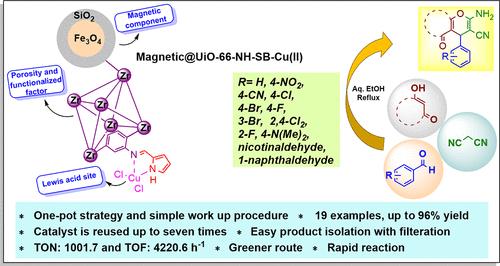
This study explores the design and synthesis of the magnetic UiO-66-NH2(Zr) functionalized with a Schiff base copper(II) complex via the postsynthesis method, forming a core–shell structure that acts as a magnetically recyclable nanocatalyst. The nanocatalyst was synthesized using an affordable and straightforward method and abbreviated as magnetic@UiO-66-NH-SB-Cu(II). For this purpose, magnetic@UiO-66-NH2 was synthesized by modifying Fe3O4 with tetraethyl orthosilicate, ZrCl4, and 2-aminoterephthalic acid, stabilizing the core, and promoting Zr-MOF growth. The surface was functionalized with pyrrole-2-carboxaldehyde and CuCl2, followed by characterization through various techniques. Using particle size distributions from transmission electron microscopy images, the average size was determined to be roughly 10–22 nm. The presence of cupric ions (Cu2+) within the catalyst was confirmed through X-ray photoelectron spectroscopy analysis, which distinctly revealed two peaks at 940.2 and 960.1 eV corresponding to Cu 2p3/2 and Cu 2p1/2, respectively. The synthesized nanocatalyst exhibits improved performance in the formation of chromene-annulated heterocycles from various aromatic aldehydes and various phenols with malononitrile in ethanol under reflux conditions. The catalyst can be reused by a magnet field up to seven times with only a minimal drop in the yield of the product. Cu leaching is confirmed by inductively coupled plasma analysis to occur at a rate of 0.7 wt %.
期刊介绍:
Inorganic Chemistry publishes fundamental studies in all phases of inorganic chemistry. Coverage includes experimental and theoretical reports on quantitative studies of structure and thermodynamics, kinetics, mechanisms of inorganic reactions, bioinorganic chemistry, and relevant aspects of organometallic chemistry, solid-state phenomena, and chemical bonding theory. Emphasis is placed on the synthesis, structure, thermodynamics, reactivity, spectroscopy, and bonding properties of significant new and known compounds.



 京公网安备 11010802042870号
京ICP备2023020795号-1
京公网安备 11010802042870号
京ICP备2023020795号-1

 分享
分享
 求助内容:
求助内容: 应助结果提醒方式:
 扫码关注我们
