{"title":"Structural Analysis of Selenium Coordination Compounds and Mesoporous TiO2-Based Photocatalysts for Hydrogen Generation","authors":"Rodrigo Cervo, Cândida Alíssia Brandl, Tanize Bortolotto, Camila Nunes Cechin, Natália de Freitas Daudt, Bernardo Almeida Iglesias, Ernesto Schulz Lang, Bárbara Tirloni, Roberta Cargnelutti","doi":"10.1021/acs.inorgchem.4c05325","DOIUrl":null,"url":null,"abstract":"This study reports the synthesis of ten coordination compounds (<b>1</b>–<b>10</b>) derived from the ligand bis((3-aminopyridin-2-yl)selanyl)methane (<b>L</b>) and different metal centers (Co<sup>II</sup>, Cu<sup>I</sup>, Cu<sup>II</sup>, Zn<sup>II</sup>, and Ag<sup>I</sup>). Single crystals of the complexes were obtained via slow diffusion from overlaid solutions of ligand <b>L</b> and the corresponding metal. Their crystalline structures were determined by single-crystal X-ray diffraction (SCXRD) and further characterized using spectroscopic, spectrometric, and voltammetric techniques. Complexes <b>1</b>–<b>5</b>, <b>7</b>, and <b>10</b> were evaluated as cocatalysts of mesoporous titanium dioxide (m-TiO<sub>2</sub>) for photocatalytic hydrogen production via water photolysis under solar light simulation, using triethanolamine (TEOA) as the sacrificial agent. The results showed that complexes <b>4</b>, <b>5</b>, <b>7</b>, and <b>10</b> enhanced m-TiO<sub>2</sub> photocatalytic activity, achieving hydrogen evolution rates at least four times higher than standard m-TiO<sub>2</sub> and P25. Among these, the photocatalyst m-TiO<sub>2</sub>-<b>7</b> (<b>7</b> = [Cu<sub>2</sub>(μ-SO<sub>4</sub>)<sub>2</sub><b>L</b><sub><b>2</b></sub>]) exhibited the highest hydrogen production, reaching approximately 7800 μmol/g over a 6-h experiment–nearly 26 times greater than pure m-TiO<sub>2</sub> (300 μmol/g). These findings highlight the potential of organoselenium metal complexes for the development of novel photocatalytic materials based on nonprecious metals.","PeriodicalId":40,"journal":{"name":"Inorganic Chemistry","volume":"35 1","pages":""},"PeriodicalIF":4.7000,"publicationDate":"2025-04-16","publicationTypes":"Journal Article","fieldsOfStudy":null,"isOpenAccess":false,"openAccessPdf":"","citationCount":"0","resultStr":null,"platform":"Semanticscholar","paperid":null,"PeriodicalName":"Inorganic Chemistry","FirstCategoryId":"92","ListUrlMain":"https://doi.org/10.1021/acs.inorgchem.4c05325","RegionNum":2,"RegionCategory":"化学","ArticlePicture":[],"TitleCN":null,"AbstractTextCN":null,"PMCID":null,"EPubDate":"","PubModel":"","JCR":"Q1","JCRName":"CHEMISTRY, INORGANIC & NUCLEAR","Score":null,"Total":0}
引用次数: 0
Abstract
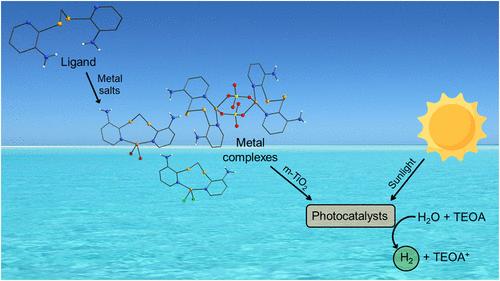
This study reports the synthesis of ten coordination compounds (1–10) derived from the ligand bis((3-aminopyridin-2-yl)selanyl)methane (L) and different metal centers (CoII, CuI, CuII, ZnII, and AgI). Single crystals of the complexes were obtained via slow diffusion from overlaid solutions of ligand L and the corresponding metal. Their crystalline structures were determined by single-crystal X-ray diffraction (SCXRD) and further characterized using spectroscopic, spectrometric, and voltammetric techniques. Complexes 1–5, 7, and 10 were evaluated as cocatalysts of mesoporous titanium dioxide (m-TiO2) for photocatalytic hydrogen production via water photolysis under solar light simulation, using triethanolamine (TEOA) as the sacrificial agent. The results showed that complexes 4, 5, 7, and 10 enhanced m-TiO2 photocatalytic activity, achieving hydrogen evolution rates at least four times higher than standard m-TiO2 and P25. Among these, the photocatalyst m-TiO2-7 (7 = [Cu2(μ-SO4)2L2]) exhibited the highest hydrogen production, reaching approximately 7800 μmol/g over a 6-h experiment–nearly 26 times greater than pure m-TiO2 (300 μmol/g). These findings highlight the potential of organoselenium metal complexes for the development of novel photocatalytic materials based on nonprecious metals.
期刊介绍:
Inorganic Chemistry publishes fundamental studies in all phases of inorganic chemistry. Coverage includes experimental and theoretical reports on quantitative studies of structure and thermodynamics, kinetics, mechanisms of inorganic reactions, bioinorganic chemistry, and relevant aspects of organometallic chemistry, solid-state phenomena, and chemical bonding theory. Emphasis is placed on the synthesis, structure, thermodynamics, reactivity, spectroscopy, and bonding properties of significant new and known compounds.



 京公网安备 11010802042870号
京ICP备2023020795号-1
京公网安备 11010802042870号
京ICP备2023020795号-1

 分享
分享
 求助内容:
求助内容: 应助结果提醒方式:
 扫码关注我们
