Guangxiang Lu, Zien Cheng, Maxim Avdeev, Pengfei Jiang, Rihong Cong, Tao Yang
{"title":"Exploring the Photocatalytic Mechanism of BiTi4GaO11: Insights from the Electronic Structure and Chemical Bonding","authors":"Guangxiang Lu, Zien Cheng, Maxim Avdeev, Pengfei Jiang, Rihong Cong, Tao Yang","doi":"10.1021/acs.inorgchem.5c00784","DOIUrl":null,"url":null,"abstract":"Photocatalytic water splitting and CO<sub>2</sub> reduction offer sustainable solutions to energy and environmental issues, but efficient semiconductor photocatalysts are still limited. Oxide photocatalysts with d<sup>0</sup> and/or d<sup>10</sup> metals often have wide bandgaps, and incorporating d<sup>10</sup>ns<sup>2</sup> metals can raise the valence band maximum (VBM) and narrow the bandgap. Here, we synthesized BiTi<sub>4</sub>GaO<sub>11</sub> (BTGO), a new photocatalyst containing d<sup>10</sup>6s<sup>2</sup>, d<sup>0</sup>, and d<sup>10</sup> metals. Structural analysis via powder X-ray and neutron diffraction confirmed BTGO crystallizes in the space group <i>Cmcm</i>, with Ga cooccupying all three Ti sites. Density functional theory calculations revealed that the conduction band minimum (CBM) of BTGO is primarily composed of Ti t<sub>2g</sub> - O 2p antibonding orbitals. Hybridization between Bi 6s and O 2p orbitals leads to the formation of antibonding orbitals, which further interact with Bi 6p orbitals to form the VBM. This interaction shifts the VBM upward, narrows the bandgap (<i>E</i><sub>g</sub> = 2.82 eV), and enables the visible-light absorption. Experimental results demonstrated that BTGO efficiently catalyzes photocatalytic H<sub>2</sub> production and CO<sub>2</sub> reduction. Furthermore, the incorporation of cocatalysts suppressed the recombination of photogenerated charge carriers, enhancing photocatalytic activity. This work highlights the importance of electronic structure and bonding analysis in understanding the fundamental mechanisms of photocatalysis.","PeriodicalId":40,"journal":{"name":"Inorganic Chemistry","volume":"4 1","pages":""},"PeriodicalIF":4.7000,"publicationDate":"2025-04-16","publicationTypes":"Journal Article","fieldsOfStudy":null,"isOpenAccess":false,"openAccessPdf":"","citationCount":"0","resultStr":null,"platform":"Semanticscholar","paperid":null,"PeriodicalName":"Inorganic Chemistry","FirstCategoryId":"92","ListUrlMain":"https://doi.org/10.1021/acs.inorgchem.5c00784","RegionNum":2,"RegionCategory":"化学","ArticlePicture":[],"TitleCN":null,"AbstractTextCN":null,"PMCID":null,"EPubDate":"","PubModel":"","JCR":"Q1","JCRName":"CHEMISTRY, INORGANIC & NUCLEAR","Score":null,"Total":0}
引用次数: 0
Abstract
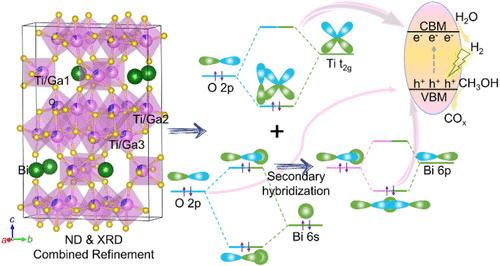
Photocatalytic water splitting and CO2 reduction offer sustainable solutions to energy and environmental issues, but efficient semiconductor photocatalysts are still limited. Oxide photocatalysts with d0 and/or d10 metals often have wide bandgaps, and incorporating d10ns2 metals can raise the valence band maximum (VBM) and narrow the bandgap. Here, we synthesized BiTi4GaO11 (BTGO), a new photocatalyst containing d106s2, d0, and d10 metals. Structural analysis via powder X-ray and neutron diffraction confirmed BTGO crystallizes in the space group Cmcm, with Ga cooccupying all three Ti sites. Density functional theory calculations revealed that the conduction band minimum (CBM) of BTGO is primarily composed of Ti t2g - O 2p antibonding orbitals. Hybridization between Bi 6s and O 2p orbitals leads to the formation of antibonding orbitals, which further interact with Bi 6p orbitals to form the VBM. This interaction shifts the VBM upward, narrows the bandgap (Eg = 2.82 eV), and enables the visible-light absorption. Experimental results demonstrated that BTGO efficiently catalyzes photocatalytic H2 production and CO2 reduction. Furthermore, the incorporation of cocatalysts suppressed the recombination of photogenerated charge carriers, enhancing photocatalytic activity. This work highlights the importance of electronic structure and bonding analysis in understanding the fundamental mechanisms of photocatalysis.
期刊介绍:
Inorganic Chemistry publishes fundamental studies in all phases of inorganic chemistry. Coverage includes experimental and theoretical reports on quantitative studies of structure and thermodynamics, kinetics, mechanisms of inorganic reactions, bioinorganic chemistry, and relevant aspects of organometallic chemistry, solid-state phenomena, and chemical bonding theory. Emphasis is placed on the synthesis, structure, thermodynamics, reactivity, spectroscopy, and bonding properties of significant new and known compounds.



 京公网安备 11010802042870号
京ICP备2023020795号-1
京公网安备 11010802042870号
京ICP备2023020795号-1

 分享
分享
 求助内容:
求助内容: 应助结果提醒方式:
 扫码关注我们
