Lei He, Peng Cao, Zi-Ning Zhou, Ya-Wen Yang, Le-Qi Chen, Qiong Ye
{"title":"Alkali Metal Substitution for Modulating Three-Dimensional Halide Double Perovskite Ferroelectric","authors":"Lei He, Peng Cao, Zi-Ning Zhou, Ya-Wen Yang, Le-Qi Chen, Qiong Ye","doi":"10.1021/acs.inorgchem.5c01211","DOIUrl":null,"url":null,"abstract":"Organic–inorganic hybrid halide double perovskites have garnered significant attention because of their broad utility in data storage, transducers, and signal processing. However, halide double perovskites incorporating alkali metal components with ferroelectricity are still relatively scarce. Herein, we utilize the alkali metal substitution strategy to fabricate a new homochiral K/Bi-based halide double perovskite ferroelectric, (<i>S</i>-3-hydroxypyrrolidinium)<sub>2</sub>KBiBr<sub>6</sub> (<b>1</b>). Compound <b>1</b> forms a three-dimensional (3D) inorganic framework and features a lon topology characterized by a Schläfli symbol of 6<sup>6</sup>. The sp<sup>3</sup> O atoms from the organic cations coordinate with the alkali metal K atoms, forming the twist dodecahedron and creating a large distortion in the inorganic framework. Structural analysis reveals <b>1</b> undergoes two phase transitions at 357 and 420 K. Symmetry-breaking with the 2<i>F</i>1 structural species leads to the emergence of ferroelasticity and ferroelectricity. <b>1</b> possesses clear ferroelectricity with a remnant polarization (<i>P</i><sub>r</sub>) value of 1.86 μC cm<sup>–2</sup> and a low coercive field (<i>E</i><sub>c</sub>) value of 1.4 kV cm<sup>–1</sup>. Interestingly, the <i>P</i><sub>r</sub> value remains nearly unchanged, while the <i>E</i><sub>c</sub> value decreases by 17.6% after the alkali metal substitution. This work enlarges the family of hybrid bimetal halides containing alkali metals and provides new insights for exploring stable multifunctional ferroelectric materials.","PeriodicalId":40,"journal":{"name":"Inorganic Chemistry","volume":"22 1","pages":""},"PeriodicalIF":4.7000,"publicationDate":"2025-04-15","publicationTypes":"Journal Article","fieldsOfStudy":null,"isOpenAccess":false,"openAccessPdf":"","citationCount":"0","resultStr":null,"platform":"Semanticscholar","paperid":null,"PeriodicalName":"Inorganic Chemistry","FirstCategoryId":"92","ListUrlMain":"https://doi.org/10.1021/acs.inorgchem.5c01211","RegionNum":2,"RegionCategory":"化学","ArticlePicture":[],"TitleCN":null,"AbstractTextCN":null,"PMCID":null,"EPubDate":"","PubModel":"","JCR":"Q1","JCRName":"CHEMISTRY, INORGANIC & NUCLEAR","Score":null,"Total":0}
引用次数: 0
Abstract
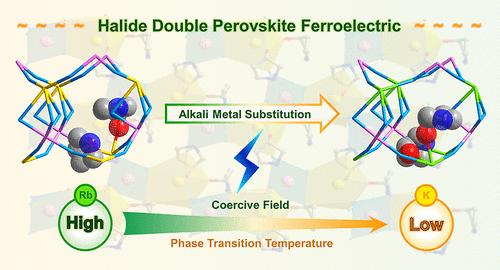
Organic–inorganic hybrid halide double perovskites have garnered significant attention because of their broad utility in data storage, transducers, and signal processing. However, halide double perovskites incorporating alkali metal components with ferroelectricity are still relatively scarce. Herein, we utilize the alkali metal substitution strategy to fabricate a new homochiral K/Bi-based halide double perovskite ferroelectric, (S-3-hydroxypyrrolidinium)2KBiBr6 (1). Compound 1 forms a three-dimensional (3D) inorganic framework and features a lon topology characterized by a Schläfli symbol of 66. The sp3 O atoms from the organic cations coordinate with the alkali metal K atoms, forming the twist dodecahedron and creating a large distortion in the inorganic framework. Structural analysis reveals 1 undergoes two phase transitions at 357 and 420 K. Symmetry-breaking with the 2F1 structural species leads to the emergence of ferroelasticity and ferroelectricity. 1 possesses clear ferroelectricity with a remnant polarization (Pr) value of 1.86 μC cm–2 and a low coercive field (Ec) value of 1.4 kV cm–1. Interestingly, the Pr value remains nearly unchanged, while the Ec value decreases by 17.6% after the alkali metal substitution. This work enlarges the family of hybrid bimetal halides containing alkali metals and provides new insights for exploring stable multifunctional ferroelectric materials.
期刊介绍:
Inorganic Chemistry publishes fundamental studies in all phases of inorganic chemistry. Coverage includes experimental and theoretical reports on quantitative studies of structure and thermodynamics, kinetics, mechanisms of inorganic reactions, bioinorganic chemistry, and relevant aspects of organometallic chemistry, solid-state phenomena, and chemical bonding theory. Emphasis is placed on the synthesis, structure, thermodynamics, reactivity, spectroscopy, and bonding properties of significant new and known compounds.



 京公网安备 11010802042870号
京ICP备2023020795号-1
京公网安备 11010802042870号
京ICP备2023020795号-1

 分享
分享
 求助内容:
求助内容: 应助结果提醒方式:
 扫码关注我们
