Aline de Souza Bozzi, Rita de Cássia Oliveira Sebastião and Willian Ricardo Rocha
{"title":"Understanding the excited state decay mechanism of complex systems: a general first-order kinetic model†","authors":"Aline de Souza Bozzi, Rita de Cássia Oliveira Sebastião and Willian Ricardo Rocha","doi":"10.1039/D5CP00606F","DOIUrl":null,"url":null,"abstract":"<p >In this work, we have proposed and evaluated a first-order kinetic model to describe the excited-states dynamics of molecules as a computationally cheaper alternative to describe and understand the photophysical profile of large systems. The method is based on calculating the radiative and nonradiative rate constants of all photophysical processes of a collection of crucial low-lying excited states and modeling the decay over time using a first-order kinetic model. We have successfully applied the method to the [Ru(bpz)<small><sub>3</sub></small>]<small><sup>2+</sup></small> (bpz = 2,2′-bipyrazyl) complex as a case study, obtaining good results. By employing this first-order kinetic model, it is possible to simulate the time-dependent decay process and the evolution of the excited-state population, revealing not only the primary deactivation pathway but also secondary states that contribute to the overall decay mechanism, highlighting alternative channels that may lead to photochemical side products. This approach provides a computationally efficient yet accurate method for studying more intricate systems relevant to photoinduced processes. It enhances the understanding of these compounds and offers guidance for fine-tuning their chemical and structural properties for targeted applications.</p>","PeriodicalId":99,"journal":{"name":"Physical Chemistry Chemical Physics","volume":" 18","pages":" 9806-9816"},"PeriodicalIF":2.9000,"publicationDate":"2025-04-15","publicationTypes":"Journal Article","fieldsOfStudy":null,"isOpenAccess":false,"openAccessPdf":"","citationCount":"0","resultStr":null,"platform":"Semanticscholar","paperid":null,"PeriodicalName":"Physical Chemistry Chemical Physics","FirstCategoryId":"92","ListUrlMain":"https://pubs.rsc.org/en/content/articlelanding/2025/cp/d5cp00606f","RegionNum":3,"RegionCategory":"化学","ArticlePicture":[],"TitleCN":null,"AbstractTextCN":null,"PMCID":null,"EPubDate":"","PubModel":"","JCR":"Q3","JCRName":"CHEMISTRY, PHYSICAL","Score":null,"Total":0}
引用次数: 0
Abstract
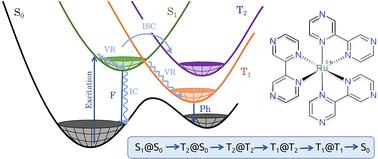
In this work, we have proposed and evaluated a first-order kinetic model to describe the excited-states dynamics of molecules as a computationally cheaper alternative to describe and understand the photophysical profile of large systems. The method is based on calculating the radiative and nonradiative rate constants of all photophysical processes of a collection of crucial low-lying excited states and modeling the decay over time using a first-order kinetic model. We have successfully applied the method to the [Ru(bpz)3]2+ (bpz = 2,2′-bipyrazyl) complex as a case study, obtaining good results. By employing this first-order kinetic model, it is possible to simulate the time-dependent decay process and the evolution of the excited-state population, revealing not only the primary deactivation pathway but also secondary states that contribute to the overall decay mechanism, highlighting alternative channels that may lead to photochemical side products. This approach provides a computationally efficient yet accurate method for studying more intricate systems relevant to photoinduced processes. It enhances the understanding of these compounds and offers guidance for fine-tuning their chemical and structural properties for targeted applications.
期刊介绍:
Physical Chemistry Chemical Physics (PCCP) is an international journal co-owned by 19 physical chemistry and physics societies from around the world. This journal publishes original, cutting-edge research in physical chemistry, chemical physics and biophysical chemistry. To be suitable for publication in PCCP, articles must include significant innovation and/or insight into physical chemistry; this is the most important criterion that reviewers and Editors will judge against when evaluating submissions.
The journal has a broad scope and welcomes contributions spanning experiment, theory, computation and data science. Topical coverage includes spectroscopy, dynamics, kinetics, statistical mechanics, thermodynamics, electrochemistry, catalysis, surface science, quantum mechanics, quantum computing and machine learning. Interdisciplinary research areas such as polymers and soft matter, materials, nanoscience, energy, surfaces/interfaces, and biophysical chemistry are welcomed if they demonstrate significant innovation and/or insight into physical chemistry. Joined experimental/theoretical studies are particularly appreciated when complementary and based on up-to-date approaches.




 京公网安备 11010802042870号
京ICP备2023020795号-1
京公网安备 11010802042870号
京ICP备2023020795号-1

 分享
分享
 求助内容:
求助内容: 应助结果提醒方式:
 扫码关注我们
