Exploring the Charge Dynamics in a Synergistically Modified BiVO4 Photoanode with La Doping and Cobalt-Based Phytate Compound Cocatalyst for Photoelectrochemical Water Oxidation
Tao Zhang, Huiqing Wu, Naihan Li, Chen Li, Zhiqiang Wang, Guanghui Liu, Song Xu, Meng Wei, Jinzhan Su, Jiehu Cui
{"title":"Exploring the Charge Dynamics in a Synergistically Modified BiVO4 Photoanode with La Doping and Cobalt-Based Phytate Compound Cocatalyst for Photoelectrochemical Water Oxidation","authors":"Tao Zhang, Huiqing Wu, Naihan Li, Chen Li, Zhiqiang Wang, Guanghui Liu, Song Xu, Meng Wei, Jinzhan Su, Jiehu Cui","doi":"10.1021/acs.inorgchem.5c00587","DOIUrl":null,"url":null,"abstract":"Bismuth vanadate (BiVO<sub>4</sub>) is a potential photoelectrode for photoelectrochemical (PEC) applications. Nevertheless, the rapid charge recombination and sluggish water oxidation kinetics greatly limit the PEC activity. To address these drawbacks, this study developed a cooperative modification strategy with simultaneous La doping and amorphous cobalt-phytate compound (Co-phy) as a cocatalyst on BiVO<sub>4</sub> to raise the PEC performance. La doping increased the donor density, and the decoration of the Co-phy cocatalyst expedited water oxidation kinetics and further improved the utilization efficiency of charge carriers. As a result, the constructed hybrid photoelectrode (La-BVO/Co-phy) generated a photocurrent of 2.12 mA·cm<sup>–2</sup> at 1.23 V vs RHE, about 4.8 times that of the pristine BiVO<sub>4</sub> photoelectrode (0.44 mA·cm<sup>–2</sup>). Moreover, a significant reduction in onset potential and prominent improvement in conversion efficiency, stability, and charge separation efficiency were achieved for the synergistically modified photoanode. Furthermore, a profound exploration on the charge dynamics disclosed increased carrier density, decreased charge recombination, and enhanced charge transfer kinetics as a consequence of the synchronized effect of La doping and Co-phy cocatalyst, which greatly contributed to the elevated PEC activity. This work introduces a practical route to fabricating BiVO<sub>4</sub>-based photoelectrodes for solar water splitting applications.","PeriodicalId":40,"journal":{"name":"Inorganic Chemistry","volume":"121 1","pages":""},"PeriodicalIF":4.7000,"publicationDate":"2025-04-16","publicationTypes":"Journal Article","fieldsOfStudy":null,"isOpenAccess":false,"openAccessPdf":"","citationCount":"0","resultStr":null,"platform":"Semanticscholar","paperid":null,"PeriodicalName":"Inorganic Chemistry","FirstCategoryId":"92","ListUrlMain":"https://doi.org/10.1021/acs.inorgchem.5c00587","RegionNum":2,"RegionCategory":"化学","ArticlePicture":[],"TitleCN":null,"AbstractTextCN":null,"PMCID":null,"EPubDate":"","PubModel":"","JCR":"Q1","JCRName":"CHEMISTRY, INORGANIC & NUCLEAR","Score":null,"Total":0}
引用次数: 0
Abstract
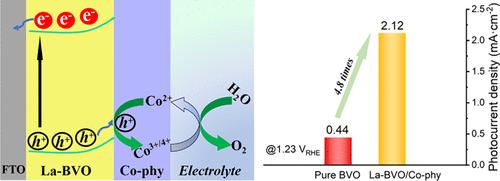
Bismuth vanadate (BiVO4) is a potential photoelectrode for photoelectrochemical (PEC) applications. Nevertheless, the rapid charge recombination and sluggish water oxidation kinetics greatly limit the PEC activity. To address these drawbacks, this study developed a cooperative modification strategy with simultaneous La doping and amorphous cobalt-phytate compound (Co-phy) as a cocatalyst on BiVO4 to raise the PEC performance. La doping increased the donor density, and the decoration of the Co-phy cocatalyst expedited water oxidation kinetics and further improved the utilization efficiency of charge carriers. As a result, the constructed hybrid photoelectrode (La-BVO/Co-phy) generated a photocurrent of 2.12 mA·cm–2 at 1.23 V vs RHE, about 4.8 times that of the pristine BiVO4 photoelectrode (0.44 mA·cm–2). Moreover, a significant reduction in onset potential and prominent improvement in conversion efficiency, stability, and charge separation efficiency were achieved for the synergistically modified photoanode. Furthermore, a profound exploration on the charge dynamics disclosed increased carrier density, decreased charge recombination, and enhanced charge transfer kinetics as a consequence of the synchronized effect of La doping and Co-phy cocatalyst, which greatly contributed to the elevated PEC activity. This work introduces a practical route to fabricating BiVO4-based photoelectrodes for solar water splitting applications.
钒酸铋(BiVO4)是一种潜在的光电化学(PEC)光电极。然而,快速的电荷重组和缓慢的水氧化动力学极大地限制了PEC的活性。为了解决这些问题,本研究开发了一种同时掺杂La和无定形钴-植酸化合物(Co-phy)作为BiVO4助催化剂的协同改性策略,以提高其PEC性能。La掺杂增加了给体密度,Co-phy助催化剂的修饰加速了水氧化动力学,进一步提高了载流子的利用效率。结果表明,复合光电极(La-BVO/Co-phy)在1.23 V vs RHE下产生的光电流为2.12 mA·cm-2,约为原始BiVO4光电极(0.44 mA·cm-2)的4.8倍。此外,协同修饰的光阳极显著降低了起始电位,显著提高了转换效率、稳定性和电荷分离效率。此外,对电荷动力学的深入研究表明,La掺杂和Co-phy助催化剂的同步作用增加了载流子密度,减少了电荷重组,增强了电荷转移动力学,这是PEC活性提高的重要原因。这项工作介绍了一种实用的途径来制造基于bivo4的光电极,用于太阳能水分解应用。
期刊介绍:
Inorganic Chemistry publishes fundamental studies in all phases of inorganic chemistry. Coverage includes experimental and theoretical reports on quantitative studies of structure and thermodynamics, kinetics, mechanisms of inorganic reactions, bioinorganic chemistry, and relevant aspects of organometallic chemistry, solid-state phenomena, and chemical bonding theory. Emphasis is placed on the synthesis, structure, thermodynamics, reactivity, spectroscopy, and bonding properties of significant new and known compounds.



 京公网安备 11010802042870号
京ICP备2023020795号-1
京公网安备 11010802042870号
京ICP备2023020795号-1

 分享
分享
 求助内容:
求助内容: 应助结果提醒方式:
 扫码关注我们
