{"title":"Hybrid moiré excitons in a strained heterobilayer of transition metal dichalcogenides","authors":"Houssem Eddine Hannachi and Sihem Jaziri","doi":"10.1039/D4CP04759A","DOIUrl":null,"url":null,"abstract":"<p >In this paper, we theoretically investigate the effects of twist and heterostrain on moiré excitons in the MoSe<small><sub>2</sub></small>/WSe<small><sub>2</sub></small> heterobilayer. Using a continuum model, we analyze the band structures and wavefunction distributions of moiré excitons, photoluminescence spectra, and the hybridization between interlayer and intralayer moiré excitons. Our key findings reveal that the three-fold rotational symmetry breaking induced by heterostrain leads to significant tunability of the exciton band structure, thereby modifying the distribution of bright-state energies around the light cone. Moreover, tuning the strain magnitude and direction can enhance the brightness of moiré excitons, highlighting the crucial role of strain orientation in excitonic optical modulator applications. Furthermore, the interplay between twist and strain induces a high degree of tunability in the mixing of interlayer and intralayer exciton wavefunctions. Remarkably, under specific strain magnitudes and directions—such as normal compressive strain—we observe the emergence of a topological moiré exciton Chern insulator, characterized by protected edge modes. Our results may pave the way for exploring novel topological exciton phenomena and moiré exciton-correlated physics. They are particularly intriguing for potential device applications with the excitonic quantum anomalous Hall effect (EQAHE) enabled by the combined effects of strain and twist.</p>","PeriodicalId":99,"journal":{"name":"Physical Chemistry Chemical Physics","volume":" 19","pages":" 10235-10247"},"PeriodicalIF":2.9000,"publicationDate":"2025-04-15","publicationTypes":"Journal Article","fieldsOfStudy":null,"isOpenAccess":false,"openAccessPdf":"","citationCount":"0","resultStr":null,"platform":"Semanticscholar","paperid":null,"PeriodicalName":"Physical Chemistry Chemical Physics","FirstCategoryId":"92","ListUrlMain":"https://pubs.rsc.org/en/content/articlelanding/2025/cp/d4cp04759a","RegionNum":3,"RegionCategory":"化学","ArticlePicture":[],"TitleCN":null,"AbstractTextCN":null,"PMCID":null,"EPubDate":"","PubModel":"","JCR":"Q3","JCRName":"CHEMISTRY, PHYSICAL","Score":null,"Total":0}
引用次数: 0
Abstract
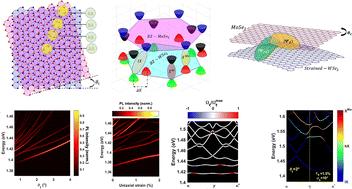
In this paper, we theoretically investigate the effects of twist and heterostrain on moiré excitons in the MoSe2/WSe2 heterobilayer. Using a continuum model, we analyze the band structures and wavefunction distributions of moiré excitons, photoluminescence spectra, and the hybridization between interlayer and intralayer moiré excitons. Our key findings reveal that the three-fold rotational symmetry breaking induced by heterostrain leads to significant tunability of the exciton band structure, thereby modifying the distribution of bright-state energies around the light cone. Moreover, tuning the strain magnitude and direction can enhance the brightness of moiré excitons, highlighting the crucial role of strain orientation in excitonic optical modulator applications. Furthermore, the interplay between twist and strain induces a high degree of tunability in the mixing of interlayer and intralayer exciton wavefunctions. Remarkably, under specific strain magnitudes and directions—such as normal compressive strain—we observe the emergence of a topological moiré exciton Chern insulator, characterized by protected edge modes. Our results may pave the way for exploring novel topological exciton phenomena and moiré exciton-correlated physics. They are particularly intriguing for potential device applications with the excitonic quantum anomalous Hall effect (EQAHE) enabled by the combined effects of strain and twist.
期刊介绍:
Physical Chemistry Chemical Physics (PCCP) is an international journal co-owned by 19 physical chemistry and physics societies from around the world. This journal publishes original, cutting-edge research in physical chemistry, chemical physics and biophysical chemistry. To be suitable for publication in PCCP, articles must include significant innovation and/or insight into physical chemistry; this is the most important criterion that reviewers and Editors will judge against when evaluating submissions.
The journal has a broad scope and welcomes contributions spanning experiment, theory, computation and data science. Topical coverage includes spectroscopy, dynamics, kinetics, statistical mechanics, thermodynamics, electrochemistry, catalysis, surface science, quantum mechanics, quantum computing and machine learning. Interdisciplinary research areas such as polymers and soft matter, materials, nanoscience, energy, surfaces/interfaces, and biophysical chemistry are welcomed if they demonstrate significant innovation and/or insight into physical chemistry. Joined experimental/theoretical studies are particularly appreciated when complementary and based on up-to-date approaches.




 京公网安备 11010802042870号
京ICP备2023020795号-1
京公网安备 11010802042870号
京ICP备2023020795号-1

 分享
分享
 求助内容:
求助内容: 应助结果提醒方式:
 扫码关注我们
