Amanda R. Bubas, Amanda D. French, Kali M. Melby, Michael J. Rodriguez and Richard M Cox
{"title":"An inductively coupled plasma tandem mass spectrometry investigation of the activation of methane by lanthanide cations","authors":"Amanda R. Bubas, Amanda D. French, Kali M. Melby, Michael J. Rodriguez and Richard M Cox","doi":"10.1039/D5CP00343A","DOIUrl":null,"url":null,"abstract":"<p >The activation of C–H and C–C bonds by atomic metal cations remains a profitable area of research to utilize environmentally abundant methane and produce useful hydrocarbon fuel. Although methane activation by transition metal cations has been the focus of catalysis research for decades, less is known about the catalytic capabilities of lanthanide cations. Here we employ inductively coupled plasma tandem mass spectrometry to examine the kinetic energy dependences of the reactions of lanthanide cations Ce<small><sup>+</sup></small>, Pr<small><sup>+</sup></small>, Nd<small><sup>+</sup></small>, Sm<small><sup>+</sup></small>, and Eu<small><sup>+</sup></small> with methane. The resulting energy-dependent reaction cross sections enable a measurement of the reaction thermochemistry and provide fundamental insight into the physical characteristics that enable Ln<small><sup>+</sup></small> reactivity. We report values for the Ln<small><sup>+</sup></small>–D bond dissociation energies, <em>D</em><small><sub>0</sub></small>(Ln<small><sup>+</sup></small>–D), and the first experimentally obtained values for <em>D</em><small><sub>0</sub></small>(Ln<small><sup>+</sup></small>–CD<small><sub>3</sub></small>) and <em>D</em><small><sub>0</sub></small>(Ln<small><sup>+</sup></small>–CD). We find that the observed reaction efficiencies correlate to the promotion energies (<em>E</em><small><sub>p</sub></small>) from the Ln<small><sup>+</sup></small> ground state electronic configurations to the 5d<small><sup>2</sup></small> or 5d6s electronic configuration. This indicates that the Ln<small><sup>+</sup></small> requires an electron configuration with two unpaired valence electrons in non-f orbitals to effectively insert into C–H bonds.</p>","PeriodicalId":99,"journal":{"name":"Physical Chemistry Chemical Physics","volume":" 18","pages":" 9781-9793"},"PeriodicalIF":2.9000,"publicationDate":"2025-04-16","publicationTypes":"Journal Article","fieldsOfStudy":null,"isOpenAccess":false,"openAccessPdf":"https://pubs.rsc.org/en/content/articlepdf/2025/cp/d5cp00343a?page=search","citationCount":"0","resultStr":null,"platform":"Semanticscholar","paperid":null,"PeriodicalName":"Physical Chemistry Chemical Physics","FirstCategoryId":"92","ListUrlMain":"https://pubs.rsc.org/en/content/articlelanding/2025/cp/d5cp00343a","RegionNum":3,"RegionCategory":"化学","ArticlePicture":[],"TitleCN":null,"AbstractTextCN":null,"PMCID":null,"EPubDate":"","PubModel":"","JCR":"Q3","JCRName":"CHEMISTRY, PHYSICAL","Score":null,"Total":0}
引用次数: 0
Abstract
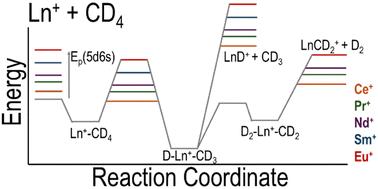
The activation of C–H and C–C bonds by atomic metal cations remains a profitable area of research to utilize environmentally abundant methane and produce useful hydrocarbon fuel. Although methane activation by transition metal cations has been the focus of catalysis research for decades, less is known about the catalytic capabilities of lanthanide cations. Here we employ inductively coupled plasma tandem mass spectrometry to examine the kinetic energy dependences of the reactions of lanthanide cations Ce+, Pr+, Nd+, Sm+, and Eu+ with methane. The resulting energy-dependent reaction cross sections enable a measurement of the reaction thermochemistry and provide fundamental insight into the physical characteristics that enable Ln+ reactivity. We report values for the Ln+–D bond dissociation energies, D0(Ln+–D), and the first experimentally obtained values for D0(Ln+–CD3) and D0(Ln+–CD). We find that the observed reaction efficiencies correlate to the promotion energies (Ep) from the Ln+ ground state electronic configurations to the 5d2 or 5d6s electronic configuration. This indicates that the Ln+ requires an electron configuration with two unpaired valence electrons in non-f orbitals to effectively insert into C–H bonds.
期刊介绍:
Physical Chemistry Chemical Physics (PCCP) is an international journal co-owned by 19 physical chemistry and physics societies from around the world. This journal publishes original, cutting-edge research in physical chemistry, chemical physics and biophysical chemistry. To be suitable for publication in PCCP, articles must include significant innovation and/or insight into physical chemistry; this is the most important criterion that reviewers and Editors will judge against when evaluating submissions.
The journal has a broad scope and welcomes contributions spanning experiment, theory, computation and data science. Topical coverage includes spectroscopy, dynamics, kinetics, statistical mechanics, thermodynamics, electrochemistry, catalysis, surface science, quantum mechanics, quantum computing and machine learning. Interdisciplinary research areas such as polymers and soft matter, materials, nanoscience, energy, surfaces/interfaces, and biophysical chemistry are welcomed if they demonstrate significant innovation and/or insight into physical chemistry. Joined experimental/theoretical studies are particularly appreciated when complementary and based on up-to-date approaches.




 京公网安备 11010802042870号
京ICP备2023020795号-1
京公网安备 11010802042870号
京ICP备2023020795号-1

 分享
分享
 求助内容:
求助内容: 应助结果提醒方式:
 扫码关注我们
