{"title":"Collision-induced dissociation mass spectra of Na+-tagged aldohexoses simulated from first-principles calculations†","authors":"Hai Thi Huynh, Jer-Lai Kuo and Cheng-chau Chiu","doi":"10.1039/D5CP00579E","DOIUrl":null,"url":null,"abstract":"<p >Understanding the dissociation pattern of saccharides is key to establishing mass spectrometry-based methods as routine methods for identifying oligosaccharides. This work uses energetics at MP2/6-311+G(d,p) level of theory to set up a micro-kinetic model that aims at simulating the processes in collision-induced dissociation mass spectrometry of Na<small><sup>+</sup></small>-tagged glucose, mannose, and galactose. The product concentrations obtained from the simulation can be converted to mass spectra signals, which allow a direct comparison with the experiment. One crucial aspect of this work is the treatment of the system's temperature. In the experiment, the energy for overcoming the barriers of the dissociation processes comes from the activation process, in which the parent ion is brought to collision with neutral gas atoms/molecules. To match this situation, we have assumed that the system's temperature increases linearly and considered different temperature gradients. It could be shown that the temperature gradient only has a negligible impact on the final product distribution and relative signal intensities. All dissociation processes of the considered monosaccharides are finished when the system reaches a temperature between 600 K and 700 K. As the dehydration processes are favored by entropy only at high temperatures >1000 K, the intensities of the dehydration signals seem to be generally underestimated by our calculations. Nevertheless, our model predicts most trends in the signal intensities to be qualitatively correct, including the signal intensity ratio between the dehydration and the so-called cross-ring dissociation channels.</p>","PeriodicalId":99,"journal":{"name":"Physical Chemistry Chemical Physics","volume":" 18","pages":" 9721-9731"},"PeriodicalIF":2.9000,"publicationDate":"2025-04-16","publicationTypes":"Journal Article","fieldsOfStudy":null,"isOpenAccess":false,"openAccessPdf":"","citationCount":"0","resultStr":null,"platform":"Semanticscholar","paperid":null,"PeriodicalName":"Physical Chemistry Chemical Physics","FirstCategoryId":"92","ListUrlMain":"https://pubs.rsc.org/en/content/articlelanding/2025/cp/d5cp00579e","RegionNum":3,"RegionCategory":"化学","ArticlePicture":[],"TitleCN":null,"AbstractTextCN":null,"PMCID":null,"EPubDate":"","PubModel":"","JCR":"Q3","JCRName":"CHEMISTRY, PHYSICAL","Score":null,"Total":0}
引用次数: 0
Abstract
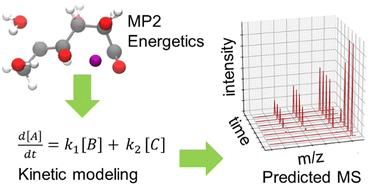
Understanding the dissociation pattern of saccharides is key to establishing mass spectrometry-based methods as routine methods for identifying oligosaccharides. This work uses energetics at MP2/6-311+G(d,p) level of theory to set up a micro-kinetic model that aims at simulating the processes in collision-induced dissociation mass spectrometry of Na+-tagged glucose, mannose, and galactose. The product concentrations obtained from the simulation can be converted to mass spectra signals, which allow a direct comparison with the experiment. One crucial aspect of this work is the treatment of the system's temperature. In the experiment, the energy for overcoming the barriers of the dissociation processes comes from the activation process, in which the parent ion is brought to collision with neutral gas atoms/molecules. To match this situation, we have assumed that the system's temperature increases linearly and considered different temperature gradients. It could be shown that the temperature gradient only has a negligible impact on the final product distribution and relative signal intensities. All dissociation processes of the considered monosaccharides are finished when the system reaches a temperature between 600 K and 700 K. As the dehydration processes are favored by entropy only at high temperatures >1000 K, the intensities of the dehydration signals seem to be generally underestimated by our calculations. Nevertheless, our model predicts most trends in the signal intensities to be qualitatively correct, including the signal intensity ratio between the dehydration and the so-called cross-ring dissociation channels.
期刊介绍:
Physical Chemistry Chemical Physics (PCCP) is an international journal co-owned by 19 physical chemistry and physics societies from around the world. This journal publishes original, cutting-edge research in physical chemistry, chemical physics and biophysical chemistry. To be suitable for publication in PCCP, articles must include significant innovation and/or insight into physical chemistry; this is the most important criterion that reviewers and Editors will judge against when evaluating submissions.
The journal has a broad scope and welcomes contributions spanning experiment, theory, computation and data science. Topical coverage includes spectroscopy, dynamics, kinetics, statistical mechanics, thermodynamics, electrochemistry, catalysis, surface science, quantum mechanics, quantum computing and machine learning. Interdisciplinary research areas such as polymers and soft matter, materials, nanoscience, energy, surfaces/interfaces, and biophysical chemistry are welcomed if they demonstrate significant innovation and/or insight into physical chemistry. Joined experimental/theoretical studies are particularly appreciated when complementary and based on up-to-date approaches.




 京公网安备 11010802042870号
京ICP备2023020795号-1
京公网安备 11010802042870号
京ICP备2023020795号-1

 分享
分享
 求助内容:
求助内容: 应助结果提醒方式:
 扫码关注我们
