Dan He, Linwei Xie, Yahui Bai, Xingxing Shen, Xiangxi Wu, Jianqi Zhang, Xiaojun Li, Yongfang Li and Fuwen Zhao
{"title":"19.35%-Efficiency organic solar cells and reduced non-radiative recombination energy loss by a ternary copolymerization strategy†","authors":"Dan He, Linwei Xie, Yahui Bai, Xingxing Shen, Xiangxi Wu, Jianqi Zhang, Xiaojun Li, Yongfang Li and Fuwen Zhao","doi":"10.1039/D5TC00024F","DOIUrl":null,"url":null,"abstract":"<p >The low open-circuit voltage (<em>V</em><small><sub>OC</sub></small>) imposed by the large energy loss, especially non-radiative recombination energy loss (Δ<em>E</em><small><sub>nr</sub></small>), accounts for the behindhand power conversion efficiency (PCE) of organic solar cells (OSCs), compared to those of silicon/perovskite solar cells. Hence, it is vital to reduce Δ<em>E</em><small><sub>nr</sub></small> to remedy the gap and further improve the PCEs. Herein, two terpolymer donors, DQ20 and DQ40, are developed <em>via</em> introducing a dimethyl dithieno[3,2-<em>f</em>:2′,3′-<em>h</em>]quinoxaline-2,3-dicarboxylate unit (TQC) into the backbone of D18 in consideration of the features of TQC. The introduction of TQC endows DQ20 and DQ40 with down-shifted energy levels and improved miscibility with the electron acceptor, L8-BO. As a result, the <em>V</em><small><sub>OC</sub></small> increases from D18:L8-BO (0.895 V) to DQ20:L8-BO (0.906 V) to DQ40:L8-BO (0.920 V)-based OSCs, mainly ascribed to the gradually decreased Δ<em>E</em><small><sub>nr</sub></small>. Moreover, the DQ20:L8-BO blend film exhibits fine phase separation with ordered molecular stacking, and thus achieves the highest charge carrier mobility and weakest charge recombination in devices for the best <em>J</em><small><sub>SC</sub></small> (27.11 mA cm<small><sup>−2</sup></small>) and FF (78.73%). Consequently, DQ20:L8-BO based OSCs afford a higher PCE of 19.35%, compared with D18:L8-BO and DQ40:L8-BO counterparts. This work demonstrates that ternary copolymerization is an effective strategy to realize suppressed Δ<em>E</em><small><sub>nr</sub></small> and high efficiency <em>via</em> finely tuning the energy level offset and miscibility between the donor and acceptor.</p>","PeriodicalId":84,"journal":{"name":"Journal of Materials Chemistry C","volume":" 16","pages":" 7957-7962"},"PeriodicalIF":5.1000,"publicationDate":"2025-03-05","publicationTypes":"Journal Article","fieldsOfStudy":null,"isOpenAccess":false,"openAccessPdf":"","citationCount":"0","resultStr":null,"platform":"Semanticscholar","paperid":null,"PeriodicalName":"Journal of Materials Chemistry C","FirstCategoryId":"1","ListUrlMain":"https://pubs.rsc.org/en/content/articlelanding/2025/tc/d5tc00024f","RegionNum":2,"RegionCategory":"材料科学","ArticlePicture":[],"TitleCN":null,"AbstractTextCN":null,"PMCID":null,"EPubDate":"","PubModel":"","JCR":"Q2","JCRName":"MATERIALS SCIENCE, MULTIDISCIPLINARY","Score":null,"Total":0}
引用次数: 0
Abstract
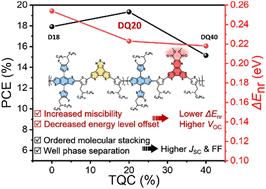
The low open-circuit voltage (VOC) imposed by the large energy loss, especially non-radiative recombination energy loss (ΔEnr), accounts for the behindhand power conversion efficiency (PCE) of organic solar cells (OSCs), compared to those of silicon/perovskite solar cells. Hence, it is vital to reduce ΔEnr to remedy the gap and further improve the PCEs. Herein, two terpolymer donors, DQ20 and DQ40, are developed via introducing a dimethyl dithieno[3,2-f:2′,3′-h]quinoxaline-2,3-dicarboxylate unit (TQC) into the backbone of D18 in consideration of the features of TQC. The introduction of TQC endows DQ20 and DQ40 with down-shifted energy levels and improved miscibility with the electron acceptor, L8-BO. As a result, the VOC increases from D18:L8-BO (0.895 V) to DQ20:L8-BO (0.906 V) to DQ40:L8-BO (0.920 V)-based OSCs, mainly ascribed to the gradually decreased ΔEnr. Moreover, the DQ20:L8-BO blend film exhibits fine phase separation with ordered molecular stacking, and thus achieves the highest charge carrier mobility and weakest charge recombination in devices for the best JSC (27.11 mA cm−2) and FF (78.73%). Consequently, DQ20:L8-BO based OSCs afford a higher PCE of 19.35%, compared with D18:L8-BO and DQ40:L8-BO counterparts. This work demonstrates that ternary copolymerization is an effective strategy to realize suppressed ΔEnr and high efficiency via finely tuning the energy level offset and miscibility between the donor and acceptor.
期刊介绍:
The Journal of Materials Chemistry is divided into three distinct sections, A, B, and C, each catering to specific applications of the materials under study:
Journal of Materials Chemistry A focuses primarily on materials intended for applications in energy and sustainability.
Journal of Materials Chemistry B specializes in materials designed for applications in biology and medicine.
Journal of Materials Chemistry C is dedicated to materials suitable for applications in optical, magnetic, and electronic devices.
Example topic areas within the scope of Journal of Materials Chemistry C are listed below. This list is neither exhaustive nor exclusive.
Bioelectronics
Conductors
Detectors
Dielectrics
Displays
Ferroelectrics
Lasers
LEDs
Lighting
Liquid crystals
Memory
Metamaterials
Multiferroics
Photonics
Photovoltaics
Semiconductors
Sensors
Single molecule conductors
Spintronics
Superconductors
Thermoelectrics
Topological insulators
Transistors



 京公网安备 11010802042870号
京ICP备2023020795号-1
京公网安备 11010802042870号
京ICP备2023020795号-1

 分享
分享
 求助内容:
求助内容: 应助结果提醒方式:
 扫码关注我们
