Zesheng Zhang, Lingchen Kong, Chao Liu, Hua Tang, Xinkang Wang, Mingqing Chen, Mei Luo, Lianjie Zhang, Cheng Liu, Xuncheng Liu, Dongge Ma, Christoph J. Brabec and Junwu Chen
{"title":"Highly efficient organic solar cells based on a simple polymer donor derived from a difluorinated benzene-quarterthiophene skeleton†","authors":"Zesheng Zhang, Lingchen Kong, Chao Liu, Hua Tang, Xinkang Wang, Mingqing Chen, Mei Luo, Lianjie Zhang, Cheng Liu, Xuncheng Liu, Dongge Ma, Christoph J. Brabec and Junwu Chen","doi":"10.1039/D5TC00664C","DOIUrl":null,"url":null,"abstract":"<p >Conjugated polymers with simple chemical structures are essential for the commercialization of organic solar cells (OSCs). However, a simplicity-performance dilemma arises, as current design principles often result in an inverse correlation between these two factors, significantly hindering the commercialization of OSCs. In this study, we investigated the impact of fluorine substitution positions on benzene rings within polythiophenes (PTs), leading to two polymers composed of non-fused rings of <em>o</em>-difluorobenzene-quarterthiophene and <em>p</em>-difluorobenzene-quarterthiophene, namely, Po2F and Pp2F. The Po2F/Y6BO devices achieved a remarkable efficiency of 15.45%, with the active layer fabricated <em>via</em> layer-by-layer (LBL) spin coating, significantly surpassing the Pp2F/Y6BO blend (12.14%) and ranking among the top-performing oligothiophene-based OSCs. The enhancement is mainly attributed to improved phase separation, reduced exciton lifetimes, and suppressed mixing compatibility with Y6BO of Po2F, compared to Pp2F. In addition, the simple polymer Po2F demonstrated a much higher figure of merit (FOM) in chemical accessibility than polymers with fused rings, indicating its great potential for cost reduction. Beyond its role as a donor, Po2F also enhanced the efficiency of PM6:L8BO from 17.74% to 19.05% and extended <em>T</em><small><sub>80</sub></small> from 239 to 377 hours when used as an interlayer between the PEDOT:PSS buffer layer and the active layer. This study highlights the significance of a polymer donor-based non-fused ring towards commercially viable OSCs and offers valuable insights for designing high-performance polymers.</p>","PeriodicalId":84,"journal":{"name":"Journal of Materials Chemistry C","volume":" 16","pages":" 7963-7972"},"PeriodicalIF":5.1000,"publicationDate":"2025-03-12","publicationTypes":"Journal Article","fieldsOfStudy":null,"isOpenAccess":false,"openAccessPdf":"","citationCount":"0","resultStr":null,"platform":"Semanticscholar","paperid":null,"PeriodicalName":"Journal of Materials Chemistry C","FirstCategoryId":"1","ListUrlMain":"https://pubs.rsc.org/en/content/articlelanding/2025/tc/d5tc00664c","RegionNum":2,"RegionCategory":"材料科学","ArticlePicture":[],"TitleCN":null,"AbstractTextCN":null,"PMCID":null,"EPubDate":"","PubModel":"","JCR":"Q2","JCRName":"MATERIALS SCIENCE, MULTIDISCIPLINARY","Score":null,"Total":0}
引用次数: 0
Abstract
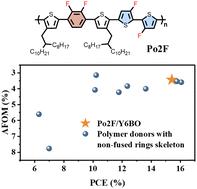
Conjugated polymers with simple chemical structures are essential for the commercialization of organic solar cells (OSCs). However, a simplicity-performance dilemma arises, as current design principles often result in an inverse correlation between these two factors, significantly hindering the commercialization of OSCs. In this study, we investigated the impact of fluorine substitution positions on benzene rings within polythiophenes (PTs), leading to two polymers composed of non-fused rings of o-difluorobenzene-quarterthiophene and p-difluorobenzene-quarterthiophene, namely, Po2F and Pp2F. The Po2F/Y6BO devices achieved a remarkable efficiency of 15.45%, with the active layer fabricated via layer-by-layer (LBL) spin coating, significantly surpassing the Pp2F/Y6BO blend (12.14%) and ranking among the top-performing oligothiophene-based OSCs. The enhancement is mainly attributed to improved phase separation, reduced exciton lifetimes, and suppressed mixing compatibility with Y6BO of Po2F, compared to Pp2F. In addition, the simple polymer Po2F demonstrated a much higher figure of merit (FOM) in chemical accessibility than polymers with fused rings, indicating its great potential for cost reduction. Beyond its role as a donor, Po2F also enhanced the efficiency of PM6:L8BO from 17.74% to 19.05% and extended T80 from 239 to 377 hours when used as an interlayer between the PEDOT:PSS buffer layer and the active layer. This study highlights the significance of a polymer donor-based non-fused ring towards commercially viable OSCs and offers valuable insights for designing high-performance polymers.
期刊介绍:
The Journal of Materials Chemistry is divided into three distinct sections, A, B, and C, each catering to specific applications of the materials under study:
Journal of Materials Chemistry A focuses primarily on materials intended for applications in energy and sustainability.
Journal of Materials Chemistry B specializes in materials designed for applications in biology and medicine.
Journal of Materials Chemistry C is dedicated to materials suitable for applications in optical, magnetic, and electronic devices.
Example topic areas within the scope of Journal of Materials Chemistry C are listed below. This list is neither exhaustive nor exclusive.
Bioelectronics
Conductors
Detectors
Dielectrics
Displays
Ferroelectrics
Lasers
LEDs
Lighting
Liquid crystals
Memory
Metamaterials
Multiferroics
Photonics
Photovoltaics
Semiconductors
Sensors
Single molecule conductors
Spintronics
Superconductors
Thermoelectrics
Topological insulators
Transistors



 京公网安备 11010802042870号
京ICP备2023020795号-1
京公网安备 11010802042870号
京ICP备2023020795号-1

 分享
分享
 求助内容:
求助内容: 应助结果提醒方式:
 扫码关注我们
