Jian Liu, Ying Nie, Xiaolong Zhou, Juanjuan Qi, Dongke Li, Jianqiang Luo and Ke Wang
{"title":"Synaptic plasticity and handwritten digit recognition of a memristor based on a high-stability lead-free Cs3Bi2Br9 perovskite thin film†","authors":"Jian Liu, Ying Nie, Xiaolong Zhou, Juanjuan Qi, Dongke Li, Jianqiang Luo and Ke Wang","doi":"10.1039/D4TC05075D","DOIUrl":null,"url":null,"abstract":"<p >The lead-free Cs<small><sub>3</sub></small>Bi<small><sub>2</sub></small>Br<small><sub>9</sub></small> perovskite has emerged as a promising candidate for memristor and artificial synapse devices due to its high environmental stability and low toxicity compared to lead-based alternatives. In this work, we successfully prepared a high-quality Cs<small><sub>3</sub></small>Bi<small><sub>2</sub></small>Br<small><sub>9</sub></small> perovskite film <em>via</em> a simple spin-coating method combined with low-pressure assisted treatment. Based on the obtained Cs<small><sub>3</sub></small>Bi<small><sub>2</sub></small>Br<small><sub>9</sub></small> film, a memristor with the structure of W/Cs<small><sub>3</sub></small>Bi<small><sub>2</sub></small>Br<small><sub>9</sub></small>/ITO was fabricated. The memristor demonstrated excellent resistive switching performance, including analog-switching behavior, high environmental stability (>11 months), low operating voltages (<em>V</em><small><sub>FORMING</sub></small> ∼ 0.65 V, <em>V</em><small><sub>SET</sub></small> ∼ 0.53 ± 0.08 V, and <em>V</em><small><sub>RESET</sub></small> ∼ −0.83 ± 0.11 V), fast switching speed (<1 μs), and long switching endurance (>1100 cycles). Furthermore, the synaptic plasticity aspects such as short-term plasticity, long-term plasticity, and synaptic weight potentiation and depression were successfully simulated <em>via</em> pulse-train measurement. Finally, a fully connected neural network built using the W/Cs<small><sub>3</sub></small>Bi<small><sub>2</sub></small>Br<small><sub>9</sub></small>/ITO memristor can obtain an accuracy of about 90% in recognizing handwritten digits. The results indicate that the lead-free Cs<small><sub>3</sub></small>Bi<small><sub>2</sub></small>Br<small><sub>9</sub></small>-based memristor has great potential in high-stability, cost-effective, eco-friendly, and low-power consumption nonvolatile memory and neuromorphic computing applications.</p>","PeriodicalId":84,"journal":{"name":"Journal of Materials Chemistry C","volume":" 16","pages":" 8084-8094"},"PeriodicalIF":5.1000,"publicationDate":"2025-03-07","publicationTypes":"Journal Article","fieldsOfStudy":null,"isOpenAccess":false,"openAccessPdf":"","citationCount":"0","resultStr":null,"platform":"Semanticscholar","paperid":null,"PeriodicalName":"Journal of Materials Chemistry C","FirstCategoryId":"1","ListUrlMain":"https://pubs.rsc.org/en/content/articlelanding/2025/tc/d4tc05075d","RegionNum":2,"RegionCategory":"材料科学","ArticlePicture":[],"TitleCN":null,"AbstractTextCN":null,"PMCID":null,"EPubDate":"","PubModel":"","JCR":"Q2","JCRName":"MATERIALS SCIENCE, MULTIDISCIPLINARY","Score":null,"Total":0}
引用次数: 0
Abstract
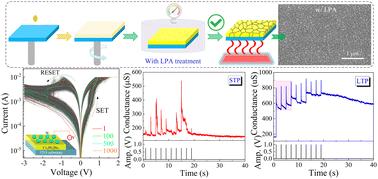
The lead-free Cs3Bi2Br9 perovskite has emerged as a promising candidate for memristor and artificial synapse devices due to its high environmental stability and low toxicity compared to lead-based alternatives. In this work, we successfully prepared a high-quality Cs3Bi2Br9 perovskite film via a simple spin-coating method combined with low-pressure assisted treatment. Based on the obtained Cs3Bi2Br9 film, a memristor with the structure of W/Cs3Bi2Br9/ITO was fabricated. The memristor demonstrated excellent resistive switching performance, including analog-switching behavior, high environmental stability (>11 months), low operating voltages (VFORMING ∼ 0.65 V, VSET ∼ 0.53 ± 0.08 V, and VRESET ∼ −0.83 ± 0.11 V), fast switching speed (<1 μs), and long switching endurance (>1100 cycles). Furthermore, the synaptic plasticity aspects such as short-term plasticity, long-term plasticity, and synaptic weight potentiation and depression were successfully simulated via pulse-train measurement. Finally, a fully connected neural network built using the W/Cs3Bi2Br9/ITO memristor can obtain an accuracy of about 90% in recognizing handwritten digits. The results indicate that the lead-free Cs3Bi2Br9-based memristor has great potential in high-stability, cost-effective, eco-friendly, and low-power consumption nonvolatile memory and neuromorphic computing applications.
期刊介绍:
The Journal of Materials Chemistry is divided into three distinct sections, A, B, and C, each catering to specific applications of the materials under study:
Journal of Materials Chemistry A focuses primarily on materials intended for applications in energy and sustainability.
Journal of Materials Chemistry B specializes in materials designed for applications in biology and medicine.
Journal of Materials Chemistry C is dedicated to materials suitable for applications in optical, magnetic, and electronic devices.
Example topic areas within the scope of Journal of Materials Chemistry C are listed below. This list is neither exhaustive nor exclusive.
Bioelectronics
Conductors
Detectors
Dielectrics
Displays
Ferroelectrics
Lasers
LEDs
Lighting
Liquid crystals
Memory
Metamaterials
Multiferroics
Photonics
Photovoltaics
Semiconductors
Sensors
Single molecule conductors
Spintronics
Superconductors
Thermoelectrics
Topological insulators
Transistors



 京公网安备 11010802042870号
京ICP备2023020795号-1
京公网安备 11010802042870号
京ICP备2023020795号-1

 分享
分享
 求助内容:
求助内容: 应助结果提醒方式:
 扫码关注我们
