{"title":"Congested position isomerism enhanced mechanoluminescence of triarylboranes†","authors":"Yangbin Xie, Yujie Zhou, Yan-Ting Zhang, Hanting Zhou, Zhenghua Ju, Shenlong Jiang, Chun-Lin Sun, Jincai Wu, Qun Zhang and Xiaobo Pan","doi":"10.1039/D5TC00180C","DOIUrl":null,"url":null,"abstract":"<p >The study of the mechanoluminescence enhancement (MLE) mechanism has been a challenging topic in the field of luminescent materials. Here, we implanted organoboron units with a steric hindrance effect into the molecular backbone and achieved the synthesis of MLE molecules using molecular engineering and crystal engineering. <em>ortho</em>-, <em>meta</em>-, and <em>para</em>-substituted organoboron compounds, namely <strong><em>o</em>-NAB</strong>, <strong><em>m</em>-NAB</strong>, and <strong><em>p</em>-NAB</strong>, were synthesized, where <strong><em>o</em>-NAB</strong> showed notable MLE, whereas <strong><em>m</em>-NAB</strong> and <strong><em>p</em>-NAB</strong> showed decreased fluorescence intensity upon mechanical activation without the assistance of solvent. Our study finds that the steric conformation resulting from different substitution positions plays a decisive role in the fluorescence performance. Grinding releases spatial stress in the <strong><em>o</em>-NAB</strong> structure, thereby affecting the process of mechanoresponsive fluorescence transition. Our research provides a congested position strategy for constructing MLE molecules, which not only enhances the fundamental understanding of MLE mechanisms but also bears significant implications for future research.</p>","PeriodicalId":84,"journal":{"name":"Journal of Materials Chemistry C","volume":" 16","pages":" 8095-8103"},"PeriodicalIF":5.1000,"publicationDate":"2025-03-06","publicationTypes":"Journal Article","fieldsOfStudy":null,"isOpenAccess":false,"openAccessPdf":"","citationCount":"0","resultStr":null,"platform":"Semanticscholar","paperid":null,"PeriodicalName":"Journal of Materials Chemistry C","FirstCategoryId":"1","ListUrlMain":"https://pubs.rsc.org/en/content/articlelanding/2025/tc/d5tc00180c","RegionNum":2,"RegionCategory":"材料科学","ArticlePicture":[],"TitleCN":null,"AbstractTextCN":null,"PMCID":null,"EPubDate":"","PubModel":"","JCR":"Q2","JCRName":"MATERIALS SCIENCE, MULTIDISCIPLINARY","Score":null,"Total":0}
引用次数: 0
Abstract
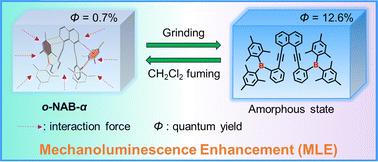
The study of the mechanoluminescence enhancement (MLE) mechanism has been a challenging topic in the field of luminescent materials. Here, we implanted organoboron units with a steric hindrance effect into the molecular backbone and achieved the synthesis of MLE molecules using molecular engineering and crystal engineering. ortho-, meta-, and para-substituted organoboron compounds, namely o-NAB, m-NAB, and p-NAB, were synthesized, where o-NAB showed notable MLE, whereas m-NAB and p-NAB showed decreased fluorescence intensity upon mechanical activation without the assistance of solvent. Our study finds that the steric conformation resulting from different substitution positions plays a decisive role in the fluorescence performance. Grinding releases spatial stress in the o-NAB structure, thereby affecting the process of mechanoresponsive fluorescence transition. Our research provides a congested position strategy for constructing MLE molecules, which not only enhances the fundamental understanding of MLE mechanisms but also bears significant implications for future research.
期刊介绍:
The Journal of Materials Chemistry is divided into three distinct sections, A, B, and C, each catering to specific applications of the materials under study:
Journal of Materials Chemistry A focuses primarily on materials intended for applications in energy and sustainability.
Journal of Materials Chemistry B specializes in materials designed for applications in biology and medicine.
Journal of Materials Chemistry C is dedicated to materials suitable for applications in optical, magnetic, and electronic devices.
Example topic areas within the scope of Journal of Materials Chemistry C are listed below. This list is neither exhaustive nor exclusive.
Bioelectronics
Conductors
Detectors
Dielectrics
Displays
Ferroelectrics
Lasers
LEDs
Lighting
Liquid crystals
Memory
Metamaterials
Multiferroics
Photonics
Photovoltaics
Semiconductors
Sensors
Single molecule conductors
Spintronics
Superconductors
Thermoelectrics
Topological insulators
Transistors



 京公网安备 11010802042870号
京ICP备2023020795号-1
京公网安备 11010802042870号
京ICP备2023020795号-1

 分享
分享
 求助内容:
求助内容: 应助结果提醒方式:
 扫码关注我们
