Xiao-Bao Li, Mark E. Light, Ana Arauzo, Elena Bartolomé and José Giner Planas
{"title":"Metal–organic frameworks built from a carborane linker isolating ideal one-dimensional large-spin chains of Co (S = 3/2) or Ni (S = 1)†","authors":"Xiao-Bao Li, Mark E. Light, Ana Arauzo, Elena Bartolomé and José Giner Planas","doi":"10.1039/D5TC00280J","DOIUrl":null,"url":null,"abstract":"<p >One-dimensional (1D) antiferromagnetic chains are fascinating because of their exotic quantum phenomena. However, isolating large-spin <em>S</em> chains remains challenging as even minimal interchain interaction <em>J</em>′ tends to drive unwanted long-range ordering. Here, we report on the synthesis, crystal structure, magnetism, optical, and electronic properties of two isostructural metal–organic frameworks (MOFs), [M<small><sub>2</sub></small>(<em>m</em>CB-L)<small><sub>2</sub></small>(μ<small><sub>2</sub></small>-H<small><sub>2</sub></small>O)<small><sub>2</sub></small>(DMF)<small><sub>4</sub></small>]<small><sub><em>n</em></sub></small>·solv (M = Co(<small>II</small>) (<strong><em>m</em>CB-Co</strong>) or Ni(<small>II</small>) (<strong><em>m</em>CB-Ni</strong>)), which feature water-bridged Co (<em>S</em> = 3/2) or Ni (<em>S</em> = 1) spin chains that are effectively separated by bulky carborane linkers (1,7-di(4-carboxyphenyl)-1,7-dicarba-<em>closo</em>-dodecaborane, <em>m</em>CBLH<small><sub>2</sub></small>). The temperature-dependent susceptibility reveals strong antiferromagnetic interactions with significant intrachain coupling, <em>J</em><small><sub>Co</sub></small>/<em>k</em><small><sub>B</sub></small> = −4.65 K (<strong><em>m</em>CB-Co</strong>) and <em>J</em><small><sub>Ni</sub></small>/<em>k</em><small><sub>B</sub></small> = −23.36 K (<strong><em>m</em>CB-Ni</strong>), yet confirm the absence of long-range order down to 0.3 K due to negligible interchain interactions, as corroborated by specific heat data. This indicates extremely small <em>J</em>′, with <em>J</em>′/<em>J</em> < 4.7 × 10<small><sup>−4</sup></small> (3.7 × 10<small><sup>−5</sup></small>) for Co (Ni) MOFs, making these new materials nearly ideal 1D antiferromagnets. Additionally, optical band gaps were estimated <em>via</em> the Kubelka–Munk method, yielding an increase from 3.83 eV for <strong><em>m</em>CB-Co</strong> to 4.20 eV for <strong><em>m</em>CB-Ni</strong>, showcasing tunable electronic properties across the two MOFs.</p>","PeriodicalId":84,"journal":{"name":"Journal of Materials Chemistry C","volume":" 16","pages":" 8020-8031"},"PeriodicalIF":5.1000,"publicationDate":"2025-03-12","publicationTypes":"Journal Article","fieldsOfStudy":null,"isOpenAccess":false,"openAccessPdf":"https://pubs.rsc.org/en/content/articlepdf/2025/tc/d5tc00280j?page=search","citationCount":"0","resultStr":null,"platform":"Semanticscholar","paperid":null,"PeriodicalName":"Journal of Materials Chemistry C","FirstCategoryId":"1","ListUrlMain":"https://pubs.rsc.org/en/content/articlelanding/2025/tc/d5tc00280j","RegionNum":2,"RegionCategory":"材料科学","ArticlePicture":[],"TitleCN":null,"AbstractTextCN":null,"PMCID":null,"EPubDate":"","PubModel":"","JCR":"Q2","JCRName":"MATERIALS SCIENCE, MULTIDISCIPLINARY","Score":null,"Total":0}
引用次数: 0
Abstract
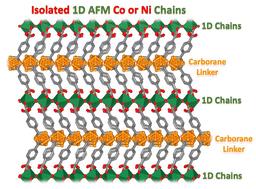
One-dimensional (1D) antiferromagnetic chains are fascinating because of their exotic quantum phenomena. However, isolating large-spin S chains remains challenging as even minimal interchain interaction J′ tends to drive unwanted long-range ordering. Here, we report on the synthesis, crystal structure, magnetism, optical, and electronic properties of two isostructural metal–organic frameworks (MOFs), [M2(mCB-L)2(μ2-H2O)2(DMF)4]n·solv (M = Co(II) (mCB-Co) or Ni(II) (mCB-Ni)), which feature water-bridged Co (S = 3/2) or Ni (S = 1) spin chains that are effectively separated by bulky carborane linkers (1,7-di(4-carboxyphenyl)-1,7-dicarba-closo-dodecaborane, mCBLH2). The temperature-dependent susceptibility reveals strong antiferromagnetic interactions with significant intrachain coupling, JCo/kB = −4.65 K (mCB-Co) and JNi/kB = −23.36 K (mCB-Ni), yet confirm the absence of long-range order down to 0.3 K due to negligible interchain interactions, as corroborated by specific heat data. This indicates extremely small J′, with J′/J < 4.7 × 10⁻⁴ (3.7 × 10⁻⁵) for Co (Ni) MOFs, making these new materials nearly ideal 1D antiferromagnets. Additionally, optical band gaps were estimated via the Kubelka–Munk method, yielding an increase from 3.83 eV for mCB-Co to 4.20 eV for mCB-Ni, showcasing tunable electronic properties across the two MOFs.
期刊介绍:
The Journal of Materials Chemistry is divided into three distinct sections, A, B, and C, each catering to specific applications of the materials under study:
Journal of Materials Chemistry A focuses primarily on materials intended for applications in energy and sustainability.
Journal of Materials Chemistry B specializes in materials designed for applications in biology and medicine.
Journal of Materials Chemistry C is dedicated to materials suitable for applications in optical, magnetic, and electronic devices.
Example topic areas within the scope of Journal of Materials Chemistry C are listed below. This list is neither exhaustive nor exclusive.
Bioelectronics
Conductors
Detectors
Dielectrics
Displays
Ferroelectrics
Lasers
LEDs
Lighting
Liquid crystals
Memory
Metamaterials
Multiferroics
Photonics
Photovoltaics
Semiconductors
Sensors
Single molecule conductors
Spintronics
Superconductors
Thermoelectrics
Topological insulators
Transistors



 京公网安备 11010802042870号
京ICP备2023020795号-1
京公网安备 11010802042870号
京ICP备2023020795号-1

 分享
分享
 求助内容:
求助内容: 应助结果提醒方式:
 扫码关注我们
