{"title":"Crystal growth and temperature dependence of luminescence characteristics of Pr3+ and Tb3+ doped solid-solution sesquioxide single crystals","authors":"Yuka Abe, Takahiko Horiai, Yuui Yokota, Masao Yoshino, Rikito Murakami, Takashi Hanada, Akihiro Yamaji, Hiroki Sato, Yuji Ohashi, Shunsuke Kurosawa, Kei Kamada and Akira Yoshikawa","doi":"10.1039/D5TC00156K","DOIUrl":null,"url":null,"abstract":"<p >In recent decades, optical thermometry has gained significant attention due to its promising properties, such as non-contact measurement, temperature mapping and immunity to electromagnetic interference. It overcomes the limitations of conventional temperature measurement methods and offers additional benefits. However, the widespread adoption of optical thermometry requires an expanded operating temperature range and improved sensitivity. Therefore, in this study, we focused on solid-solution sesquioxides, which are expected not only to enable the growth of single crystals with a cubic structure but also to allow for a wider selection of luminescence centers. We evaluated the applicability of (Lu, Y, Sc)<small><sub>2</sub></small>O<small><sub>3</sub></small> single crystals doped with Pr<small><sup>3+</sup></small> and Tb<small><sup>3+</sup></small>, which exhibit different temperature dependent behaviors, for optical thermometry. The optical temperature sensing properties evaluated using the fluorescence lifetime method revealed a maximal relative sensitivity of 1.53% K<small><sup>−1</sup></small> in the temperature range of 78–790 K for Pr<small><sup>3+</sup></small>, Tb<small><sup>3+</sup></small>:(Lu, Y, Sc)<small><sub>2</sub></small>O<small><sub>3</sub></small>. These results suggest that (Lu, Y, Sc)<small><sub>2</sub></small>O<small><sub>3</sub></small> co-doped with Pr<small><sup>3+</sup></small> and Tb<small><sup>3+</sup></small> is a promising candidate for optical thermometry.</p>","PeriodicalId":84,"journal":{"name":"Journal of Materials Chemistry C","volume":" 16","pages":" 8032-8042"},"PeriodicalIF":5.1000,"publicationDate":"2025-03-05","publicationTypes":"Journal Article","fieldsOfStudy":null,"isOpenAccess":false,"openAccessPdf":"https://pubs.rsc.org/en/content/articlepdf/2025/tc/d5tc00156k?page=search","citationCount":"0","resultStr":null,"platform":"Semanticscholar","paperid":null,"PeriodicalName":"Journal of Materials Chemistry C","FirstCategoryId":"1","ListUrlMain":"https://pubs.rsc.org/en/content/articlelanding/2025/tc/d5tc00156k","RegionNum":2,"RegionCategory":"材料科学","ArticlePicture":[],"TitleCN":null,"AbstractTextCN":null,"PMCID":null,"EPubDate":"","PubModel":"","JCR":"Q2","JCRName":"MATERIALS SCIENCE, MULTIDISCIPLINARY","Score":null,"Total":0}
引用次数: 0
Abstract
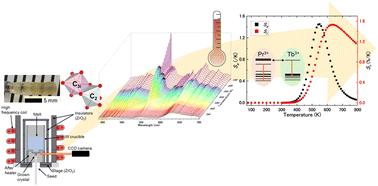
In recent decades, optical thermometry has gained significant attention due to its promising properties, such as non-contact measurement, temperature mapping and immunity to electromagnetic interference. It overcomes the limitations of conventional temperature measurement methods and offers additional benefits. However, the widespread adoption of optical thermometry requires an expanded operating temperature range and improved sensitivity. Therefore, in this study, we focused on solid-solution sesquioxides, which are expected not only to enable the growth of single crystals with a cubic structure but also to allow for a wider selection of luminescence centers. We evaluated the applicability of (Lu, Y, Sc)2O3 single crystals doped with Pr3+ and Tb3+, which exhibit different temperature dependent behaviors, for optical thermometry. The optical temperature sensing properties evaluated using the fluorescence lifetime method revealed a maximal relative sensitivity of 1.53% K−1 in the temperature range of 78–790 K for Pr3+, Tb3+:(Lu, Y, Sc)2O3. These results suggest that (Lu, Y, Sc)2O3 co-doped with Pr3+ and Tb3+ is a promising candidate for optical thermometry.
近几十年来,光学测温因其具有非接触测量、温度测绘和抗电磁干扰等优点而受到广泛关注。它克服了传统温度测量方法的局限性,并提供了额外的好处。然而,广泛采用光学测温需要扩大工作温度范围和提高灵敏度。因此,在本研究中,我们将重点放在固溶体倍半氧化物上,这不仅可以使具有立方结构的单晶生长,而且还可以允许更广泛的发光中心选择。我们评估了Pr3+和Tb3+掺杂(Lu, Y, Sc)2O3单晶在光学测温中的适用性,它们具有不同的温度依赖行为。利用荧光寿命法对Pr3+, Tb3+:(Lu, Y, Sc)2O3的光学感温性能进行了评价,结果表明在78 ~ 790 K温度范围内,Pr3+, Tb3+:(Lu, Y, Sc)2O3的最大相对灵敏度为1.53% K−1。这些结果表明,(Lu, Y, Sc)2O3与Pr3+和Tb3+共掺杂是一种很有前途的光学测温材料。
期刊介绍:
The Journal of Materials Chemistry is divided into three distinct sections, A, B, and C, each catering to specific applications of the materials under study:
Journal of Materials Chemistry A focuses primarily on materials intended for applications in energy and sustainability.
Journal of Materials Chemistry B specializes in materials designed for applications in biology and medicine.
Journal of Materials Chemistry C is dedicated to materials suitable for applications in optical, magnetic, and electronic devices.
Example topic areas within the scope of Journal of Materials Chemistry C are listed below. This list is neither exhaustive nor exclusive.
Bioelectronics
Conductors
Detectors
Dielectrics
Displays
Ferroelectrics
Lasers
LEDs
Lighting
Liquid crystals
Memory
Metamaterials
Multiferroics
Photonics
Photovoltaics
Semiconductors
Sensors
Single molecule conductors
Spintronics
Superconductors
Thermoelectrics
Topological insulators
Transistors



 京公网安备 11010802042870号
京ICP备2023020795号-1
京公网安备 11010802042870号
京ICP备2023020795号-1

 分享
分享
 求助内容:
求助内容: 应助结果提醒方式:
 扫码关注我们
