Tatsuya Kaburagi, Kazunori Morimoto and Takayuki Miyamae
{"title":"Probing charge behaviour in multilayer organic light-emitting diodes via electronic sum-frequency generation spectroscopy†","authors":"Tatsuya Kaburagi, Kazunori Morimoto and Takayuki Miyamae","doi":"10.1039/D4TC04970E","DOIUrl":null,"url":null,"abstract":"<p >Understanding the charge behavior inside organic layer interfaces in multilayer organic light-emitting diodes (OLEDs) is essential for improving device efficiency and lifetime. However, examining charge transport during voltage application passing through these organic interfaces in ultrathin and in encapsulated OLEDs is extremely challenging. To address this, electronic sum-frequency generation (ESFG) spectroscopy, a non-invasive technique, offers interface-selective information on the electronic structure of organic interfaces under light-emitting conditions. This study demonstrates the capabilities of ESFG spectroscopy by comparing the spectra of three different OLED devices with buried interfacial electronic structures under operation. The ESFG spectra revealed ESFG signal increases in intensity at the absorption band of the hole transport material upon voltage application and decreases in ESFG intensity at the absorption band of the light emitting layer. This observation is attributed to the electrical potential balance of the specific organic layers inside the devices caused by charge injection into the devices. Time-resolved ESFG measurements using square-wave pulse voltages have also enabled a detailed investigation of the electric field formation process caused by charge injection into the devices. This technique is an innovative, highly effective, and nondestructive spectroscopic approach for investigating electric-field formation owing to injected charges in solid-state thin-film devices.</p>","PeriodicalId":84,"journal":{"name":"Journal of Materials Chemistry C","volume":" 16","pages":" 8068-8076"},"PeriodicalIF":5.1000,"publicationDate":"2025-03-10","publicationTypes":"Journal Article","fieldsOfStudy":null,"isOpenAccess":false,"openAccessPdf":"https://pubs.rsc.org/en/content/articlepdf/2025/tc/d4tc04970e?page=search","citationCount":"0","resultStr":null,"platform":"Semanticscholar","paperid":null,"PeriodicalName":"Journal of Materials Chemistry C","FirstCategoryId":"1","ListUrlMain":"https://pubs.rsc.org/en/content/articlelanding/2025/tc/d4tc04970e","RegionNum":2,"RegionCategory":"材料科学","ArticlePicture":[],"TitleCN":null,"AbstractTextCN":null,"PMCID":null,"EPubDate":"","PubModel":"","JCR":"Q2","JCRName":"MATERIALS SCIENCE, MULTIDISCIPLINARY","Score":null,"Total":0}
引用次数: 0
Abstract
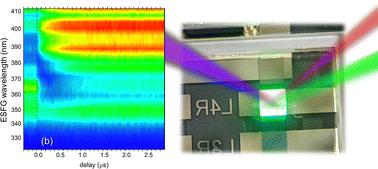
Understanding the charge behavior inside organic layer interfaces in multilayer organic light-emitting diodes (OLEDs) is essential for improving device efficiency and lifetime. However, examining charge transport during voltage application passing through these organic interfaces in ultrathin and in encapsulated OLEDs is extremely challenging. To address this, electronic sum-frequency generation (ESFG) spectroscopy, a non-invasive technique, offers interface-selective information on the electronic structure of organic interfaces under light-emitting conditions. This study demonstrates the capabilities of ESFG spectroscopy by comparing the spectra of three different OLED devices with buried interfacial electronic structures under operation. The ESFG spectra revealed ESFG signal increases in intensity at the absorption band of the hole transport material upon voltage application and decreases in ESFG intensity at the absorption band of the light emitting layer. This observation is attributed to the electrical potential balance of the specific organic layers inside the devices caused by charge injection into the devices. Time-resolved ESFG measurements using square-wave pulse voltages have also enabled a detailed investigation of the electric field formation process caused by charge injection into the devices. This technique is an innovative, highly effective, and nondestructive spectroscopic approach for investigating electric-field formation owing to injected charges in solid-state thin-film devices.
期刊介绍:
The Journal of Materials Chemistry is divided into three distinct sections, A, B, and C, each catering to specific applications of the materials under study:
Journal of Materials Chemistry A focuses primarily on materials intended for applications in energy and sustainability.
Journal of Materials Chemistry B specializes in materials designed for applications in biology and medicine.
Journal of Materials Chemistry C is dedicated to materials suitable for applications in optical, magnetic, and electronic devices.
Example topic areas within the scope of Journal of Materials Chemistry C are listed below. This list is neither exhaustive nor exclusive.
Bioelectronics
Conductors
Detectors
Dielectrics
Displays
Ferroelectrics
Lasers
LEDs
Lighting
Liquid crystals
Memory
Metamaterials
Multiferroics
Photonics
Photovoltaics
Semiconductors
Sensors
Single molecule conductors
Spintronics
Superconductors
Thermoelectrics
Topological insulators
Transistors



 京公网安备 11010802042870号
京ICP备2023020795号-1
京公网安备 11010802042870号
京ICP备2023020795号-1

 分享
分享
 求助内容:
求助内容: 应助结果提醒方式:
 扫码关注我们
