Huagui Zhuo, Ye In Cho, Ke Gao, Zhiwei Wang, Zhenping Li, Xingshuo Chu, Tianhang Cui, Wanuk Choi, Gang Chang, Jaeyong Ahn, Xiaobo Shang and Joon Hak Oh
{"title":"Enhancing optoelectronic performance of organic phototransistors through surface doping of tetra-bromo perylene diimide single crystals†","authors":"Huagui Zhuo, Ye In Cho, Ke Gao, Zhiwei Wang, Zhenping Li, Xingshuo Chu, Tianhang Cui, Wanuk Choi, Gang Chang, Jaeyong Ahn, Xiaobo Shang and Joon Hak Oh","doi":"10.1039/D5TC00361J","DOIUrl":null,"url":null,"abstract":"<p >Organic phototransistors (OPTs) built from organic single crystals offer distinct advantages over their thin-film counterparts due to their superior charge transport, large surface area, and defect-free molecular arrangement. However, the progress in developing high-performance n-type organic semiconductors has largged behind that of p-type materials, posing a challenge to the advancement of organicelectronic devices. To address this issue, we synthesized novel tetra-bromo-substituted chiral perylene diimides, which self-assembled into single crystals, offering potential of n-type semiconductors. Traditional doping techniques often risk damaging the delicate crystal structure; therefore, we implemented a mild surface doping method using aniline vapor, which preserves the structural integrity of the crystals while significantly enhancing their optoelectronic properties. The doped devices exhibited a remarkable improvement in charge transport, with electron mobility increasing four times to 1.19 × 10<small><sup>−2</sup></small> cm<small><sup>2</sup></small> V<small><sup>−1</sup></small> s<small><sup>−1</sup></small>. Furthermore, the optoelectronic characteristics were significantly improved simultaneously, with the external quantum efficiency increasing over two-fold, and response times becoming notably faster. These enhancements are attributed to the increased charge carrier density and improved exciton separation efficiency following doping. This study demonstrates that our surface doping strategy is a highly effective approach for optimizing the performance of organic single-crystal OPTs, providing a promising pathway for future applications in advanced optoelectronic devices.</p>","PeriodicalId":84,"journal":{"name":"Journal of Materials Chemistry C","volume":" 16","pages":" 8077-8083"},"PeriodicalIF":5.1000,"publicationDate":"2025-03-13","publicationTypes":"Journal Article","fieldsOfStudy":null,"isOpenAccess":false,"openAccessPdf":"https://pubs.rsc.org/en/content/articlepdf/2025/tc/d5tc00361j?page=search","citationCount":"0","resultStr":null,"platform":"Semanticscholar","paperid":null,"PeriodicalName":"Journal of Materials Chemistry C","FirstCategoryId":"1","ListUrlMain":"https://pubs.rsc.org/en/content/articlelanding/2025/tc/d5tc00361j","RegionNum":2,"RegionCategory":"材料科学","ArticlePicture":[],"TitleCN":null,"AbstractTextCN":null,"PMCID":null,"EPubDate":"","PubModel":"","JCR":"Q2","JCRName":"MATERIALS SCIENCE, MULTIDISCIPLINARY","Score":null,"Total":0}
引用次数: 0
Abstract
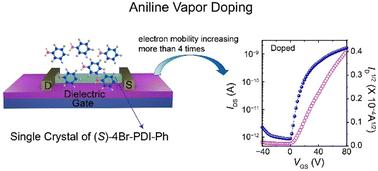
Organic phototransistors (OPTs) built from organic single crystals offer distinct advantages over their thin-film counterparts due to their superior charge transport, large surface area, and defect-free molecular arrangement. However, the progress in developing high-performance n-type organic semiconductors has largged behind that of p-type materials, posing a challenge to the advancement of organicelectronic devices. To address this issue, we synthesized novel tetra-bromo-substituted chiral perylene diimides, which self-assembled into single crystals, offering potential of n-type semiconductors. Traditional doping techniques often risk damaging the delicate crystal structure; therefore, we implemented a mild surface doping method using aniline vapor, which preserves the structural integrity of the crystals while significantly enhancing their optoelectronic properties. The doped devices exhibited a remarkable improvement in charge transport, with electron mobility increasing four times to 1.19 × 10⁻² cm2 V−1 s−1. Furthermore, the optoelectronic characteristics were significantly improved simultaneously, with the external quantum efficiency increasing over two-fold, and response times becoming notably faster. These enhancements are attributed to the increased charge carrier density and improved exciton separation efficiency following doping. This study demonstrates that our surface doping strategy is a highly effective approach for optimizing the performance of organic single-crystal OPTs, providing a promising pathway for future applications in advanced optoelectronic devices.
期刊介绍:
The Journal of Materials Chemistry is divided into three distinct sections, A, B, and C, each catering to specific applications of the materials under study:
Journal of Materials Chemistry A focuses primarily on materials intended for applications in energy and sustainability.
Journal of Materials Chemistry B specializes in materials designed for applications in biology and medicine.
Journal of Materials Chemistry C is dedicated to materials suitable for applications in optical, magnetic, and electronic devices.
Example topic areas within the scope of Journal of Materials Chemistry C are listed below. This list is neither exhaustive nor exclusive.
Bioelectronics
Conductors
Detectors
Dielectrics
Displays
Ferroelectrics
Lasers
LEDs
Lighting
Liquid crystals
Memory
Metamaterials
Multiferroics
Photonics
Photovoltaics
Semiconductors
Sensors
Single molecule conductors
Spintronics
Superconductors
Thermoelectrics
Topological insulators
Transistors



 京公网安备 11010802042870号
京ICP备2023020795号-1
京公网安备 11010802042870号
京ICP备2023020795号-1

 分享
分享
 求助内容:
求助内容: 应助结果提醒方式:
 扫码关注我们
