Kaixuan Sun, Kexing Yu, Xiang Yu, Wenqi Zhang, Rui Yang, Fangcheng Lv and Sidi Fan
{"title":"Tailoring chain-packing structure in co-blended aramid composites for high mechanical and insulating performance†","authors":"Kaixuan Sun, Kexing Yu, Xiang Yu, Wenqi Zhang, Rui Yang, Fangcheng Lv and Sidi Fan","doi":"10.1039/D5TC00142K","DOIUrl":null,"url":null,"abstract":"<p >Aramid paper materials, renowned for their exceptional mechanical properties, insulting capabilities, and thermal stability, are crucial for next-generation electrical and electronic devices. Among them, the poly(<em>m</em>-phenylene isophthalamide) (PMIA) paper exhibits practical potential through its simple and cost-effective preparation methods. However, the traditional PMIA paper produced by the wet-laid process suffers from interfacial defects, while the PMIA nanopaper prepared <em>via</em> protonation is more homogeneous, yet lacks the crystalline structure to sustain high mechanical strength. Here, PMIA is blended with a heterocyclic aramid (HA), a derivative of aramid, to prepare co-blending paper. The HA contains benzimidazole groups in its molecular structure, providing more hydrogen bond-forming sites that enhance the mechanical robustness. The strengthened hydrogen bonding network facilitates a stronger interaction between PMIA and HA, as well as a reduced interchain spacing, which tailors the chain packing structure with a smaller free volume fraction, conducive to a higher breakdown strength. Additionally, the HA and PMIA share a common solvent for co-blending, highly simplifying the preparation process. At an optimized HA content of 20 wt%, the PMIA/HA co-blending paper exhibits high structural integrity, characterized by a dense and compact configuration. Its Young's modulus is 4.6 GPa and breakdown strength is 300.6 kV mm<small><sup>−1</sup></small>. Moreover, hydrogen bonds effectively suppress dielectric loss. Due to its superior flexibility, colorability, and flame retardancy, the aramid co-blending paper exhibits versatile and high-performance features for a wide range of applications.</p>","PeriodicalId":84,"journal":{"name":"Journal of Materials Chemistry C","volume":" 16","pages":" 8188-8197"},"PeriodicalIF":5.1000,"publicationDate":"2025-03-07","publicationTypes":"Journal Article","fieldsOfStudy":null,"isOpenAccess":false,"openAccessPdf":"","citationCount":"0","resultStr":null,"platform":"Semanticscholar","paperid":null,"PeriodicalName":"Journal of Materials Chemistry C","FirstCategoryId":"1","ListUrlMain":"https://pubs.rsc.org/en/content/articlelanding/2025/tc/d5tc00142k","RegionNum":2,"RegionCategory":"材料科学","ArticlePicture":[],"TitleCN":null,"AbstractTextCN":null,"PMCID":null,"EPubDate":"","PubModel":"","JCR":"Q2","JCRName":"MATERIALS SCIENCE, MULTIDISCIPLINARY","Score":null,"Total":0}
引用次数: 0
Abstract
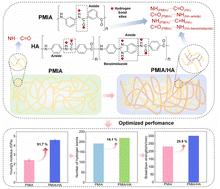
Aramid paper materials, renowned for their exceptional mechanical properties, insulting capabilities, and thermal stability, are crucial for next-generation electrical and electronic devices. Among them, the poly(m-phenylene isophthalamide) (PMIA) paper exhibits practical potential through its simple and cost-effective preparation methods. However, the traditional PMIA paper produced by the wet-laid process suffers from interfacial defects, while the PMIA nanopaper prepared via protonation is more homogeneous, yet lacks the crystalline structure to sustain high mechanical strength. Here, PMIA is blended with a heterocyclic aramid (HA), a derivative of aramid, to prepare co-blending paper. The HA contains benzimidazole groups in its molecular structure, providing more hydrogen bond-forming sites that enhance the mechanical robustness. The strengthened hydrogen bonding network facilitates a stronger interaction between PMIA and HA, as well as a reduced interchain spacing, which tailors the chain packing structure with a smaller free volume fraction, conducive to a higher breakdown strength. Additionally, the HA and PMIA share a common solvent for co-blending, highly simplifying the preparation process. At an optimized HA content of 20 wt%, the PMIA/HA co-blending paper exhibits high structural integrity, characterized by a dense and compact configuration. Its Young's modulus is 4.6 GPa and breakdown strength is 300.6 kV mm−1. Moreover, hydrogen bonds effectively suppress dielectric loss. Due to its superior flexibility, colorability, and flame retardancy, the aramid co-blending paper exhibits versatile and high-performance features for a wide range of applications.
期刊介绍:
The Journal of Materials Chemistry is divided into three distinct sections, A, B, and C, each catering to specific applications of the materials under study:
Journal of Materials Chemistry A focuses primarily on materials intended for applications in energy and sustainability.
Journal of Materials Chemistry B specializes in materials designed for applications in biology and medicine.
Journal of Materials Chemistry C is dedicated to materials suitable for applications in optical, magnetic, and electronic devices.
Example topic areas within the scope of Journal of Materials Chemistry C are listed below. This list is neither exhaustive nor exclusive.
Bioelectronics
Conductors
Detectors
Dielectrics
Displays
Ferroelectrics
Lasers
LEDs
Lighting
Liquid crystals
Memory
Metamaterials
Multiferroics
Photonics
Photovoltaics
Semiconductors
Sensors
Single molecule conductors
Spintronics
Superconductors
Thermoelectrics
Topological insulators
Transistors



 京公网安备 11010802042870号
京ICP备2023020795号-1
京公网安备 11010802042870号
京ICP备2023020795号-1

 分享
分享
 求助内容:
求助内容: 应助结果提醒方式:
 扫码关注我们
