{"title":"Fabrication of large-area nanostructures of pine needles with a dewdrop array for surface-enhanced Raman spectroscopy†","authors":"Jing Du, Kuanguo Li, Yonghua Lu and Pei Wang","doi":"10.1039/D5TC00211G","DOIUrl":null,"url":null,"abstract":"<p >Surface-enhanced Raman spectroscopy (SERS) depends on the development of a nanostructured substrate on which the excitation of a localized surface plasmon enhances the Raman scattering signals. Herein, we proposed a large-area three-dimensional (3D) pine needle with a dewdrop array (PNDA) nanostructure that can be easily fabricated <em>via</em> a film deposition technique with the help of a self-assembled polystyrene microsphere template and ultra-thin anodized aluminum oxide mask. Electromagnetic hotspots generated at the cracks or gaps between adjacent island structures of the PNDA are responsible for the SERS enhancement factor of 6.7 × 10<small><sup>6</sup></small> when the structural parameters of the PNDA substrate are optimized. Experiments demonstrated that the rhodamine 6G (R6G) molecule can be probed with the PNDA substrate at the lowest concentration of 10<small><sup>−9</sup></small> M using SERS. The homogeneity of the substrate was confirmed by verifying the relative standard deviation (RSD) of Raman spectra at different sites (6.5% at 611 cm<small><sup>−1</sup></small> and 8.3% at 1652 cm<small><sup>−1</sup></small>). Moreover, crystal violet (CV) molecules were probed using our SERS experiment at the lowest detection concentration of 10<small><sup>−8</sup></small> M. The results confirm that the PNDA structure is a reliable and sensitive SERS substrate to detect trace amounts of pollutants in an aquatic environment.</p>","PeriodicalId":84,"journal":{"name":"Journal of Materials Chemistry C","volume":" 16","pages":" 8198-8204"},"PeriodicalIF":5.1000,"publicationDate":"2025-03-06","publicationTypes":"Journal Article","fieldsOfStudy":null,"isOpenAccess":false,"openAccessPdf":"https://pubs.rsc.org/en/content/articlepdf/2025/tc/d5tc00211g?page=search","citationCount":"0","resultStr":null,"platform":"Semanticscholar","paperid":null,"PeriodicalName":"Journal of Materials Chemistry C","FirstCategoryId":"1","ListUrlMain":"https://pubs.rsc.org/en/content/articlelanding/2025/tc/d5tc00211g","RegionNum":2,"RegionCategory":"材料科学","ArticlePicture":[],"TitleCN":null,"AbstractTextCN":null,"PMCID":null,"EPubDate":"","PubModel":"","JCR":"Q2","JCRName":"MATERIALS SCIENCE, MULTIDISCIPLINARY","Score":null,"Total":0}
引用次数: 0
Abstract
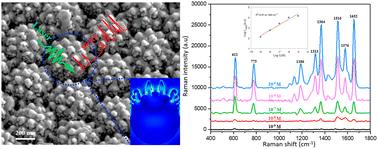
Surface-enhanced Raman spectroscopy (SERS) depends on the development of a nanostructured substrate on which the excitation of a localized surface plasmon enhances the Raman scattering signals. Herein, we proposed a large-area three-dimensional (3D) pine needle with a dewdrop array (PNDA) nanostructure that can be easily fabricated via a film deposition technique with the help of a self-assembled polystyrene microsphere template and ultra-thin anodized aluminum oxide mask. Electromagnetic hotspots generated at the cracks or gaps between adjacent island structures of the PNDA are responsible for the SERS enhancement factor of 6.7 × 10⁶ when the structural parameters of the PNDA substrate are optimized. Experiments demonstrated that the rhodamine 6G (R6G) molecule can be probed with the PNDA substrate at the lowest concentration of 10−9 M using SERS. The homogeneity of the substrate was confirmed by verifying the relative standard deviation (RSD) of Raman spectra at different sites (6.5% at 611 cm−1 and 8.3% at 1652 cm−1). Moreover, crystal violet (CV) molecules were probed using our SERS experiment at the lowest detection concentration of 10−8 M. The results confirm that the PNDA structure is a reliable and sensitive SERS substrate to detect trace amounts of pollutants in an aquatic environment.
期刊介绍:
The Journal of Materials Chemistry is divided into three distinct sections, A, B, and C, each catering to specific applications of the materials under study:
Journal of Materials Chemistry A focuses primarily on materials intended for applications in energy and sustainability.
Journal of Materials Chemistry B specializes in materials designed for applications in biology and medicine.
Journal of Materials Chemistry C is dedicated to materials suitable for applications in optical, magnetic, and electronic devices.
Example topic areas within the scope of Journal of Materials Chemistry C are listed below. This list is neither exhaustive nor exclusive.
Bioelectronics
Conductors
Detectors
Dielectrics
Displays
Ferroelectrics
Lasers
LEDs
Lighting
Liquid crystals
Memory
Metamaterials
Multiferroics
Photonics
Photovoltaics
Semiconductors
Sensors
Single molecule conductors
Spintronics
Superconductors
Thermoelectrics
Topological insulators
Transistors




 京公网安备 11010802042870号
京ICP备2023020795号-1
京公网安备 11010802042870号
京ICP备2023020795号-1

 分享
分享
 求助内容:
求助内容: 应助结果提醒方式:
 扫码关注我们
