Teng Li, Yue Wang, Yanqing Liu, Guokui Liu, Lingqiang Meng, Yongshen Zheng and Yangyang Dang
{"title":"Chiral hybrid manganese(ii) chloride single crystals for achieving second harmonic generation and moderate circularly polarized luminescence†","authors":"Teng Li, Yue Wang, Yanqing Liu, Guokui Liu, Lingqiang Meng, Yongshen Zheng and Yangyang Dang","doi":"10.1039/D5TC00279F","DOIUrl":null,"url":null,"abstract":"<p >Chiral hybrid metal halides have attracted much attention in optoelectronic fields such as encryption storage, security monitoring, and three-dimensional (3D) displays, due to their low cost, low toxicity, good stability, high luminescence efficiency, tunable emission, and chiroptical and nonlinear optical properties. Here, a pair of chiral manganese(<small>II</small>)-based hybrid chloride single crystals (<em>R</em>/<em>S</em>-2-mpip)MnCl<small><sub>4</sub></small>·2H<small><sub>2</sub></small>O and (<em>rac</em>-2-mpip)MnCl<small><sub>4</sub></small>·2H<small><sub>2</sub></small>O (mpip = methylpiperazinium) were synthesized by a slow evaporation method. The crystal structures, X-ray photoelectron spectroscopy (XPS), second harmonic generation, band gap calculation and photoluminescence (PL) were systematically studied. (<em>R</em>/<em>S</em>-2-mpip)MnCl<small><sub>4</sub></small>·2H<small><sub>2</sub></small>O and (<em>rac</em>-2-mpip)MnCl<small><sub>4</sub></small>·2H<small><sub>2</sub></small>O single crystals exhibited strong red emission characteristics caused by d–d transition of free Mn<small><sup>2+</sup></small> when heated to 383 K. Moreover, heated (<em>R</em>/<em>S</em>-2-mpip)MnCl<small><sub>4</sub></small>·2H<small><sub>2</sub></small>O materials exhibit the obvious circular dichroism and red circularly polarized luminescence characteristics with a moderate luminescence dissymmetry factor <em>g</em><small><sub>lum</sub></small> value reaching ±1.2 × 10<small><sup>−3</sup></small>, which provides a new research direction for further applications from anticounterfeiting to 3D displays, as well as encryption storage.</p>","PeriodicalId":84,"journal":{"name":"Journal of Materials Chemistry C","volume":" 16","pages":" 8238-8246"},"PeriodicalIF":5.1000,"publicationDate":"2025-03-10","publicationTypes":"Journal Article","fieldsOfStudy":null,"isOpenAccess":false,"openAccessPdf":"","citationCount":"0","resultStr":null,"platform":"Semanticscholar","paperid":null,"PeriodicalName":"Journal of Materials Chemistry C","FirstCategoryId":"1","ListUrlMain":"https://pubs.rsc.org/en/content/articlelanding/2025/tc/d5tc00279f","RegionNum":2,"RegionCategory":"材料科学","ArticlePicture":[],"TitleCN":null,"AbstractTextCN":null,"PMCID":null,"EPubDate":"","PubModel":"","JCR":"Q2","JCRName":"MATERIALS SCIENCE, MULTIDISCIPLINARY","Score":null,"Total":0}
引用次数: 0
Abstract
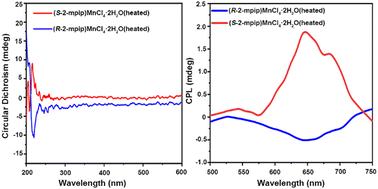
Chiral hybrid metal halides have attracted much attention in optoelectronic fields such as encryption storage, security monitoring, and three-dimensional (3D) displays, due to their low cost, low toxicity, good stability, high luminescence efficiency, tunable emission, and chiroptical and nonlinear optical properties. Here, a pair of chiral manganese(II)-based hybrid chloride single crystals (R/S-2-mpip)MnCl4·2H2O and (rac-2-mpip)MnCl4·2H2O (mpip = methylpiperazinium) were synthesized by a slow evaporation method. The crystal structures, X-ray photoelectron spectroscopy (XPS), second harmonic generation, band gap calculation and photoluminescence (PL) were systematically studied. (R/S-2-mpip)MnCl4·2H2O and (rac-2-mpip)MnCl4·2H2O single crystals exhibited strong red emission characteristics caused by d–d transition of free Mn2+ when heated to 383 K. Moreover, heated (R/S-2-mpip)MnCl4·2H2O materials exhibit the obvious circular dichroism and red circularly polarized luminescence characteristics with a moderate luminescence dissymmetry factor glum value reaching ±1.2 × 10⁻³, which provides a new research direction for further applications from anticounterfeiting to 3D displays, as well as encryption storage.
期刊介绍:
The Journal of Materials Chemistry is divided into three distinct sections, A, B, and C, each catering to specific applications of the materials under study:
Journal of Materials Chemistry A focuses primarily on materials intended for applications in energy and sustainability.
Journal of Materials Chemistry B specializes in materials designed for applications in biology and medicine.
Journal of Materials Chemistry C is dedicated to materials suitable for applications in optical, magnetic, and electronic devices.
Example topic areas within the scope of Journal of Materials Chemistry C are listed below. This list is neither exhaustive nor exclusive.
Bioelectronics
Conductors
Detectors
Dielectrics
Displays
Ferroelectrics
Lasers
LEDs
Lighting
Liquid crystals
Memory
Metamaterials
Multiferroics
Photonics
Photovoltaics
Semiconductors
Sensors
Single molecule conductors
Spintronics
Superconductors
Thermoelectrics
Topological insulators
Transistors



 京公网安备 11010802042870号
京ICP备2023020795号-1
京公网安备 11010802042870号
京ICP备2023020795号-1

 分享
分享
 求助内容:
求助内容: 应助结果提醒方式:
 扫码关注我们
