Liangchen Fan, Yulong Liao, Yuanxun Li, Fuyu Li, Jie Li, Wenhao Chen and Qiang Zhao
{"title":"Low loss and excellent stability of Zn0.7Mg0.3TiO3 ceramics with V2O5–TiO2 addition for application in low-temperature co-fired ceramic technology†","authors":"Liangchen Fan, Yulong Liao, Yuanxun Li, Fuyu Li, Jie Li, Wenhao Chen and Qiang Zhao","doi":"10.1039/D4TC04698F","DOIUrl":null,"url":null,"abstract":"<p >Ceramics composed of Zn<small><sub>0.7</sub></small>Mg<small><sub>0.3</sub></small>TiO<small><sub>3</sub></small> are employed in creating microwave devices because of their outstanding dielectric characteristics. Nonetheless, their elevated sintering temperature poses a significant challenge, rendering them unsuitable for meeting industrial production standards. Innovative Zn<small><sub>0.7</sub></small>Mg<small><sub>0.3</sub></small>TiO<small><sub>3</sub></small> ceramics, enhanced with V<small><sub>2</sub></small>O<small><sub>5</sub></small> and TiO<small><sub>2</sub></small>, were synthesized using a solid-state reaction technique. Findings revealed that V<small><sub>2</sub></small>O<small><sub>5</sub></small> and TiO<small><sub>2</sub></small> serve as effective sintering aids, leading to an improved densification rate and a decrease in the sintering temperature. Exceptional microwave dielectric characteristics were achieved by sintering Zn<small><sub>0.7</sub></small>Mg<small><sub>0.3</sub></small>TiO<small><sub>3</sub></small> ceramics (<em>x</em> = 1.5) at 950 °C: <em>ε</em><small><sub>r</sub></small> ≈ 20.92, <em>Q</em> × <em>f</em> ≈ 25862.7 GHz (@8.6 GHz), and <em>τ</em><small><sub>f</sub></small> ≈ −15.2 ppm °C<small><sup>−1</sup></small>. Additionally, the optimal <em>τ</em><small><sub>f</sub></small> value is nearly 30% higher than that reported in existing literature (which is only −55 ppm °C<small><sup>−1</sup></small>). Based on the P–V–L theory, Zn/Mg–O and Ti–O bonds contribute significantly to the dielectric constant and internal losses. The <em>τ</em><small><sub>f</sub></small> parameter is influenced directly by the distortion within the octahedral [TiO<small><sub>6</sub></small>]. Incorporating V<small><sub>2</sub></small>O<small><sub>5</sub></small> and TiO<small><sub>2</sub></small> into Zn<small><sub>0.7</sub></small>Mg<small><sub>0.3</sub></small>TiO<small><sub>3</sub></small> ceramics endows them with considerable potential for utilization in LTCC microwave devices.</p>","PeriodicalId":84,"journal":{"name":"Journal of Materials Chemistry C","volume":" 16","pages":" 8247-8256"},"PeriodicalIF":5.1000,"publicationDate":"2025-03-12","publicationTypes":"Journal Article","fieldsOfStudy":null,"isOpenAccess":false,"openAccessPdf":"","citationCount":"0","resultStr":null,"platform":"Semanticscholar","paperid":null,"PeriodicalName":"Journal of Materials Chemistry C","FirstCategoryId":"1","ListUrlMain":"https://pubs.rsc.org/en/content/articlelanding/2025/tc/d4tc04698f","RegionNum":2,"RegionCategory":"材料科学","ArticlePicture":[],"TitleCN":null,"AbstractTextCN":null,"PMCID":null,"EPubDate":"","PubModel":"","JCR":"Q2","JCRName":"MATERIALS SCIENCE, MULTIDISCIPLINARY","Score":null,"Total":0}
引用次数: 0
Abstract
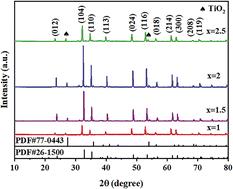
Ceramics composed of Zn0.7Mg0.3TiO3 are employed in creating microwave devices because of their outstanding dielectric characteristics. Nonetheless, their elevated sintering temperature poses a significant challenge, rendering them unsuitable for meeting industrial production standards. Innovative Zn0.7Mg0.3TiO3 ceramics, enhanced with V2O5 and TiO2, were synthesized using a solid-state reaction technique. Findings revealed that V2O5 and TiO2 serve as effective sintering aids, leading to an improved densification rate and a decrease in the sintering temperature. Exceptional microwave dielectric characteristics were achieved by sintering Zn0.7Mg0.3TiO3 ceramics (x = 1.5) at 950 °C: εr ≈ 20.92, Q × f ≈ 25862.7 GHz (@8.6 GHz), and τf ≈ −15.2 ppm °C−1. Additionally, the optimal τf value is nearly 30% higher than that reported in existing literature (which is only −55 ppm °C−1). Based on the P–V–L theory, Zn/Mg–O and Ti–O bonds contribute significantly to the dielectric constant and internal losses. The τf parameter is influenced directly by the distortion within the octahedral [TiO6]. Incorporating V2O5 and TiO2 into Zn0.7Mg0.3TiO3 ceramics endows them with considerable potential for utilization in LTCC microwave devices.
期刊介绍:
The Journal of Materials Chemistry is divided into three distinct sections, A, B, and C, each catering to specific applications of the materials under study:
Journal of Materials Chemistry A focuses primarily on materials intended for applications in energy and sustainability.
Journal of Materials Chemistry B specializes in materials designed for applications in biology and medicine.
Journal of Materials Chemistry C is dedicated to materials suitable for applications in optical, magnetic, and electronic devices.
Example topic areas within the scope of Journal of Materials Chemistry C are listed below. This list is neither exhaustive nor exclusive.
Bioelectronics
Conductors
Detectors
Dielectrics
Displays
Ferroelectrics
Lasers
LEDs
Lighting
Liquid crystals
Memory
Metamaterials
Multiferroics
Photonics
Photovoltaics
Semiconductors
Sensors
Single molecule conductors
Spintronics
Superconductors
Thermoelectrics
Topological insulators
Transistors



 京公网安备 11010802042870号
京ICP备2023020795号-1
京公网安备 11010802042870号
京ICP备2023020795号-1

 分享
分享
 求助内容:
求助内容: 应助结果提醒方式:
 扫码关注我们
