{"title":"MAPbI3 piezoelectric semiconductor and its multifunctional light-force detector","authors":"Yong Huang, Xuefeng Zhao, Yecheng Ding, Zeen Zhao and Guoliang Yuan","doi":"10.1039/D5TC00262A","DOIUrl":null,"url":null,"abstract":"<p >MAPbI<small><sub>3</sub></small> single crystals possess excellent semiconductor properties and exhibit broad prospects in applications such as photodetection and photovoltaics; however, it is a big challenge to achieve macroscopic piezoelectricity. Herein, MAPbI<small><sub>3</sub></small> semiconducting single crystals were fully polarized with a series of pulsed electric fields, and their macroscopic piezoelectric coefficient (<em>d</em><small><sub>33</sub></small>) value was ∼8.3 pC N<small><sup>−1</sup></small>. A multifunctional force-light detector was prepared using the MAPbI<small><sub>3</sub></small> piezoelectric semiconductor. Initially, the self-powered photodetector could detect a 405 nm wavelength laser with an energy density of ≥4 nW cm<small><sup>−2</sup></small>. Without applied pressure, the self-powered photodetector exhibited a high responsivity of ∼129.6 A W<small><sup>−1</sup></small> and a high detectivity of ∼7.1 × 10<small><sup>14</sup></small> jones. Additionally, external force could optimize the performance of the photodetector, increasing its responsivity and detectivity by 25% under a pressure of 1.5 N and laser illumination intensity of 4.15 mW cm<small><sup>−2</sup></small>. This work demonstrates that the MAPbI<small><sub>3</sub></small> piezoelectric semiconductor is promising in the development of a multifunctional light-force-electrical coupling device.</p>","PeriodicalId":84,"journal":{"name":"Journal of Materials Chemistry C","volume":" 16","pages":" 8257-8264"},"PeriodicalIF":5.1000,"publicationDate":"2025-03-10","publicationTypes":"Journal Article","fieldsOfStudy":null,"isOpenAccess":false,"openAccessPdf":"","citationCount":"0","resultStr":null,"platform":"Semanticscholar","paperid":null,"PeriodicalName":"Journal of Materials Chemistry C","FirstCategoryId":"1","ListUrlMain":"https://pubs.rsc.org/en/content/articlelanding/2025/tc/d5tc00262a","RegionNum":2,"RegionCategory":"材料科学","ArticlePicture":[],"TitleCN":null,"AbstractTextCN":null,"PMCID":null,"EPubDate":"","PubModel":"","JCR":"Q2","JCRName":"MATERIALS SCIENCE, MULTIDISCIPLINARY","Score":null,"Total":0}
引用次数: 0
Abstract
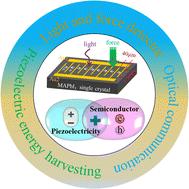
MAPbI3 single crystals possess excellent semiconductor properties and exhibit broad prospects in applications such as photodetection and photovoltaics; however, it is a big challenge to achieve macroscopic piezoelectricity. Herein, MAPbI3 semiconducting single crystals were fully polarized with a series of pulsed electric fields, and their macroscopic piezoelectric coefficient (d33) value was ∼8.3 pC N−1. A multifunctional force-light detector was prepared using the MAPbI3 piezoelectric semiconductor. Initially, the self-powered photodetector could detect a 405 nm wavelength laser with an energy density of ≥4 nW cm−2. Without applied pressure, the self-powered photodetector exhibited a high responsivity of ∼129.6 A W−1 and a high detectivity of ∼7.1 × 10¹⁴ jones. Additionally, external force could optimize the performance of the photodetector, increasing its responsivity and detectivity by 25% under a pressure of 1.5 N and laser illumination intensity of 4.15 mW cm−2. This work demonstrates that the MAPbI3 piezoelectric semiconductor is promising in the development of a multifunctional light-force-electrical coupling device.
期刊介绍:
The Journal of Materials Chemistry is divided into three distinct sections, A, B, and C, each catering to specific applications of the materials under study:
Journal of Materials Chemistry A focuses primarily on materials intended for applications in energy and sustainability.
Journal of Materials Chemistry B specializes in materials designed for applications in biology and medicine.
Journal of Materials Chemistry C is dedicated to materials suitable for applications in optical, magnetic, and electronic devices.
Example topic areas within the scope of Journal of Materials Chemistry C are listed below. This list is neither exhaustive nor exclusive.
Bioelectronics
Conductors
Detectors
Dielectrics
Displays
Ferroelectrics
Lasers
LEDs
Lighting
Liquid crystals
Memory
Metamaterials
Multiferroics
Photonics
Photovoltaics
Semiconductors
Sensors
Single molecule conductors
Spintronics
Superconductors
Thermoelectrics
Topological insulators
Transistors



 京公网安备 11010802042870号
京ICP备2023020795号-1
京公网安备 11010802042870号
京ICP备2023020795号-1

 分享
分享
 求助内容:
求助内容: 应助结果提醒方式:
 扫码关注我们
