Quynh Nguyen, Attilio Zilli, Michele Celebrano and Andrea Baldi
{"title":"Tailoring core size, shell thickness, and aluminium doping of Au@ZnO core@shell nanoparticles†","authors":"Quynh Nguyen, Attilio Zilli, Michele Celebrano and Andrea Baldi","doi":"10.1039/D4TC04644G","DOIUrl":null,"url":null,"abstract":"<p >Plasmonic materials, such as gold nanoparticles (AuNPs), exhibit significant extinction and near-field enhancement across the visible and near-infrared spectrum, attributable to localized surface plasmon resonances (LSPRs). Epsilon-near-zero (ENZ) materials, such as aluminium doped zinc oxide (AZO) are known in non-linear optics for their ability to generate and manipulate light-matter interactions through processes like higher harmonic generation. Combining doped ZnO with plasmonic materials therefore holds promise for enhancing non-linear efficiencies and tuning their operational wavelengths. To date, however, only top-down structures based on plasmonically decorated thin ENZ films have been realized, and no colloidal and scalable route to obtain these hybrid materials has been reported yet. Here, we introduce a novel colloidal synthesis approach for fabricating Au@AZO core@shell nanoparticles with tunable core size, shell thickness, and dopant concentration, allowing for the spectral alignment of the LSPRs of the AuNPs with the non-linear optical properties of the AZO shells. Our method involves the colloidal synthesis of gold cores followed by an ascorbic acid-assisted process to deposit polycristalline ZnO and AZO shells, resulting in core diameters ranging from 25 to 69 nm, shell thicknesses from 16 to 47 nm, and aluminium doping levels between 0 and 4 at%. Our procedure widens the range of hybrid plasmonic nanostructures that can be colloidally synthesised, opening new possibilities for the large scale fabrication of high-performance nanomaterials for integration in photonic, photocatalytic, and sensing applications.</p>","PeriodicalId":84,"journal":{"name":"Journal of Materials Chemistry C","volume":" 16","pages":" 8302-8309"},"PeriodicalIF":5.1000,"publicationDate":"2025-03-13","publicationTypes":"Journal Article","fieldsOfStudy":null,"isOpenAccess":false,"openAccessPdf":"https://pubs.rsc.org/en/content/articlepdf/2025/tc/d4tc04644g?page=search","citationCount":"0","resultStr":null,"platform":"Semanticscholar","paperid":null,"PeriodicalName":"Journal of Materials Chemistry C","FirstCategoryId":"1","ListUrlMain":"https://pubs.rsc.org/en/content/articlelanding/2025/tc/d4tc04644g","RegionNum":2,"RegionCategory":"材料科学","ArticlePicture":[],"TitleCN":null,"AbstractTextCN":null,"PMCID":null,"EPubDate":"","PubModel":"","JCR":"Q2","JCRName":"MATERIALS SCIENCE, MULTIDISCIPLINARY","Score":null,"Total":0}
引用次数: 0
Abstract
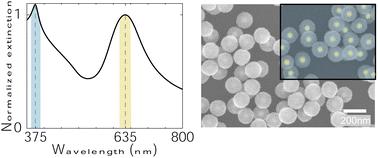
Plasmonic materials, such as gold nanoparticles (AuNPs), exhibit significant extinction and near-field enhancement across the visible and near-infrared spectrum, attributable to localized surface plasmon resonances (LSPRs). Epsilon-near-zero (ENZ) materials, such as aluminium doped zinc oxide (AZO) are known in non-linear optics for their ability to generate and manipulate light-matter interactions through processes like higher harmonic generation. Combining doped ZnO with plasmonic materials therefore holds promise for enhancing non-linear efficiencies and tuning their operational wavelengths. To date, however, only top-down structures based on plasmonically decorated thin ENZ films have been realized, and no colloidal and scalable route to obtain these hybrid materials has been reported yet. Here, we introduce a novel colloidal synthesis approach for fabricating Au@AZO core@shell nanoparticles with tunable core size, shell thickness, and dopant concentration, allowing for the spectral alignment of the LSPRs of the AuNPs with the non-linear optical properties of the AZO shells. Our method involves the colloidal synthesis of gold cores followed by an ascorbic acid-assisted process to deposit polycristalline ZnO and AZO shells, resulting in core diameters ranging from 25 to 69 nm, shell thicknesses from 16 to 47 nm, and aluminium doping levels between 0 and 4 at%. Our procedure widens the range of hybrid plasmonic nanostructures that can be colloidally synthesised, opening new possibilities for the large scale fabrication of high-performance nanomaterials for integration in photonic, photocatalytic, and sensing applications.
期刊介绍:
The Journal of Materials Chemistry is divided into three distinct sections, A, B, and C, each catering to specific applications of the materials under study:
Journal of Materials Chemistry A focuses primarily on materials intended for applications in energy and sustainability.
Journal of Materials Chemistry B specializes in materials designed for applications in biology and medicine.
Journal of Materials Chemistry C is dedicated to materials suitable for applications in optical, magnetic, and electronic devices.
Example topic areas within the scope of Journal of Materials Chemistry C are listed below. This list is neither exhaustive nor exclusive.
Bioelectronics
Conductors
Detectors
Dielectrics
Displays
Ferroelectrics
Lasers
LEDs
Lighting
Liquid crystals
Memory
Metamaterials
Multiferroics
Photonics
Photovoltaics
Semiconductors
Sensors
Single molecule conductors
Spintronics
Superconductors
Thermoelectrics
Topological insulators
Transistors



 京公网安备 11010802042870号
京ICP备2023020795号-1
京公网安备 11010802042870号
京ICP备2023020795号-1

 分享
分享
 求助内容:
求助内容: 应助结果提醒方式:
 扫码关注我们
