Yu-Yin Wang, Yue Wang, Xin-Wei Du, Xue-Hui Zhang, Lin Zhao, Bing-Rong Yan, Ruo-Fan Zhang, De-Long Liu, Jing Zhang and Guoming Lin
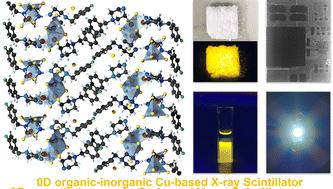
{"title":"A zero-dimensional hybrid halide with superior water resistance for high-efficiency X-ray scintillation and solid-state lighting†","authors":"Yu-Yin Wang, Yue Wang, Xin-Wei Du, Xue-Hui Zhang, Lin Zhao, Bing-Rong Yan, Ruo-Fan Zhang, De-Long Liu, Jing Zhang and Guoming Lin","doi":"10.1039/D5TC00788G","DOIUrl":null,"url":null,"abstract":"<p >In recent years, hybrid metal halides have gained considerable attention for optoelectronic applications due to their outstanding photophysical properties, despite challenges with stability. In this study, we present the design and synthesis of a highly stable and efficient zero-dimensional (0D) hybrid copper(<small>I</small>) halide, [FBZPA]<small><sub>4</sub></small>Cu<small><sub>5</sub></small>Br<small><sub>13</sub></small> (FBZPA = protonated 1-(4-fluorobenzyl)piperazine)), for advanced scintillation and solid-state lighting applications. This material exhibits efficient yellow light emission with a photoluminescence quantum yield of 88.5%, driven by radiative recombination of self-trapped excitons, which is facilitated by structural deformation and strong electron–phonon coupling within the 0D structure. [FBZPA]<small><sub>4</sub></small>Cu<small><sub>5</sub></small>Br<small><sub>13</sub></small> shows excellent scintillation properties, including a high light yield (∼39 100 photons MeV<small><sup>−1</sup></small>), a low detection limit (0.102 μGy<small><sub>air</sub></small> s<small><sup>−1</sup></small>), and a high spatial resolution (15 lp mm<small><sup>−1</sup></small>), making it an ideal candidate for high quality X-ray imaging. Additionally, we fabricated a white light-emitting diode (WLED) by combining [FBZPA]<small><sub>4</sub></small>Cu<small><sub>5</sub></small>Br<small><sub>13</sub></small> with a commercial blue phosphor on a UV chip. The WLED exhibited a high color rendering index of 90 with stable emission. It demonstrates remarkable stability, retaining its structure and optical properties after exposure to water, and intense light, without requiring encapsulation or chemical modifications. This study highlights [FBZPA]<small><sub>4</sub></small>Cu<small><sub>5</sub></small>Br<small><sub>13</sub></small> as a promising material for next-generation scintillation and solid-state lighting applications.</p>","PeriodicalId":84,"journal":{"name":"Journal of Materials Chemistry C","volume":" 16","pages":" 8320-8327"},"PeriodicalIF":5.1000,"publicationDate":"2025-03-17","publicationTypes":"Journal Article","fieldsOfStudy":null,"isOpenAccess":false,"openAccessPdf":"https://pubs.rsc.org/en/content/articlepdf/2025/tc/d5tc00788g?page=search","citationCount":"0","resultStr":null,"platform":"Semanticscholar","paperid":null,"PeriodicalName":"Journal of Materials Chemistry C","FirstCategoryId":"1","ListUrlMain":"https://pubs.rsc.org/en/content/articlelanding/2025/tc/d5tc00788g","RegionNum":2,"RegionCategory":"材料科学","ArticlePicture":[],"TitleCN":null,"AbstractTextCN":null,"PMCID":null,"EPubDate":"","PubModel":"","JCR":"Q2","JCRName":"MATERIALS SCIENCE, MULTIDISCIPLINARY","Score":null,"Total":0}
引用次数: 0
Abstract
In recent years, hybrid metal halides have gained considerable attention for optoelectronic applications due to their outstanding photophysical properties, despite challenges with stability. In this study, we present the design and synthesis of a highly stable and efficient zero-dimensional (0D) hybrid copper(I) halide, [FBZPA]4Cu5Br13 (FBZPA = protonated 1-(4-fluorobenzyl)piperazine)), for advanced scintillation and solid-state lighting applications. This material exhibits efficient yellow light emission with a photoluminescence quantum yield of 88.5%, driven by radiative recombination of self-trapped excitons, which is facilitated by structural deformation and strong electron–phonon coupling within the 0D structure. [FBZPA]4Cu5Br13 shows excellent scintillation properties, including a high light yield (∼39 100 photons MeV−1), a low detection limit (0.102 μGyair s−1), and a high spatial resolution (15 lp mm−1), making it an ideal candidate for high quality X-ray imaging. Additionally, we fabricated a white light-emitting diode (WLED) by combining [FBZPA]4Cu5Br13 with a commercial blue phosphor on a UV chip. The WLED exhibited a high color rendering index of 90 with stable emission. It demonstrates remarkable stability, retaining its structure and optical properties after exposure to water, and intense light, without requiring encapsulation or chemical modifications. This study highlights [FBZPA]4Cu5Br13 as a promising material for next-generation scintillation and solid-state lighting applications.
期刊介绍:
The Journal of Materials Chemistry is divided into three distinct sections, A, B, and C, each catering to specific applications of the materials under study:
Journal of Materials Chemistry A focuses primarily on materials intended for applications in energy and sustainability.
Journal of Materials Chemistry B specializes in materials designed for applications in biology and medicine.
Journal of Materials Chemistry C is dedicated to materials suitable for applications in optical, magnetic, and electronic devices.
Example topic areas within the scope of Journal of Materials Chemistry C are listed below. This list is neither exhaustive nor exclusive.
Bioelectronics
Conductors
Detectors
Dielectrics
Displays
Ferroelectrics
Lasers
LEDs
Lighting
Liquid crystals
Memory
Metamaterials
Multiferroics
Photonics
Photovoltaics
Semiconductors
Sensors
Single molecule conductors
Spintronics
Superconductors
Thermoelectrics
Topological insulators
Transistors



 京公网安备 11010802042870号
京ICP备2023020795号-1
京公网安备 11010802042870号
京ICP备2023020795号-1

 分享
分享
 求助内容:
求助内容: 应助结果提醒方式:
 扫码关注我们
