{"title":"Ferroelectric heterointerface control of spin polarization in a Janus antiferromagnet and its application in multistate storage†","authors":"Huan Xiao, Jialong Qi, Zhenzhen Feng, Lili Kang, Gaofeng Zhao and Peng Jiang","doi":"10.1039/D5TC00277J","DOIUrl":null,"url":null,"abstract":"<p >With the successful fabrication of two-dimensional (2D) magnets and ferroelectrics, constructing multiferroic van der Waals (vdW) heterostructures offers a practicable route toward high-performance nanoelectronics and spintronics device technology. In this work, based on first-principles calculations, we propose a Mn<small><sub>2</sub></small>ClF/Sc<small><sub>2</sub></small>CO<small><sub>2</sub></small> vdW multiferroic heterostructure by stacking the A-type antiferromagnetic (AFM) material Mn<small><sub>2</sub></small>ClF and the 2D ferroelectric material Sc<small><sub>2</sub></small>CO<small><sub>2</sub></small>. Our findings demonstrate that the AFM layer Mn<small><sub>2</sub></small>ClF will transition between semiconductor and half-metal by reversing the ferroelectric polarization state of the Sc<small><sub>2</sub></small>CO<small><sub>2</sub></small> layer. This transition is attributable to the different band alignments of Mn<small><sub>2</sub></small>ClF and Sc<small><sub>2</sub></small>CO<small><sub>2</sub></small> for different polarization states. Then, we design a multiferroic tunnel junction (MFTJ) based on the Sc<small><sub>2</sub></small>CO<small><sub>2</sub></small>/Mn<small><sub>2</sub></small>ClF/Sc<small><sub>2</sub></small>CO<small><sub>2</sub></small> vdW multiferroic heterostructure, which realizes the function of four-state information storage. Furthermore, we show that the spin polarization of near 100% is achieved by applying a small bias on the MFTJ. These results present a promising avenue for the application of multifunctional spintronic devices.</p>","PeriodicalId":84,"journal":{"name":"Journal of Materials Chemistry C","volume":" 16","pages":" 8328-8335"},"PeriodicalIF":5.1000,"publicationDate":"2025-03-14","publicationTypes":"Journal Article","fieldsOfStudy":null,"isOpenAccess":false,"openAccessPdf":"","citationCount":"0","resultStr":null,"platform":"Semanticscholar","paperid":null,"PeriodicalName":"Journal of Materials Chemistry C","FirstCategoryId":"1","ListUrlMain":"https://pubs.rsc.org/en/content/articlelanding/2025/tc/d5tc00277j","RegionNum":2,"RegionCategory":"材料科学","ArticlePicture":[],"TitleCN":null,"AbstractTextCN":null,"PMCID":null,"EPubDate":"","PubModel":"","JCR":"Q2","JCRName":"MATERIALS SCIENCE, MULTIDISCIPLINARY","Score":null,"Total":0}
引用次数: 0
Abstract
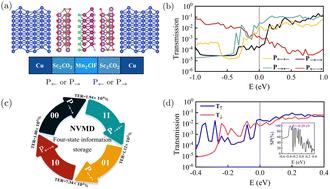
With the successful fabrication of two-dimensional (2D) magnets and ferroelectrics, constructing multiferroic van der Waals (vdW) heterostructures offers a practicable route toward high-performance nanoelectronics and spintronics device technology. In this work, based on first-principles calculations, we propose a Mn2ClF/Sc2CO2 vdW multiferroic heterostructure by stacking the A-type antiferromagnetic (AFM) material Mn2ClF and the 2D ferroelectric material Sc2CO2. Our findings demonstrate that the AFM layer Mn2ClF will transition between semiconductor and half-metal by reversing the ferroelectric polarization state of the Sc2CO2 layer. This transition is attributable to the different band alignments of Mn2ClF and Sc2CO2 for different polarization states. Then, we design a multiferroic tunnel junction (MFTJ) based on the Sc2CO2/Mn2ClF/Sc2CO2 vdW multiferroic heterostructure, which realizes the function of four-state information storage. Furthermore, we show that the spin polarization of near 100% is achieved by applying a small bias on the MFTJ. These results present a promising avenue for the application of multifunctional spintronic devices.
期刊介绍:
The Journal of Materials Chemistry is divided into three distinct sections, A, B, and C, each catering to specific applications of the materials under study:
Journal of Materials Chemistry A focuses primarily on materials intended for applications in energy and sustainability.
Journal of Materials Chemistry B specializes in materials designed for applications in biology and medicine.
Journal of Materials Chemistry C is dedicated to materials suitable for applications in optical, magnetic, and electronic devices.
Example topic areas within the scope of Journal of Materials Chemistry C are listed below. This list is neither exhaustive nor exclusive.
Bioelectronics
Conductors
Detectors
Dielectrics
Displays
Ferroelectrics
Lasers
LEDs
Lighting
Liquid crystals
Memory
Metamaterials
Multiferroics
Photonics
Photovoltaics
Semiconductors
Sensors
Single molecule conductors
Spintronics
Superconductors
Thermoelectrics
Topological insulators
Transistors



 京公网安备 11010802042870号
京ICP备2023020795号-1
京公网安备 11010802042870号
京ICP备2023020795号-1

 分享
分享
 求助内容:
求助内容: 应助结果提醒方式:
 扫码关注我们
