Gehad Ismail Sayed, Samar Ibrahim, Aboul Ella Hassanien
{"title":"Early Detection of Red Palm Weevil in Agricultural Environment Using Deep Learning","authors":"Gehad Ismail Sayed, Samar Ibrahim, Aboul Ella Hassanien","doi":"10.3103/S1060992X24700899","DOIUrl":null,"url":null,"abstract":"<p>The red palm weevil (RPW) represents a significant danger to palm trees farms all over the world, which will result in considerable financial losses. The absence of apparent signs until the death of the palm tree makes it difficult to identify RPW infections at an early stage. The prompt detection of RPW diseases is further complicated by large-scale farms. In order to accomplish early detection of RPW using image analysis, this paper proposed a RPW classification model based on the proposed modified ResNet-34 deep learning architecture. A dataset of 483 images is used to assess the model’s performance. For the assessment, two different dataset settings are used. In the initial dataset setup, images are divided into three groups: adults, eggs, and Pupae. Four additional categories are added to the classification in the second dataset setup: female adults, male adults, eggs, and pupae. Experimental findings show the usefulness of the proposed model, with a remarkable total accuracy of 98% for both dataset setups. These results highlight the value of using the modified ResNet-34 architecture for the early detection of RPW. Moreover, the findings demonstrated that the proposed model offers great potential for decreasing the negative effects of RPW on palm tree farms and preventing financial losses in the agriculture sector.</p>","PeriodicalId":721,"journal":{"name":"Optical Memory and Neural Networks","volume":"34 1","pages":"63 - 76"},"PeriodicalIF":0.8000,"publicationDate":"2025-04-16","publicationTypes":"Journal Article","fieldsOfStudy":null,"isOpenAccess":false,"openAccessPdf":"","citationCount":"0","resultStr":null,"platform":"Semanticscholar","paperid":null,"PeriodicalName":"Optical Memory and Neural Networks","FirstCategoryId":"1085","ListUrlMain":"https://link.springer.com/article/10.3103/S1060992X24700899","RegionNum":0,"RegionCategory":null,"ArticlePicture":[],"TitleCN":null,"AbstractTextCN":null,"PMCID":null,"EPubDate":"","PubModel":"","JCR":"Q4","JCRName":"OPTICS","Score":null,"Total":0}
引用次数: 0
Abstract
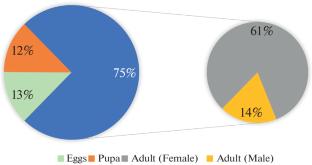
The red palm weevil (RPW) represents a significant danger to palm trees farms all over the world, which will result in considerable financial losses. The absence of apparent signs until the death of the palm tree makes it difficult to identify RPW infections at an early stage. The prompt detection of RPW diseases is further complicated by large-scale farms. In order to accomplish early detection of RPW using image analysis, this paper proposed a RPW classification model based on the proposed modified ResNet-34 deep learning architecture. A dataset of 483 images is used to assess the model’s performance. For the assessment, two different dataset settings are used. In the initial dataset setup, images are divided into three groups: adults, eggs, and Pupae. Four additional categories are added to the classification in the second dataset setup: female adults, male adults, eggs, and pupae. Experimental findings show the usefulness of the proposed model, with a remarkable total accuracy of 98% for both dataset setups. These results highlight the value of using the modified ResNet-34 architecture for the early detection of RPW. Moreover, the findings demonstrated that the proposed model offers great potential for decreasing the negative effects of RPW on palm tree farms and preventing financial losses in the agriculture sector.
期刊介绍:
The journal covers a wide range of issues in information optics such as optical memory, mechanisms for optical data recording and processing, photosensitive materials, optical, optoelectronic and holographic nanostructures, and many other related topics. Papers on memory systems using holographic and biological structures and concepts of brain operation are also included. The journal pays particular attention to research in the field of neural net systems that may lead to a new generation of computional technologies by endowing them with intelligence.



 京公网安备 11010802042870号
京ICP备2023020795号-1
京公网安备 11010802042870号
京ICP备2023020795号-1

 分享
分享
 求助内容:
求助内容: 应助结果提醒方式:
 扫码关注我们
