Brian J. Knight, Kevin J. Anderton, Juan F. Torres, Vincent J. Catalano, Ricardo Garcia-Serres, Leslie J. Murray
{"title":"Substrate-Dependent Hydridic and Radical Reactivity of Triiron Hydride Clusters","authors":"Brian J. Knight, Kevin J. Anderton, Juan F. Torres, Vincent J. Catalano, Ricardo Garcia-Serres, Leslie J. Murray","doi":"10.1021/acs.inorgchem.5c00071","DOIUrl":null,"url":null,"abstract":"The reactivity of iron clusters with one of more μ-hydrides and in the weak field pertains to catalysis on surfaces and biological metal cluster cofactors. As a model, then, a reactivity survey of the weak-field ligated iron hydride clusters Fe<sub>3</sub>H<sub>3</sub><b>L</b> (<b>1</b>) and (FeCO)<sub>2</sub>Fe(μ<sub>3</sub>–H)<b>L</b> (<b>2</b>) (where <b>L</b><sup><b>3–</b></sup> is a tris(β-diketiminate)cyclophanate) with Brønsted acids, organochlorides, acetyl chloride, boron trihalides, and titanium electrophiles is reported. Complex <b>1</b> reacts with Brønsted acids H<sub>2</sub>O and [Et<sub>3</sub>NH][Cl] to afford Fe<sub>3</sub>(OH)<sub>3</sub><b>L</b> (<b>3</b>) and Fe<sub>3</sub>H<sub>2</sub>Cl<b>L</b> (<b>4</b>), respectively, consistent with hydridic reactivity. Clusters <b>1</b> and <b>2</b> react readily with organochlorides, such as CCl<sub>4</sub>, CHCl<sub>3</sub>, and CH<sub>2</sub>Cl<sub>2</sub>, with identified intermediates supporting a radical pathway. Complex <b>1</b> reacts with trityl chloride (2 equiv) to selectively afford Fe<sub>3</sub>HCl<sub>2</sub><b>L</b> (<b>5</b>) with reductive elimination of dihydrogen observed. Mixed-valent complex <b>2</b> reacts with AcCl to afford (FeCO)Fe<sub>2</sub>HCl<b>L</b> (<b>9</b>). The scope of reactivity displayed implicates possible pathways accessible to larger clusters in biology or on metal surfaces.","PeriodicalId":40,"journal":{"name":"Inorganic Chemistry","volume":"32 1","pages":""},"PeriodicalIF":4.7000,"publicationDate":"2025-04-16","publicationTypes":"Journal Article","fieldsOfStudy":null,"isOpenAccess":false,"openAccessPdf":"","citationCount":"0","resultStr":null,"platform":"Semanticscholar","paperid":null,"PeriodicalName":"Inorganic Chemistry","FirstCategoryId":"92","ListUrlMain":"https://doi.org/10.1021/acs.inorgchem.5c00071","RegionNum":2,"RegionCategory":"化学","ArticlePicture":[],"TitleCN":null,"AbstractTextCN":null,"PMCID":null,"EPubDate":"","PubModel":"","JCR":"Q1","JCRName":"CHEMISTRY, INORGANIC & NUCLEAR","Score":null,"Total":0}
引用次数: 0
Abstract
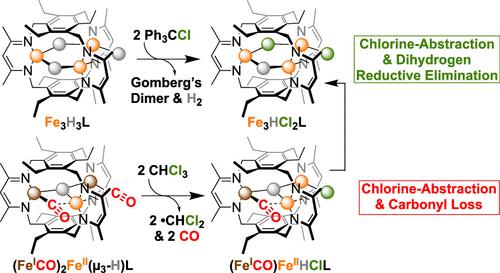
The reactivity of iron clusters with one of more μ-hydrides and in the weak field pertains to catalysis on surfaces and biological metal cluster cofactors. As a model, then, a reactivity survey of the weak-field ligated iron hydride clusters Fe3H3L (1) and (FeCO)2Fe(μ3–H)L (2) (where L3– is a tris(β-diketiminate)cyclophanate) with Brønsted acids, organochlorides, acetyl chloride, boron trihalides, and titanium electrophiles is reported. Complex 1 reacts with Brønsted acids H2O and [Et3NH][Cl] to afford Fe3(OH)3L (3) and Fe3H2ClL (4), respectively, consistent with hydridic reactivity. Clusters 1 and 2 react readily with organochlorides, such as CCl4, CHCl3, and CH2Cl2, with identified intermediates supporting a radical pathway. Complex 1 reacts with trityl chloride (2 equiv) to selectively afford Fe3HCl2L (5) with reductive elimination of dihydrogen observed. Mixed-valent complex 2 reacts with AcCl to afford (FeCO)Fe2HClL (9). The scope of reactivity displayed implicates possible pathways accessible to larger clusters in biology or on metal surfaces.
期刊介绍:
Inorganic Chemistry publishes fundamental studies in all phases of inorganic chemistry. Coverage includes experimental and theoretical reports on quantitative studies of structure and thermodynamics, kinetics, mechanisms of inorganic reactions, bioinorganic chemistry, and relevant aspects of organometallic chemistry, solid-state phenomena, and chemical bonding theory. Emphasis is placed on the synthesis, structure, thermodynamics, reactivity, spectroscopy, and bonding properties of significant new and known compounds.



 京公网安备 11010802042870号
京ICP备2023020795号-1
京公网安备 11010802042870号
京ICP备2023020795号-1

 分享
分享
 求助内容:
求助内容: 应助结果提醒方式:
 扫码关注我们
