Teresa Garcia-Mendoza, Björn Winkler, Wolfgang Morgenroth, Andrei Barkov, Alfredo Martinez-Garcia, Carlos G. Garay-Reyes, Fernando Chiñas-Castillo, Erick Adrian Juarez-Arellano
{"title":"Geomimetic Approaches in the Design and Synthesis of Ordered L10-Type Structure Platinum-Based Noble High-Entropy Alloys at Low Temperature","authors":"Teresa Garcia-Mendoza, Björn Winkler, Wolfgang Morgenroth, Andrei Barkov, Alfredo Martinez-Garcia, Carlos G. Garay-Reyes, Fernando Chiñas-Castillo, Erick Adrian Juarez-Arellano","doi":"10.1021/acs.inorgchem.5c00317","DOIUrl":null,"url":null,"abstract":"The recent discovery of new Pt-based minerals has opened up the opportunity to generate new synthetic materials. Here, geologically inspired approaches to designing and synthesizing novel platinum alloys, from ternary to high-entropy alloys (HEAs), are showcased. Empirical mathematical models of thermodynamic parameters were used to predict the formation of solid solutions with single-phase structures in the (Pt<sub>3–<i>x</i></sub>Pd<sub><i>x</i></sub>)(Cu<sub>2–<i>y</i></sub>Ni<sub><i>y</i></sub>Sn) system. Five new single-phase compounds, having ordered L1<sub>0</sub>-type structures, have been obtained at comparatively low temperatures by solid-state reactions. Two of those phases are new noble metal HEAs, (Pt<sub>2</sub>Pd)(Cu<sub>1.7</sub>Ni<sub>0.3</sub>Sn) and (Pt<sub>2</sub>Pd)(Cu<sub>1.4</sub>Ni<sub>0.6</sub>Sn). Additionally, other three new multiprinciple element alloys (mixture of ordered L1<sub>0</sub>-type and disordered FCC-type structures) were also obtained. SEM/EDX measurements gave no indication of chemical inhomogeneities on a micrometer length scale. A phase diagram is proposed. All products are thermally stable at up to 1100 K, and the two-phase samples show a tendency for nitrogen absorption. The results show that using geomimetic approaches in the design and synthesis of novel materials opened new opportunities for future materials design.","PeriodicalId":40,"journal":{"name":"Inorganic Chemistry","volume":"108 1","pages":""},"PeriodicalIF":4.7000,"publicationDate":"2025-04-16","publicationTypes":"Journal Article","fieldsOfStudy":null,"isOpenAccess":false,"openAccessPdf":"","citationCount":"0","resultStr":null,"platform":"Semanticscholar","paperid":null,"PeriodicalName":"Inorganic Chemistry","FirstCategoryId":"92","ListUrlMain":"https://doi.org/10.1021/acs.inorgchem.5c00317","RegionNum":2,"RegionCategory":"化学","ArticlePicture":[],"TitleCN":null,"AbstractTextCN":null,"PMCID":null,"EPubDate":"","PubModel":"","JCR":"Q1","JCRName":"CHEMISTRY, INORGANIC & NUCLEAR","Score":null,"Total":0}
引用次数: 0
Abstract
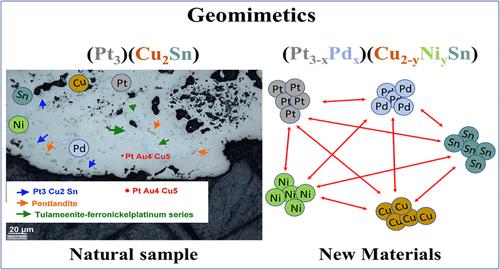
The recent discovery of new Pt-based minerals has opened up the opportunity to generate new synthetic materials. Here, geologically inspired approaches to designing and synthesizing novel platinum alloys, from ternary to high-entropy alloys (HEAs), are showcased. Empirical mathematical models of thermodynamic parameters were used to predict the formation of solid solutions with single-phase structures in the (Pt3–xPdx)(Cu2–yNiySn) system. Five new single-phase compounds, having ordered L10-type structures, have been obtained at comparatively low temperatures by solid-state reactions. Two of those phases are new noble metal HEAs, (Pt2Pd)(Cu1.7Ni0.3Sn) and (Pt2Pd)(Cu1.4Ni0.6Sn). Additionally, other three new multiprinciple element alloys (mixture of ordered L10-type and disordered FCC-type structures) were also obtained. SEM/EDX measurements gave no indication of chemical inhomogeneities on a micrometer length scale. A phase diagram is proposed. All products are thermally stable at up to 1100 K, and the two-phase samples show a tendency for nitrogen absorption. The results show that using geomimetic approaches in the design and synthesis of novel materials opened new opportunities for future materials design.
期刊介绍:
Inorganic Chemistry publishes fundamental studies in all phases of inorganic chemistry. Coverage includes experimental and theoretical reports on quantitative studies of structure and thermodynamics, kinetics, mechanisms of inorganic reactions, bioinorganic chemistry, and relevant aspects of organometallic chemistry, solid-state phenomena, and chemical bonding theory. Emphasis is placed on the synthesis, structure, thermodynamics, reactivity, spectroscopy, and bonding properties of significant new and known compounds.



 京公网安备 11010802042870号
京ICP备2023020795号-1
京公网安备 11010802042870号
京ICP备2023020795号-1

 分享
分享
 求助内容:
求助内容: 应助结果提醒方式:
 扫码关注我们
