Effect of Ligand Backbone on the Electrochemical Hydrogen Evolution Reaction and Hydrogen-Atom-Transfer Reactivity Using a Nickel Polypyridine Quinoline Complex
{"title":"Effect of Ligand Backbone on the Electrochemical Hydrogen Evolution Reaction and Hydrogen-Atom-Transfer Reactivity Using a Nickel Polypyridine Quinoline Complex","authors":"Sabarni Paul, Subhankar Sutradhar, Aniruddha Paik, Amit Biswas, Soumadip Das, Chandan Das, Rajib Maity, Alok Mahata, Siba P. Midya, Bholanath Maity, Sujoy Rana","doi":"10.1021/acs.inorgchem.4c05512","DOIUrl":null,"url":null,"abstract":"Redox-active quinoline-containing [Ni<sup>II</sup>(2PyN2Q) (H<sub>2</sub>O)]<sup>2+</sup> complex (<b>1</b>) has been developed for the electrocatalytic (<b>e</b>) hydrogen evolution reaction (HER) in the presence of organic acids and water and for the hydrogen-atom-transfer (HAT) reaction with styrene in the presence of acids. Complex <b>1</b> shows promising e-HER performance in water up to pH 9. It exhibits a stepwise (E)ECEC mechanism with AcOH, while a potential-dependent bimolecular homolytic pathway and CEEC mechanism is operative with <i>p</i>-toluene sulfonic acid during the e-HER. The one- and two-electron-reduced species of <b>1</b> are characterized by spectro-electrochemistry, optical, and EPR studies. Moreover, the inverse kinetic isotope effect (KIE = 0.83) between AcOH and <i>d</i><sub>4</sub>-AcOH during the e-HER and e-HAT with styrene for the hydro-functionalization reaction using catalyst <b>1</b> possibly suggests the involvement of nickel hydride species. The e-HER and e-HAT reactivity of <b>1</b> have been compared with redox-inactive redox-inactive [Ni<sup>II</sup>(N4Py)(H<sub>2</sub>O)]<sup>2+</sup> (<b>2</b>), demonstrating the prominent effect of quinoline in the e-HER and pyridine in the e-HAT. The proposed mechanism of the e-HER with AcOH is well supported by DFT studies.","PeriodicalId":40,"journal":{"name":"Inorganic Chemistry","volume":"40 1","pages":""},"PeriodicalIF":4.7000,"publicationDate":"2025-04-16","publicationTypes":"Journal Article","fieldsOfStudy":null,"isOpenAccess":false,"openAccessPdf":"","citationCount":"0","resultStr":null,"platform":"Semanticscholar","paperid":null,"PeriodicalName":"Inorganic Chemistry","FirstCategoryId":"92","ListUrlMain":"https://doi.org/10.1021/acs.inorgchem.4c05512","RegionNum":2,"RegionCategory":"化学","ArticlePicture":[],"TitleCN":null,"AbstractTextCN":null,"PMCID":null,"EPubDate":"","PubModel":"","JCR":"Q1","JCRName":"CHEMISTRY, INORGANIC & NUCLEAR","Score":null,"Total":0}
引用次数: 0
Abstract
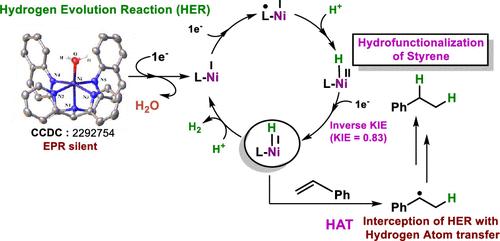
Redox-active quinoline-containing [NiII(2PyN2Q) (H2O)]2+ complex (1) has been developed for the electrocatalytic (e) hydrogen evolution reaction (HER) in the presence of organic acids and water and for the hydrogen-atom-transfer (HAT) reaction with styrene in the presence of acids. Complex 1 shows promising e-HER performance in water up to pH 9. It exhibits a stepwise (E)ECEC mechanism with AcOH, while a potential-dependent bimolecular homolytic pathway and CEEC mechanism is operative with p-toluene sulfonic acid during the e-HER. The one- and two-electron-reduced species of 1 are characterized by spectro-electrochemistry, optical, and EPR studies. Moreover, the inverse kinetic isotope effect (KIE = 0.83) between AcOH and d4-AcOH during the e-HER and e-HAT with styrene for the hydro-functionalization reaction using catalyst 1 possibly suggests the involvement of nickel hydride species. The e-HER and e-HAT reactivity of 1 have been compared with redox-inactive redox-inactive [NiII(N4Py)(H2O)]2+ (2), demonstrating the prominent effect of quinoline in the e-HER and pyridine in the e-HAT. The proposed mechanism of the e-HER with AcOH is well supported by DFT studies.
期刊介绍:
Inorganic Chemistry publishes fundamental studies in all phases of inorganic chemistry. Coverage includes experimental and theoretical reports on quantitative studies of structure and thermodynamics, kinetics, mechanisms of inorganic reactions, bioinorganic chemistry, and relevant aspects of organometallic chemistry, solid-state phenomena, and chemical bonding theory. Emphasis is placed on the synthesis, structure, thermodynamics, reactivity, spectroscopy, and bonding properties of significant new and known compounds.



 京公网安备 11010802042870号
京ICP备2023020795号-1
京公网安备 11010802042870号
京ICP备2023020795号-1

 分享
分享
 求助内容:
求助内容: 应助结果提醒方式:
 扫码关注我们
