{"title":"Dynamic Ion-Regulated Oxygen Evolution Catalyst Surface Reconstruction","authors":"Jinhui Hao, Zhilin Zhang, Zhenghao Zhang, Yitian Wu, Xiao Yang, Qianwen Qiu, Chenyang Cai, Yutao Hua, Wenshu Yang, Longhua Li, Weidong Shi","doi":"10.1021/acs.inorgchem.5c00938","DOIUrl":null,"url":null,"abstract":"Transition metal-based electrocatalysts are active materials for the oxygen evolution reaction (OER). However, their activities depend heavily on the <i>in situ</i> reconstructed new catalytic layer, which severely curtails the rational design and screening of well-defined electrocatalysts during the synthesis stage. Here, we present a method to deliberately design the <i>in situ</i> reconstructed catalyst reaction layer by adding a small amount of Fe<sup>3+</sup> ions to the electrolyte. We investigated the effect of Fe<sup>3+</sup> ions on the reconstruction process of the NiCuO<sub><i>x</i></sub>H<sub><i>y</i></sub> catalyst and their subsequent contribution to the catalytic activity. The presence of Fe<sup>3+</sup> ions promotes the formation of a well-defined catalytic layer with fewer oxygen vacancies. This structural feature allows for fast charge and active-species transfer near the reaction layer. Moreover, the Fe<sup>3+</sup>-ion-regulated reconstruction layer has a suitable electronic configuration for intermediate adsorption, thus reducing the reaction kinetics. With the assistance of the trace Fe<sup>3+</sup> ions, an increase in the current density of up to 54.2% can be achieved. Moreover, the electrolyte concentration can be saved 50% (0.5 M) while maintaining a current density of 150 mA cm<sup>–2</sup>. This work provides insights into the ion-catalyst correlation in surface reconstruction and offers guidance for the design of efficient OER electrocatalysts.","PeriodicalId":40,"journal":{"name":"Inorganic Chemistry","volume":"67 1","pages":""},"PeriodicalIF":4.7000,"publicationDate":"2025-04-16","publicationTypes":"Journal Article","fieldsOfStudy":null,"isOpenAccess":false,"openAccessPdf":"","citationCount":"0","resultStr":null,"platform":"Semanticscholar","paperid":null,"PeriodicalName":"Inorganic Chemistry","FirstCategoryId":"92","ListUrlMain":"https://doi.org/10.1021/acs.inorgchem.5c00938","RegionNum":2,"RegionCategory":"化学","ArticlePicture":[],"TitleCN":null,"AbstractTextCN":null,"PMCID":null,"EPubDate":"","PubModel":"","JCR":"Q1","JCRName":"CHEMISTRY, INORGANIC & NUCLEAR","Score":null,"Total":0}
引用次数: 0
Abstract
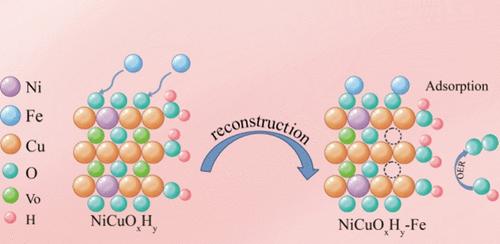
Transition metal-based electrocatalysts are active materials for the oxygen evolution reaction (OER). However, their activities depend heavily on the in situ reconstructed new catalytic layer, which severely curtails the rational design and screening of well-defined electrocatalysts during the synthesis stage. Here, we present a method to deliberately design the in situ reconstructed catalyst reaction layer by adding a small amount of Fe3+ ions to the electrolyte. We investigated the effect of Fe3+ ions on the reconstruction process of the NiCuOxHy catalyst and their subsequent contribution to the catalytic activity. The presence of Fe3+ ions promotes the formation of a well-defined catalytic layer with fewer oxygen vacancies. This structural feature allows for fast charge and active-species transfer near the reaction layer. Moreover, the Fe3+-ion-regulated reconstruction layer has a suitable electronic configuration for intermediate adsorption, thus reducing the reaction kinetics. With the assistance of the trace Fe3+ ions, an increase in the current density of up to 54.2% can be achieved. Moreover, the electrolyte concentration can be saved 50% (0.5 M) while maintaining a current density of 150 mA cm–2. This work provides insights into the ion-catalyst correlation in surface reconstruction and offers guidance for the design of efficient OER electrocatalysts.
期刊介绍:
Inorganic Chemistry publishes fundamental studies in all phases of inorganic chemistry. Coverage includes experimental and theoretical reports on quantitative studies of structure and thermodynamics, kinetics, mechanisms of inorganic reactions, bioinorganic chemistry, and relevant aspects of organometallic chemistry, solid-state phenomena, and chemical bonding theory. Emphasis is placed on the synthesis, structure, thermodynamics, reactivity, spectroscopy, and bonding properties of significant new and known compounds.



 京公网安备 11010802042870号
京ICP备2023020795号-1
京公网安备 11010802042870号
京ICP备2023020795号-1

 分享
分享
 求助内容:
求助内容: 应助结果提醒方式:
 扫码关注我们
