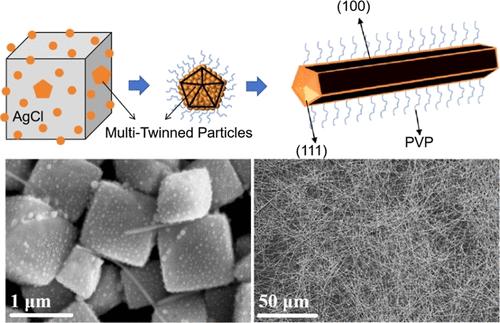
{"title":"Hydrothermal Synthesis of High-Purity, Ultralong Silver Nanowires by Heterogeneous Nucleation","authors":"Wenli Bi, Qi Zhang, Zhenzhen Mo, Wenlong Wang, Ruijing Li, Cheng Wang","doi":"10.1021/acs.inorgchem.5c01351","DOIUrl":null,"url":null,"abstract":"This study presents the synthesis of ultralong silver nanowires (AgNWs) with high purity via a hydrothermal approach. AgCl hydrosol is first converted into polyhedral particles, which serve as heterogeneous nucleation sites and a source of Ag precursor for subsequent reduction by maltose to yield AgNWs. The presence of sufficient poly(vinylpyrrolidone) (PVP) helps to suppress the growth of Ag nanoparticles formed on the Ag(100)/AgCl(100) interface. The low concentration of Ag<sup>+</sup> limited by the solubility product of AgCl hinders the secondary nucleation and growth of AgNPs in the bulk solution. A relatively high reduction rate, which is conducive to the self-catalyzed longitudinal growth of AgNWs along the ⟨110⟩ direction, can be achieved through the synergy among the low portion of AgNPs with pentagonal twinnings formed on the Ag(111)/AgCl(100) interface, stable concentration of maltose, and steady release of Ag<sup>+</sup> from AgCl. Experimental parameters including temperature, the concentration of maltose, the concentration of metal chlorides, and so on exert their influence on the formation of AgNWs via altering the reduction rate of Ag<sup>+</sup> in the reaction system. Optimal conditions result in AgNWs > 200 μm, 30 nm dia., with simplified NH<sub>4</sub>OH purification. This study provides a scalable method for high-purity AgNW production.","PeriodicalId":40,"journal":{"name":"Inorganic Chemistry","volume":"29 1","pages":""},"PeriodicalIF":4.7000,"publicationDate":"2025-04-16","publicationTypes":"Journal Article","fieldsOfStudy":null,"isOpenAccess":false,"openAccessPdf":"","citationCount":"0","resultStr":null,"platform":"Semanticscholar","paperid":null,"PeriodicalName":"Inorganic Chemistry","FirstCategoryId":"92","ListUrlMain":"https://doi.org/10.1021/acs.inorgchem.5c01351","RegionNum":2,"RegionCategory":"化学","ArticlePicture":[],"TitleCN":null,"AbstractTextCN":null,"PMCID":null,"EPubDate":"","PubModel":"","JCR":"Q1","JCRName":"CHEMISTRY, INORGANIC & NUCLEAR","Score":null,"Total":0}
引用次数: 0
Abstract
This study presents the synthesis of ultralong silver nanowires (AgNWs) with high purity via a hydrothermal approach. AgCl hydrosol is first converted into polyhedral particles, which serve as heterogeneous nucleation sites and a source of Ag precursor for subsequent reduction by maltose to yield AgNWs. The presence of sufficient poly(vinylpyrrolidone) (PVP) helps to suppress the growth of Ag nanoparticles formed on the Ag(100)/AgCl(100) interface. The low concentration of Ag+ limited by the solubility product of AgCl hinders the secondary nucleation and growth of AgNPs in the bulk solution. A relatively high reduction rate, which is conducive to the self-catalyzed longitudinal growth of AgNWs along the ⟨110⟩ direction, can be achieved through the synergy among the low portion of AgNPs with pentagonal twinnings formed on the Ag(111)/AgCl(100) interface, stable concentration of maltose, and steady release of Ag+ from AgCl. Experimental parameters including temperature, the concentration of maltose, the concentration of metal chlorides, and so on exert their influence on the formation of AgNWs via altering the reduction rate of Ag+ in the reaction system. Optimal conditions result in AgNWs > 200 μm, 30 nm dia., with simplified NH4OH purification. This study provides a scalable method for high-purity AgNW production.
期刊介绍:
Inorganic Chemistry publishes fundamental studies in all phases of inorganic chemistry. Coverage includes experimental and theoretical reports on quantitative studies of structure and thermodynamics, kinetics, mechanisms of inorganic reactions, bioinorganic chemistry, and relevant aspects of organometallic chemistry, solid-state phenomena, and chemical bonding theory. Emphasis is placed on the synthesis, structure, thermodynamics, reactivity, spectroscopy, and bonding properties of significant new and known compounds.



 京公网安备 11010802042870号
京ICP备2023020795号-1
京公网安备 11010802042870号
京ICP备2023020795号-1

 分享
分享
 求助内容:
求助内容: 应助结果提醒方式:
 扫码关注我们
