Gita A. Pathak, Robert H. Pietrzak, AnnMarie Lacobelle, Cassie Overstreet, Frank R. Wendt, Joseph D. Deak, Eleni Friligkou, Yaira Z. Nunez, Janitza L. Montalvo-Ortiz, Daniel F. Levey, Henry R. Kranzler, Joel Gelernter, Renato Polimanti
{"title":"Epigenetic and genetic profiling of comorbidity patterns among substance dependence diagnoses","authors":"Gita A. Pathak, Robert H. Pietrzak, AnnMarie Lacobelle, Cassie Overstreet, Frank R. Wendt, Joseph D. Deak, Eleni Friligkou, Yaira Z. Nunez, Janitza L. Montalvo-Ortiz, Daniel F. Levey, Henry R. Kranzler, Joel Gelernter, Renato Polimanti","doi":"10.1038/s41380-025-03031-y","DOIUrl":null,"url":null,"abstract":"This study investigated the genetic and epigenetic mechanisms underlying the comorbidity of five substance dependence diagnoses (SDs; alcohol, AD; cannabis, CaD; cocaine, CoD; opioid, OD; tobacco, TD). A latent class analysis (LCA) was performed on 22,668 individuals from six cohorts to identify comorbid DSM-IV SD patterns. In subsets of this sample, we tested SD-latent classes with respect to polygenic overlap of psychiatric and psychosocial traits in 7659 individuals of European descent and epigenome-wide changes in 886 individuals of African, European, and Admixed-American descents. The LCA identified four latent classes related to SD comorbidities: AD + TD, CoD + TD, AD + CoD + OD + TD (i.e., polysubstance addiction, PSU), and TD. In the epigenome-wide association analysis, SPATA4 cg02833127 was associated with CoD + TD, AD + TD, and PSU latent classes. AD + TD latent class was also associated with CpG sites located on ARID1B, NOTCH1, SERTAD4, and SIN3B, while additional epigenome-wide significant associations with CoD + TD latent class were observed in ANO6 and MOV10 genes. PSU-latent class was also associated with a differentially methylated region in LDB1. We also observed shared polygenic score (PGS) associations for PSU, AD + TD, and CoD + TD latent classes (i.e., attention-deficit hyperactivity disorder, anxiety, educational attainment, and schizophrenia PGS). In contrast, TD-latent class was exclusively associated with posttraumatic stress disorder-PGS. Other specific associations were observed for PSU-latent class (subjective wellbeing-PGS and neuroticism-PGS) and AD + TD-latent class (bipolar disorder-PGS). In conclusion, we identified shared and unique genetic and epigenetic mechanisms underlying SD comorbidity patterns. These findings highlight the importance of modeling the co-occurrence of SD diagnoses when investigating the molecular basis of addiction-related traits.","PeriodicalId":19008,"journal":{"name":"Molecular Psychiatry","volume":"30 9","pages":"4435-4443"},"PeriodicalIF":10.1000,"publicationDate":"2025-04-17","publicationTypes":"Journal Article","fieldsOfStudy":null,"isOpenAccess":false,"openAccessPdf":"","citationCount":"0","resultStr":null,"platform":"Semanticscholar","paperid":null,"PeriodicalName":"Molecular Psychiatry","FirstCategoryId":"3","ListUrlMain":"https://www.nature.com/articles/s41380-025-03031-y","RegionNum":1,"RegionCategory":"医学","ArticlePicture":[],"TitleCN":null,"AbstractTextCN":null,"PMCID":null,"EPubDate":"","PubModel":"","JCR":"Q1","JCRName":"BIOCHEMISTRY & MOLECULAR BIOLOGY","Score":null,"Total":0}
引用次数: 0
Abstract
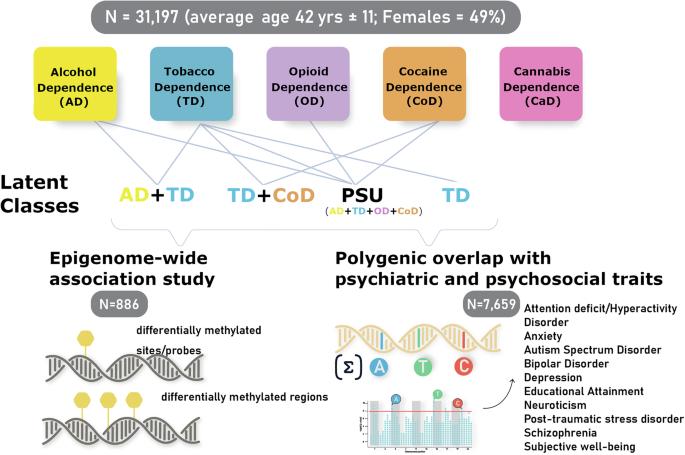
This study investigated the genetic and epigenetic mechanisms underlying the comorbidity of five substance dependence diagnoses (SDs; alcohol, AD; cannabis, CaD; cocaine, CoD; opioid, OD; tobacco, TD). A latent class analysis (LCA) was performed on 22,668 individuals from six cohorts to identify comorbid DSM-IV SD patterns. In subsets of this sample, we tested SD-latent classes with respect to polygenic overlap of psychiatric and psychosocial traits in 7659 individuals of European descent and epigenome-wide changes in 886 individuals of African, European, and Admixed-American descents. The LCA identified four latent classes related to SD comorbidities: AD + TD, CoD + TD, AD + CoD + OD + TD (i.e., polysubstance addiction, PSU), and TD. In the epigenome-wide association analysis, SPATA4 cg02833127 was associated with CoD + TD, AD + TD, and PSU latent classes. AD + TD latent class was also associated with CpG sites located on ARID1B, NOTCH1, SERTAD4, and SIN3B, while additional epigenome-wide significant associations with CoD + TD latent class were observed in ANO6 and MOV10 genes. PSU-latent class was also associated with a differentially methylated region in LDB1. We also observed shared polygenic score (PGS) associations for PSU, AD + TD, and CoD + TD latent classes (i.e., attention-deficit hyperactivity disorder, anxiety, educational attainment, and schizophrenia PGS). In contrast, TD-latent class was exclusively associated with posttraumatic stress disorder-PGS. Other specific associations were observed for PSU-latent class (subjective wellbeing-PGS and neuroticism-PGS) and AD + TD-latent class (bipolar disorder-PGS). In conclusion, we identified shared and unique genetic and epigenetic mechanisms underlying SD comorbidity patterns. These findings highlight the importance of modeling the co-occurrence of SD diagnoses when investigating the molecular basis of addiction-related traits.
期刊介绍:
Molecular Psychiatry focuses on publishing research that aims to uncover the biological mechanisms behind psychiatric disorders and their treatment. The journal emphasizes studies that bridge pre-clinical and clinical research, covering cellular, molecular, integrative, clinical, imaging, and psychopharmacology levels.




 京公网安备 11010802042870号
京ICP备2023020795号-1
京公网安备 11010802042870号
京ICP备2023020795号-1

 分享
分享
 求助内容:
求助内容: 应助结果提醒方式:
 扫码关注我们
