Muqing Chen, Wenhao Xiang, Xinde Li, Jinpeng Xin, Peng Jin, Yongfu Qiu, Zhiyu Cheng and Shangfeng Yang
{"title":"Cycloaddition reactivity of Yb@D3h-C74: the carbon cage size matters†","authors":"Muqing Chen, Wenhao Xiang, Xinde Li, Jinpeng Xin, Peng Jin, Yongfu Qiu, Zhiyu Cheng and Shangfeng Yang","doi":"10.1039/D5QI00649J","DOIUrl":null,"url":null,"abstract":"<p >Divalent endohedral metallofullerenes (Di-EMFs) with a closed-shell electronic configuration and characterized by a two-electron transfer from the inner cluster to the outer cage exhibit a very even distribution of charge over the whole cage, resulting in low chemical reactivity and thus limited chemical modification approaches. To date, the reported chemical modifications of Di-EMFs are limited to those with large carbon cages, such as C<small><sub>80</sub></small>, C<small><sub>82</sub></small>, and C<small><sub>84</sub></small>, whereas the chemical reactivity of Di-EMFs bearing cages smaller than C<small><sub>80</sub></small> remains unknown. Herein, we synthesized a medium-sized Di-EMF, Yb@<em>D</em><small><sub>3h</sub></small>-C<small><sub>74</sub></small>, and we investigated its 1,3-dipolar cycloaddition reaction and found that it has unusually high chemical reactivity at room temperature. This finding is significantly different from previously reported Di-EMFs with larger carbon cages, for which cycloaddition reactions generally require light irradiation or heating conditions. As a result, four monoadducts of Yb@<em>D</em><small><sub>3h</sub></small>-C<small><sub>74</sub></small>, labelled as <strong>2a–2d</strong>, were obtained, among which the molecular structure of <strong>2a</strong> was unambiguously determined using single-crystal X-ray crystallography. The addition sites were found to be far from the carbon cage region adjacent to the inner Yb cation, and this addition pattern is different to those of previously reported Di-EMFs with larger carbon cage sizes. Theoretical calculations rationally explained the high reactivity of Yb@<em>D</em><small><sub>3h</sub></small>-C<small><sub>74</sub></small> as well as its addition pattern.</p>","PeriodicalId":79,"journal":{"name":"Inorganic Chemistry Frontiers","volume":" 19","pages":" 5748-5755"},"PeriodicalIF":6.4000,"publicationDate":"2025-04-17","publicationTypes":"Journal Article","fieldsOfStudy":null,"isOpenAccess":false,"openAccessPdf":"","citationCount":"0","resultStr":null,"platform":"Semanticscholar","paperid":null,"PeriodicalName":"Inorganic Chemistry Frontiers","FirstCategoryId":"92","ListUrlMain":"https://pubs.rsc.org/en/content/articlelanding/2025/qi/d5qi00649j","RegionNum":1,"RegionCategory":"化学","ArticlePicture":[],"TitleCN":null,"AbstractTextCN":null,"PMCID":null,"EPubDate":"","PubModel":"","JCR":"Q1","JCRName":"CHEMISTRY, INORGANIC & NUCLEAR","Score":null,"Total":0}
引用次数: 0
Abstract
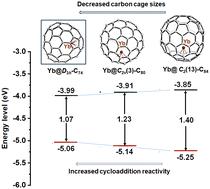
Divalent endohedral metallofullerenes (Di-EMFs) with a closed-shell electronic configuration and characterized by a two-electron transfer from the inner cluster to the outer cage exhibit a very even distribution of charge over the whole cage, resulting in low chemical reactivity and thus limited chemical modification approaches. To date, the reported chemical modifications of Di-EMFs are limited to those with large carbon cages, such as C80, C82, and C84, whereas the chemical reactivity of Di-EMFs bearing cages smaller than C80 remains unknown. Herein, we synthesized a medium-sized Di-EMF, Yb@D3h-C74, and we investigated its 1,3-dipolar cycloaddition reaction and found that it has unusually high chemical reactivity at room temperature. This finding is significantly different from previously reported Di-EMFs with larger carbon cages, for which cycloaddition reactions generally require light irradiation or heating conditions. As a result, four monoadducts of Yb@D3h-C74, labelled as 2a–2d, were obtained, among which the molecular structure of 2a was unambiguously determined using single-crystal X-ray crystallography. The addition sites were found to be far from the carbon cage region adjacent to the inner Yb cation, and this addition pattern is different to those of previously reported Di-EMFs with larger carbon cage sizes. Theoretical calculations rationally explained the high reactivity of Yb@D3h-C74 as well as its addition pattern.




 京公网安备 11010802042870号
京ICP备2023020795号-1
京公网安备 11010802042870号
京ICP备2023020795号-1

 分享
分享
 求助内容:
求助内容: 应助结果提醒方式:
 扫码关注我们
