Guenther Carlos C. Viana , Marina Ratova , Artemis E. Dimopoulou , James Redfern , Kris O’Dowd , Peter J. Kelly , Suresh C. Pillai , Camila C. Amorim
{"title":"BiVO4 thin films design via magnetron sputtering for water treatment: Antimicrobial activity, photocatalytic efficiency, and toxicity assessment","authors":"Guenther Carlos C. Viana , Marina Ratova , Artemis E. Dimopoulou , James Redfern , Kris O’Dowd , Peter J. Kelly , Suresh C. Pillai , Camila C. Amorim","doi":"10.1016/j.ces.2025.121687","DOIUrl":null,"url":null,"abstract":"<div><div>This paper investigates the production of bismuth vanadate (BiVO<sub>4</sub>) thin film for photocatalytic water treatment, verifying the effect of operational parameters for BiVO<sub>4</sub> thin film production by magnetron sputtering. The samples were characterized and through photocatalytic assessment, the BiVO<sub>4</sub> optimal production condition was determined as being 4 mTorr of pressure, 100 kHz of pulse frequency, 90 % of duty cycle, and 2 h of deposition time. The BiVO<sub>4</sub> antimicrobial proprieties were assessed following the British Standard ISO 27447:2009 with <em>E. coli</em>. Antimicrobial activity was observed under visible light, resulting in values under the detection limit (<LD) within 24 h. The material showed activity in the dark, achieving values < LD within 48 h. According to ISO 10993–5:2009, different cytotoxicity levels in humane intestinal cells were observed within the tested concentrations range. This antimicrobial activity is unprecedented, indicating a significant opportunity for advancement in disinfection and offering a safe alternative to conventional water treatment.</div></div>","PeriodicalId":271,"journal":{"name":"Chemical Engineering Science","volume":"312 ","pages":"Article 121687"},"PeriodicalIF":4.3000,"publicationDate":"2025-06-15","publicationTypes":"Journal Article","fieldsOfStudy":null,"isOpenAccess":false,"openAccessPdf":"","citationCount":"0","resultStr":null,"platform":"Semanticscholar","paperid":null,"PeriodicalName":"Chemical Engineering Science","FirstCategoryId":"5","ListUrlMain":"https://www.sciencedirect.com/science/article/pii/S000925092500510X","RegionNum":2,"RegionCategory":"工程技术","ArticlePicture":[],"TitleCN":null,"AbstractTextCN":null,"PMCID":null,"EPubDate":"2025/4/17 0:00:00","PubModel":"Epub","JCR":"Q2","JCRName":"ENGINEERING, CHEMICAL","Score":null,"Total":0}
引用次数: 0
Abstract
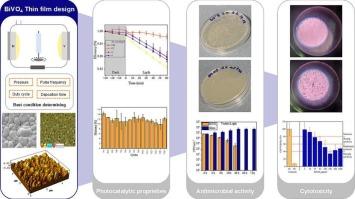
This paper investigates the production of bismuth vanadate (BiVO4) thin film for photocatalytic water treatment, verifying the effect of operational parameters for BiVO4 thin film production by magnetron sputtering. The samples were characterized and through photocatalytic assessment, the BiVO4 optimal production condition was determined as being 4 mTorr of pressure, 100 kHz of pulse frequency, 90 % of duty cycle, and 2 h of deposition time. The BiVO4 antimicrobial proprieties were assessed following the British Standard ISO 27447:2009 with E. coli. Antimicrobial activity was observed under visible light, resulting in values under the detection limit (<LD) within 24 h. The material showed activity in the dark, achieving values < LD within 48 h. According to ISO 10993–5:2009, different cytotoxicity levels in humane intestinal cells were observed within the tested concentrations range. This antimicrobial activity is unprecedented, indicating a significant opportunity for advancement in disinfection and offering a safe alternative to conventional water treatment.
期刊介绍:
Chemical engineering enables the transformation of natural resources and energy into useful products for society. It draws on and applies natural sciences, mathematics and economics, and has developed fundamental engineering science that underpins the discipline.
Chemical Engineering Science (CES) has been publishing papers on the fundamentals of chemical engineering since 1951. CES is the platform where the most significant advances in the discipline have ever since been published. Chemical Engineering Science has accompanied and sustained chemical engineering through its development into the vibrant and broad scientific discipline it is today.





 京公网安备 11010802042870号
京ICP备2023020795号-1
京公网安备 11010802042870号
京ICP备2023020795号-1

 分享
分享
 求助内容:
求助内容: 应助结果提醒方式:
 扫码关注我们
