Qishuang Zhu, Xianshu Qiao, Chuanjin Tian, Pengzhang Li, Yumin Liu, Wenyan Zhao, Liang Ma and Chang-An Wang
{"title":"Ultra-small β-Ni(OH)2 quantum dot catalyst with abundant edges for an efficient urea oxidation reaction†","authors":"Qishuang Zhu, Xianshu Qiao, Chuanjin Tian, Pengzhang Li, Yumin Liu, Wenyan Zhao, Liang Ma and Chang-An Wang","doi":"10.1039/D5QI00372E","DOIUrl":null,"url":null,"abstract":"<p >The development of efficient nonprecious-metal catalysts for the urea oxidation reaction (UOR) to improve the efficiency of electrocatalytic water splitting for hydrogen production remains a challenge. Herein, we synthesized ultra-small β-Ni(OH)<small><sub>2</sub></small> quantum dot (US-β-Ni(OH)<small><sub>2</sub></small> QD) catalysts with abundant edges <em>via</em> a coupled co-precipitation and anion-exchange approach. The obtained US-β-Ni(OH)<small><sub>2</sub></small> QD catalyst exhibits high activity toward the UOR and required a potential of only 1.48 V (<em>vs.</em> RHE) to reach 151 mA cm<small><sup>−2</sup></small>. Notably, the US-β-Ni(OH)<small><sub>2</sub></small> QD catalyst exhibits 4.1 and 96 times higher current density than do β-Ni(OH)<small><sub>2</sub></small> nanosheets (38.34 mA cm<small><sup>−2</sup></small>) and a Pt mesh electrode (1.57 mA cm<small><sup>−2</sup></small>), respectively, at a potential of 1.48 V (<em>vs.</em> RHE). The UOR catalytic reaction mechanism reveals that the US-β-Ni(OH)<small><sub>2</sub></small> QD catalyst features a high density of edge sites, where the oxygen vacancy concentration far exceeds that of the basal plane. This unique oxygen-vacancy-rich edge structure endows the US-β-Ni(OH)<small><sub>2</sub></small> QDs with a low energy barrier (0.96 eV) for the self-oxidation of Ni(OH)<small><sub>2</sub></small> to NiOOH, thereby facilitating the rate-determining step of the entire urea degradation process. This work provides a new approach for synthesizing ultra-small hydroxide quantum dot catalysts with efficient UOR activity at low cost.</p>","PeriodicalId":79,"journal":{"name":"Inorganic Chemistry Frontiers","volume":" 17","pages":" 5080-5090"},"PeriodicalIF":6.4000,"publicationDate":"2025-04-17","publicationTypes":"Journal Article","fieldsOfStudy":null,"isOpenAccess":false,"openAccessPdf":"","citationCount":"0","resultStr":null,"platform":"Semanticscholar","paperid":null,"PeriodicalName":"Inorganic Chemistry Frontiers","FirstCategoryId":"92","ListUrlMain":"https://pubs.rsc.org/en/content/articlelanding/2025/qi/d5qi00372e","RegionNum":1,"RegionCategory":"化学","ArticlePicture":[],"TitleCN":null,"AbstractTextCN":null,"PMCID":null,"EPubDate":"","PubModel":"","JCR":"Q1","JCRName":"CHEMISTRY, INORGANIC & NUCLEAR","Score":null,"Total":0}
引用次数: 0
Abstract
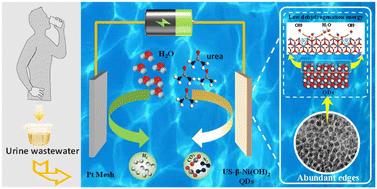
The development of efficient nonprecious-metal catalysts for the urea oxidation reaction (UOR) to improve the efficiency of electrocatalytic water splitting for hydrogen production remains a challenge. Herein, we synthesized ultra-small β-Ni(OH)2 quantum dot (US-β-Ni(OH)2 QD) catalysts with abundant edges via a coupled co-precipitation and anion-exchange approach. The obtained US-β-Ni(OH)2 QD catalyst exhibits high activity toward the UOR and required a potential of only 1.48 V (vs. RHE) to reach 151 mA cm−2. Notably, the US-β-Ni(OH)2 QD catalyst exhibits 4.1 and 96 times higher current density than do β-Ni(OH)2 nanosheets (38.34 mA cm−2) and a Pt mesh electrode (1.57 mA cm−2), respectively, at a potential of 1.48 V (vs. RHE). The UOR catalytic reaction mechanism reveals that the US-β-Ni(OH)2 QD catalyst features a high density of edge sites, where the oxygen vacancy concentration far exceeds that of the basal plane. This unique oxygen-vacancy-rich edge structure endows the US-β-Ni(OH)2 QDs with a low energy barrier (0.96 eV) for the self-oxidation of Ni(OH)2 to NiOOH, thereby facilitating the rate-determining step of the entire urea degradation process. This work provides a new approach for synthesizing ultra-small hydroxide quantum dot catalysts with efficient UOR activity at low cost.



 京公网安备 11010802042870号
京ICP备2023020795号-1
京公网安备 11010802042870号
京ICP备2023020795号-1

 分享
分享
 求助内容:
求助内容: 应助结果提醒方式:
 扫码关注我们
