{"title":"Strong Dipole Inner Salt Molecule as Interface Ion Bridge for Rechargeable Aqueous Zn-Anode Batteries","authors":"Zhaodong Wang, Yang Dong, Linlin Xue, Fengming Zhang, Meng Yu, Fangyi Cheng","doi":"10.1021/acs.jpclett.5c00594","DOIUrl":null,"url":null,"abstract":"Aqueous electrolyte additives are effective to improve the Zn anode performance, but their structural effect on electric double layer and Zn plating remains elusive. By comparing several additives with varied compositions and polarities, we reveal that the dipole moment plays an important role in modulating the electrode interface, while zincophilic functional groups are crucial to Zn stripping/plating kinetics. A strongly dipolar inner salt, L-α-glycerylphosphorylcholine, is screened as a favorable additive to stabilize the hydrophobic surface of the Zn anode and act as a Zn<sup>2+</sup>-migration bridge for fast desolvation. An aqueous 2 M ZnSO<sub>4</sub> electrolyte containing 75 mM L-α-glycerylphosphorylcholine results in the restriction of parasitic hydrogen evolution, zinc sulfation hydroxylation, and dendrite formation. Consequently, the Zn anodes achieve a high Coulombic efficiency of 99.8% in Zn||Cu cells at 1 mA cm<sup>–2</sup> and sustain 1800 h of cycling at 50% depth of discharge at 3 mA cm<sup>–2</sup>. This study underscores the screening and mechanistic understanding of dipolar inner salt additives to formulate better aqueous electrolytes.","PeriodicalId":62,"journal":{"name":"The Journal of Physical Chemistry Letters","volume":"6 1","pages":""},"PeriodicalIF":4.6000,"publicationDate":"2025-04-17","publicationTypes":"Journal Article","fieldsOfStudy":null,"isOpenAccess":false,"openAccessPdf":"","citationCount":"0","resultStr":null,"platform":"Semanticscholar","paperid":null,"PeriodicalName":"The Journal of Physical Chemistry Letters","FirstCategoryId":"1","ListUrlMain":"https://doi.org/10.1021/acs.jpclett.5c00594","RegionNum":2,"RegionCategory":"化学","ArticlePicture":[],"TitleCN":null,"AbstractTextCN":null,"PMCID":null,"EPubDate":"","PubModel":"","JCR":"Q2","JCRName":"CHEMISTRY, PHYSICAL","Score":null,"Total":0}
引用次数: 0
Abstract
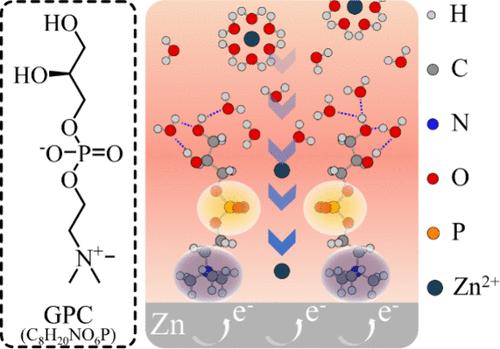
Aqueous electrolyte additives are effective to improve the Zn anode performance, but their structural effect on electric double layer and Zn plating remains elusive. By comparing several additives with varied compositions and polarities, we reveal that the dipole moment plays an important role in modulating the electrode interface, while zincophilic functional groups are crucial to Zn stripping/plating kinetics. A strongly dipolar inner salt, L-α-glycerylphosphorylcholine, is screened as a favorable additive to stabilize the hydrophobic surface of the Zn anode and act as a Zn2+-migration bridge for fast desolvation. An aqueous 2 M ZnSO4 electrolyte containing 75 mM L-α-glycerylphosphorylcholine results in the restriction of parasitic hydrogen evolution, zinc sulfation hydroxylation, and dendrite formation. Consequently, the Zn anodes achieve a high Coulombic efficiency of 99.8% in Zn||Cu cells at 1 mA cm–2 and sustain 1800 h of cycling at 50% depth of discharge at 3 mA cm–2. This study underscores the screening and mechanistic understanding of dipolar inner salt additives to formulate better aqueous electrolytes.
水溶液电解质添加剂能有效改善锌阳极的性能,但其对双电层和镀锌的结构影响尚不明确。通过比较几种不同成分和极性的添加剂,我们发现偶极力矩对电极界面的调节起重要作用,而亲锌官能团对锌剥离/镀动力学至关重要。L-α-甘油酰磷胆碱是一种强偶极内盐,可以稳定锌阳极的疏水表面,并作为快速脱溶的Zn2+迁移桥。含有75 mM L-α-甘油酰磷胆碱的2 M ZnSO4水溶液限制了寄生析氢、锌的硫酸化、羟基化和枝晶的形成。因此,锌阳极在1ma cm-2的Zn||Cu电池中达到99.8%的高库仑效率,并在3ma cm-2的50%放电深度下维持1800小时的循环。本研究强调了偶极内盐添加剂的筛选和机理理解,以配制更好的水溶液电解质。
期刊介绍:
The Journal of Physical Chemistry (JPC) Letters is devoted to reporting new and original experimental and theoretical basic research of interest to physical chemists, biophysical chemists, chemical physicists, physicists, material scientists, and engineers. An important criterion for acceptance is that the paper reports a significant scientific advance and/or physical insight such that rapid publication is essential. Two issues of JPC Letters are published each month.



 京公网安备 11010802042870号
京ICP备2023020795号-1
京公网安备 11010802042870号
京ICP备2023020795号-1

 分享
分享
 求助内容:
求助内容: 应助结果提醒方式:
 扫码关注我们
