{"title":"Manipulating Nonadiabatic Dynamics by Plasmonic Nanocavity","authors":"Yu Wang, Ruihao Bi, Wenjie Dou","doi":"10.1021/acs.jpclett.5c00736","DOIUrl":null,"url":null,"abstract":"In recent years, plasmonic nanocavities have emerged as powerful tools for controlling and enhancing light–matter interactions on the nanoscale. This study explores the role of plasmonic nanocavities in manipulating nonadiabatic dynamics, particularly in systems where fast electronic transitions are crucial. By coupling molecular states to the plasmonic resonances of metallic nanocavities, we demonstrate that the local electromagnetic fields generated by plasmons can significantly influence the rates and pathways of nonadiabatic transitions, including electron transfer and excitation relaxation processes. Using the Floquet quantum master equation (FQME) and Floquet surface hopping (FSH) methods that we previously developed, we find that plasmonic nanocavities can enhance nonadiabatic effects by tuning the plasmonic coupling strength, the molecule–metal interaction strength, and the material properties. These approaches offer a new perspective for predicting molecular dynamics in ultrafast processes. Our findings pave the way for designing novel plasmonic devices capable of controlling electron and energy transfer in chemical reactions, optoelectronic applications, and quantum information processing.","PeriodicalId":62,"journal":{"name":"The Journal of Physical Chemistry Letters","volume":"27 1","pages":""},"PeriodicalIF":4.6000,"publicationDate":"2025-04-17","publicationTypes":"Journal Article","fieldsOfStudy":null,"isOpenAccess":false,"openAccessPdf":"","citationCount":"0","resultStr":null,"platform":"Semanticscholar","paperid":null,"PeriodicalName":"The Journal of Physical Chemistry Letters","FirstCategoryId":"1","ListUrlMain":"https://doi.org/10.1021/acs.jpclett.5c00736","RegionNum":2,"RegionCategory":"化学","ArticlePicture":[],"TitleCN":null,"AbstractTextCN":null,"PMCID":null,"EPubDate":"","PubModel":"","JCR":"Q2","JCRName":"CHEMISTRY, PHYSICAL","Score":null,"Total":0}
引用次数: 0
Abstract
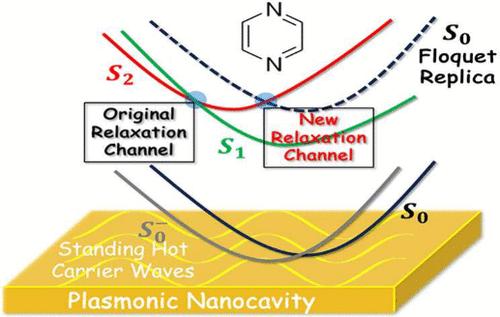
In recent years, plasmonic nanocavities have emerged as powerful tools for controlling and enhancing light–matter interactions on the nanoscale. This study explores the role of plasmonic nanocavities in manipulating nonadiabatic dynamics, particularly in systems where fast electronic transitions are crucial. By coupling molecular states to the plasmonic resonances of metallic nanocavities, we demonstrate that the local electromagnetic fields generated by plasmons can significantly influence the rates and pathways of nonadiabatic transitions, including electron transfer and excitation relaxation processes. Using the Floquet quantum master equation (FQME) and Floquet surface hopping (FSH) methods that we previously developed, we find that plasmonic nanocavities can enhance nonadiabatic effects by tuning the plasmonic coupling strength, the molecule–metal interaction strength, and the material properties. These approaches offer a new perspective for predicting molecular dynamics in ultrafast processes. Our findings pave the way for designing novel plasmonic devices capable of controlling electron and energy transfer in chemical reactions, optoelectronic applications, and quantum information processing.
期刊介绍:
The Journal of Physical Chemistry (JPC) Letters is devoted to reporting new and original experimental and theoretical basic research of interest to physical chemists, biophysical chemists, chemical physicists, physicists, material scientists, and engineers. An important criterion for acceptance is that the paper reports a significant scientific advance and/or physical insight such that rapid publication is essential. Two issues of JPC Letters are published each month.



 京公网安备 11010802042870号
京ICP备2023020795号-1
京公网安备 11010802042870号
京ICP备2023020795号-1

 分享
分享
 求助内容:
求助内容: 应助结果提醒方式:
 扫码关注我们
