Yelizaveta A. Morkhova, Emil R. Umerov, Vladislav T. Osipov, Andrey V. Sokolov, Artem A. Kabanov
{"title":"A Complete Study of MAX Phases Ti3Si1–xCuxC2 (0 ≤ x ≤ 1) Formation: Ab Initio Calculations and Sustainable Synthesis","authors":"Yelizaveta A. Morkhova, Emil R. Umerov, Vladislav T. Osipov, Andrey V. Sokolov, Artem A. Kabanov","doi":"10.1021/acs.jpcc.5c00122","DOIUrl":null,"url":null,"abstract":"Using density functional theory calculations, we simulated the substitution of silicon by copper in Ti<sub>3</sub>SiC<sub>2</sub> with the formation of Ti<sub>3</sub>Si<sub>1–<i>x</i></sub>Cu<sub><i>x</i></sub>C<sub>2</sub> (<i>x</i> = 0.0; 0.125; 0.25; 0.5; 0.75; 0.875; 1.0). We found that the Si–Cu substitution was possible up to half, with the formation of Ti<sub>3</sub>Si<sub>0.5</sub>Cu<sub>0.5</sub>C<sub>2</sub>. The elastic matrices for Ti<sub>3</sub>SiC<sub>2</sub>, Ti<sub>3</sub>Si<sub>0.5</sub>Cu<sub>0.5</sub>C<sub>2</sub>, and Ti<sub>3</sub>CuC<sub>2</sub> were calculated to determine the effect of substitution on the mechanical properties of the materials. It has been confirmed that the presence of copper leads to a decrease in elastic moduli and an increase in thermal resistivity. In this regard, Ti<sub>3</sub>Si<sub>0.5</sub>Cu<sub>0.5</sub>C<sub>2</sub> may be a promising thermal barrier coating material with a thermal conductivity of about 1.6 W m<sup>–1</sup>K<sup>–1</sup>. According to the electronic structure, both compounds have zero band gaps. In addition, an attempt to synthesize the Ti<sub>3</sub>Si<sub>1–<i>x</i></sub>Cu<sub><i>x</i></sub>C<sub>2</sub> material was carried out using high-temperature self-propagating synthesis. As a result, a sample with more than 70% yield of Ti<sub>3</sub>SiC<sub>2</sub> content was obtained through rapid and environmentally friendly synthesis, and then a 20% yield of Ti<sub>3</sub>Si<sub>0.929</sub>Cu<sub>0.071</sub>C<sub>2</sub> composition was achieved, which was confirmed by the X-ray diffraction and energy-dispersive X-ray spectroscopy investigations.","PeriodicalId":61,"journal":{"name":"The Journal of Physical Chemistry C","volume":"18 1","pages":""},"PeriodicalIF":3.2000,"publicationDate":"2025-04-17","publicationTypes":"Journal Article","fieldsOfStudy":null,"isOpenAccess":false,"openAccessPdf":"","citationCount":"0","resultStr":null,"platform":"Semanticscholar","paperid":null,"PeriodicalName":"The Journal of Physical Chemistry C","FirstCategoryId":"1","ListUrlMain":"https://doi.org/10.1021/acs.jpcc.5c00122","RegionNum":3,"RegionCategory":"化学","ArticlePicture":[],"TitleCN":null,"AbstractTextCN":null,"PMCID":null,"EPubDate":"","PubModel":"","JCR":"Q2","JCRName":"CHEMISTRY, PHYSICAL","Score":null,"Total":0}
引用次数: 0
Abstract
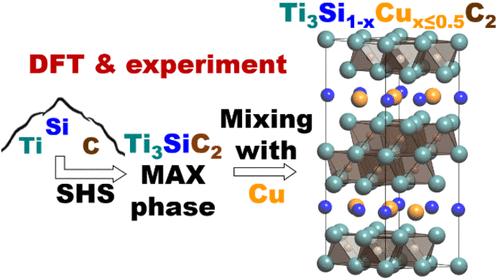
Using density functional theory calculations, we simulated the substitution of silicon by copper in Ti3SiC2 with the formation of Ti3Si1–xCuxC2 (x = 0.0; 0.125; 0.25; 0.5; 0.75; 0.875; 1.0). We found that the Si–Cu substitution was possible up to half, with the formation of Ti3Si0.5Cu0.5C2. The elastic matrices for Ti3SiC2, Ti3Si0.5Cu0.5C2, and Ti3CuC2 were calculated to determine the effect of substitution on the mechanical properties of the materials. It has been confirmed that the presence of copper leads to a decrease in elastic moduli and an increase in thermal resistivity. In this regard, Ti3Si0.5Cu0.5C2 may be a promising thermal barrier coating material with a thermal conductivity of about 1.6 W m–1K–1. According to the electronic structure, both compounds have zero band gaps. In addition, an attempt to synthesize the Ti3Si1–xCuxC2 material was carried out using high-temperature self-propagating synthesis. As a result, a sample with more than 70% yield of Ti3SiC2 content was obtained through rapid and environmentally friendly synthesis, and then a 20% yield of Ti3Si0.929Cu0.071C2 composition was achieved, which was confirmed by the X-ray diffraction and energy-dispersive X-ray spectroscopy investigations.
期刊介绍:
The Journal of Physical Chemistry A/B/C is devoted to reporting new and original experimental and theoretical basic research of interest to physical chemists, biophysical chemists, and chemical physicists.



 京公网安备 11010802042870号
京ICP备2023020795号-1
京公网安备 11010802042870号
京ICP备2023020795号-1

 分享
分享
 求助内容:
求助内容: 应助结果提醒方式:
 扫码关注我们
