Nikolai Sidorenko, Jonas Hauner, Kira Mikulinskaya, Celine Költsch, Frederike Jäschke, Jörg Libuda
{"title":"The Nucleation Mechanism of Tetrakis(dimethylamido)hafnium on CoO Nanoislands","authors":"Nikolai Sidorenko, Jonas Hauner, Kira Mikulinskaya, Celine Költsch, Frederike Jäschke, Jörg Libuda","doi":"10.1021/acs.jpcc.5c01171","DOIUrl":null,"url":null,"abstract":"Understanding the nucleation mechanisms and early stages of thin film growth is essential for advancing atomic layer deposition (ALD) processes. Here, we investigate the interaction of tetrakis(dimethylamido)hafnium (TDMAH) with cobalt oxide nanoislands under ultrahigh vacuum (UHV) conditions using infrared reflection absorption spectroscopy (IRAS) and scanning tunneling microscopy (STM). Initial nucleation of TDMAH and species formation were studied by STM at 300 K. Surface reactions were monitored at 300 and 400 K, including experiments on D<sub>2</sub>O presaturated surfaces to elucidate the role of −OH groups in precursor adsorption and decomposition. At 300 K, nucleation was driven by hydroxyl-mediated hydrolysis, leading to Hf–O bond formation. In contrast, at 400 K, Lewis acid–base interactions with cobalt and oxygen ions dominated, resulting in precursor decomposition and the formation of surface −OH groups, which subsequently acted as nucleation sites. Experiments on D<sub>2</sub>O-presaturated surfaces showed that −OH groups at island edges serve as critical adsorption sites for TDMAH, facilitating hafnium oxide formation while generating surface-adsorbed −NCH<sub><i>x</i></sub> species that inhibit further precursor adsorption. These results provide molecular-level insights into temperature-dependent nucleation mechanisms, with implications for optimizing ALD processes on cobalt oxide surfaces.","PeriodicalId":61,"journal":{"name":"The Journal of Physical Chemistry C","volume":"29 1","pages":""},"PeriodicalIF":3.2000,"publicationDate":"2025-04-17","publicationTypes":"Journal Article","fieldsOfStudy":null,"isOpenAccess":false,"openAccessPdf":"","citationCount":"0","resultStr":null,"platform":"Semanticscholar","paperid":null,"PeriodicalName":"The Journal of Physical Chemistry C","FirstCategoryId":"1","ListUrlMain":"https://doi.org/10.1021/acs.jpcc.5c01171","RegionNum":3,"RegionCategory":"化学","ArticlePicture":[],"TitleCN":null,"AbstractTextCN":null,"PMCID":null,"EPubDate":"","PubModel":"","JCR":"Q2","JCRName":"CHEMISTRY, PHYSICAL","Score":null,"Total":0}
引用次数: 0
Abstract
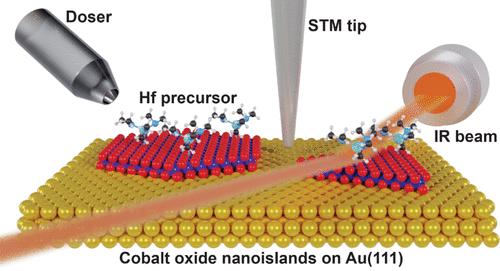
Understanding the nucleation mechanisms and early stages of thin film growth is essential for advancing atomic layer deposition (ALD) processes. Here, we investigate the interaction of tetrakis(dimethylamido)hafnium (TDMAH) with cobalt oxide nanoislands under ultrahigh vacuum (UHV) conditions using infrared reflection absorption spectroscopy (IRAS) and scanning tunneling microscopy (STM). Initial nucleation of TDMAH and species formation were studied by STM at 300 K. Surface reactions were monitored at 300 and 400 K, including experiments on D2O presaturated surfaces to elucidate the role of −OH groups in precursor adsorption and decomposition. At 300 K, nucleation was driven by hydroxyl-mediated hydrolysis, leading to Hf–O bond formation. In contrast, at 400 K, Lewis acid–base interactions with cobalt and oxygen ions dominated, resulting in precursor decomposition and the formation of surface −OH groups, which subsequently acted as nucleation sites. Experiments on D2O-presaturated surfaces showed that −OH groups at island edges serve as critical adsorption sites for TDMAH, facilitating hafnium oxide formation while generating surface-adsorbed −NCHx species that inhibit further precursor adsorption. These results provide molecular-level insights into temperature-dependent nucleation mechanisms, with implications for optimizing ALD processes on cobalt oxide surfaces.
期刊介绍:
The Journal of Physical Chemistry A/B/C is devoted to reporting new and original experimental and theoretical basic research of interest to physical chemists, biophysical chemists, and chemical physicists.



 京公网安备 11010802042870号
京ICP备2023020795号-1
京公网安备 11010802042870号
京ICP备2023020795号-1

 分享
分享
 求助内容:
求助内容: 应助结果提醒方式:
 扫码关注我们
