Yang Wang, Tongtong Luo, Yu Mu, Michael Goldstein, James Wilkes, Brooke Elander, Dunwei Wang, Udayan Mohanty, Junwei Lucas Bao
{"title":"Conformational Flexibility Dictates Thermal and Electrochemical Reactivities of Magnesium Polysulfides for Magnesium–Sulfur Battery Applications","authors":"Yang Wang, Tongtong Luo, Yu Mu, Michael Goldstein, James Wilkes, Brooke Elander, Dunwei Wang, Udayan Mohanty, Junwei Lucas Bao","doi":"10.1021/acs.jpcc.5c01352","DOIUrl":null,"url":null,"abstract":"The inherent instability and low solubility of polysulfides in Mg-based electrolytes contribute to the poor performance of magnesium–sulfur (Mg–S) battery systems. To address these challenges, we utilize a combination of first-principle theory, spectroscopy, and electrochemical measurements to investigate the chemistry of Mg polysulfides. Our study reveals the critical role of polysulfide species present in the battery electrolyte in determining electrochemical stability and performance. Through detailed atomistic-level explorations of polysulfide conformations and their role in Mg–S chemistry, corroborated by experiments, we discover that the disproportionation of long-chain Mg polysulfides into shorter-chain compounds is thermodynamically favored at room temperature. In contrast, multiple polysulfide radical species can form under electrochemical conditions. Meanwhile, the dissociation of Mg<sup>2+</sup> from the coordinating polysulfide anions is highly unfavorable regardless of the solvent used. Our theoretical predictions for UV–vis, Raman, and electron paramagnetic resonance (EPR) spectra, which account for the full ensemble of polysulfide conformers and species at thermodynamic equilibrium, align well with experimental data and facilitate reference peak assignments for future in situ studies of Mg–S systems. Furthermore, we separate the electrochemical contributions from the entire conformational ensemble by calculating the reduction potentials for the dominant Mg polysulfide species to clarify the principal redox pathways during the electrochemical cycling of Mg–S batteries. This theoretical electrochemical data is applied to explain key features in the discharge curve of an experimental Mg–S electrochemical cell. Our integrated approach provides important insights into the mechanistic behavior of Mg polysulfides in electrochemical systems. In particular, by dissecting the conformer-dependent thermal and electrochemical reactivities of Mg<sup>2+</sup>-polysulfide complexes, we enhance the fundamental understanding of their chemistry and establish new foundations for optimizing Mg–S battery design.","PeriodicalId":61,"journal":{"name":"The Journal of Physical Chemistry C","volume":"3 1","pages":""},"PeriodicalIF":3.2000,"publicationDate":"2025-04-16","publicationTypes":"Journal Article","fieldsOfStudy":null,"isOpenAccess":false,"openAccessPdf":"","citationCount":"0","resultStr":null,"platform":"Semanticscholar","paperid":null,"PeriodicalName":"The Journal of Physical Chemistry C","FirstCategoryId":"1","ListUrlMain":"https://doi.org/10.1021/acs.jpcc.5c01352","RegionNum":3,"RegionCategory":"化学","ArticlePicture":[],"TitleCN":null,"AbstractTextCN":null,"PMCID":null,"EPubDate":"","PubModel":"","JCR":"Q2","JCRName":"CHEMISTRY, PHYSICAL","Score":null,"Total":0}
引用次数: 0
Abstract
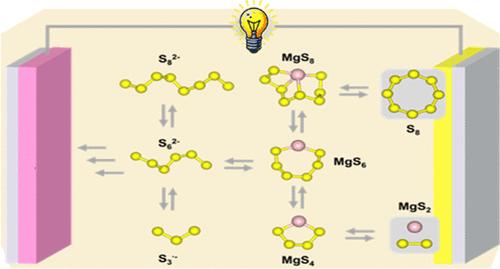
The inherent instability and low solubility of polysulfides in Mg-based electrolytes contribute to the poor performance of magnesium–sulfur (Mg–S) battery systems. To address these challenges, we utilize a combination of first-principle theory, spectroscopy, and electrochemical measurements to investigate the chemistry of Mg polysulfides. Our study reveals the critical role of polysulfide species present in the battery electrolyte in determining electrochemical stability and performance. Through detailed atomistic-level explorations of polysulfide conformations and their role in Mg–S chemistry, corroborated by experiments, we discover that the disproportionation of long-chain Mg polysulfides into shorter-chain compounds is thermodynamically favored at room temperature. In contrast, multiple polysulfide radical species can form under electrochemical conditions. Meanwhile, the dissociation of Mg2+ from the coordinating polysulfide anions is highly unfavorable regardless of the solvent used. Our theoretical predictions for UV–vis, Raman, and electron paramagnetic resonance (EPR) spectra, which account for the full ensemble of polysulfide conformers and species at thermodynamic equilibrium, align well with experimental data and facilitate reference peak assignments for future in situ studies of Mg–S systems. Furthermore, we separate the electrochemical contributions from the entire conformational ensemble by calculating the reduction potentials for the dominant Mg polysulfide species to clarify the principal redox pathways during the electrochemical cycling of Mg–S batteries. This theoretical electrochemical data is applied to explain key features in the discharge curve of an experimental Mg–S electrochemical cell. Our integrated approach provides important insights into the mechanistic behavior of Mg polysulfides in electrochemical systems. In particular, by dissecting the conformer-dependent thermal and electrochemical reactivities of Mg2+-polysulfide complexes, we enhance the fundamental understanding of their chemistry and establish new foundations for optimizing Mg–S battery design.
期刊介绍:
The Journal of Physical Chemistry A/B/C is devoted to reporting new and original experimental and theoretical basic research of interest to physical chemists, biophysical chemists, and chemical physicists.



 京公网安备 11010802042870号
京ICP备2023020795号-1
京公网安备 11010802042870号
京ICP备2023020795号-1

 分享
分享
 求助内容:
求助内容: 应助结果提醒方式:
 扫码关注我们
